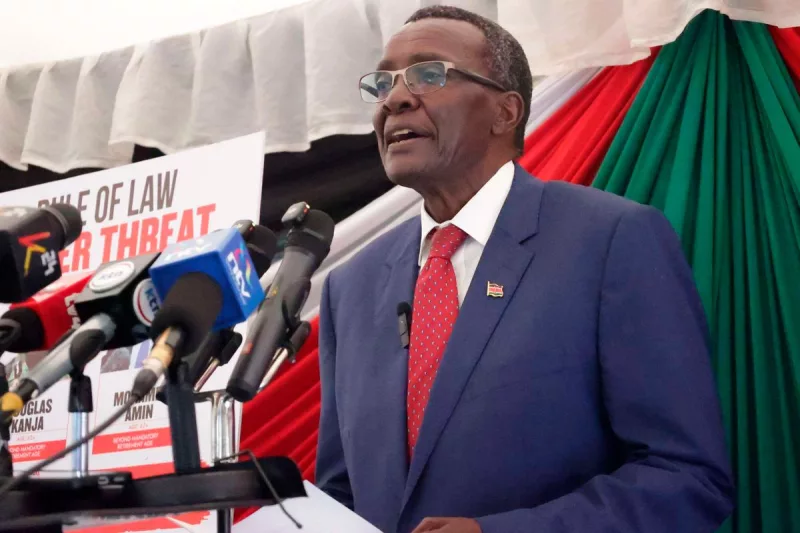
Police recruitment is riddled with bribery, political influence and favouritism, with job slots reportedly selling for up to Sh600,000, a damning taskforce report has found.
The National Taskforce on Police Reforms, chaired by former Chief Justice David Maraga, said it received complaints of corruption in police recruitment from all 47 counties, raising questions about the integrity of the process used to build the country's critical security service.
Maraga released the report on Monday after his seven-day ultimatum on President William Ruto, who received the report three years ago but failed to make it public.
The unedited report says police jobs are routinely sold to those who can afford them or given to relatives of powerful and politically connected individuals.
“The Taskforce heard, from literally all 47 counties, of rampant corruption, cronyism, nepotism, favouritism, tribalism and political influence peddling during police recruitment exercises.
“Further reports indicated slots were being sold for up to KSh600,000 if not more. Those who enter the NPS through political influence sustain their place in the Service by remaining loyal to those ‘they know’ while those who are picked on merit ‘grease’ their positions by granting favours to police bosses,” the report says.
The report adds that on the recruitment, the Taskforce received widespread concerns and complaints about the rampant corruption and bribery during selection exercises.
“Specifically, the criteria for elimination during recruitment is not known to members of the public,” it says.
The allegations contravene constitutional requirement that recruitment into the National Police Service be transparent, competitive and based on merit.
The National Police Service Act and recruitment regulations place the process under the National Police Service Commission and require the process to be transparent, fair, merit-based and free from improper influence or unlawful interference.
Vacancies are required to be publicly advertised and candidates subjected to prescribed interviews, assessments and vetting.
The Maraga Taskforce's finding that recruitment is instead being driven by “corruption, cronyism, nepotism, and political influence” reflects what has emerged in the recent past.
In a recent interview on Inooro Radio, Nyandarua Woman Representative Faith Gitau acknowledged she had helped people secure employment in the police service, while denying ever demanding payment.
“I have never taken money, and not just for teachers but the police, too, and other jobs that I have helped my residents get,” Gitau said.
Her admission reflects the political intervention in public-sector employment that the Maraga Taskforce flagged, although she denied her interventions involved bribery.
Other legislators have publicly paraded graduating recruits they rdportedly helped secure the slots.
The taskforce says the system has created a pipeline in which political connections and money can determine who enters the police service, while the influence of patrons can continue to shape an officer's career after recruitment.
“Those who enter the NPS through political influence sustain their place in the Service by remaining loyal to those ‘they know’,” the report says.
Officers who entered through merit were also not necessarily protected from corruption. According to the report, some were forced to cultivate relationships with senior officers through favours.
Those picked on merit, it says, “ ‘grease’ their positions by granting favours to police bosses.”
The taskforce also found that corruption was not confined to recruitment but had become embedded throughout the police career structure.
“Transfers, deployments, promotions, as well as procurement are riddled with corruption and favouritism,” the report says.
Accordingly, the purchase of a police job is only the beginning of a wider pay-to-play system in which officers are subsequently required to pay or offer favours to secure desirable postings, career advancement or protection.
The taskforce also received complaints that bribes and sexual favours were being demanded in exchange for deployment, transfers, training and promotions. It recommended that these processes be automated to reduce opportunities for manipulation.
The report also found corruption and favouritism played a major role in determining who was posted to lucrative stations.
It says officers reported “huge bribes” were paid by those seeking transfers to the Traffic Department, while corruption and nepotism sometimes resulted in officers being posted to their own communities, compromising their objectivity.
The Traffic Department emerged as one of the most corrupt network.
The taskforce said it received reports of junior traffic officers being given targets for collecting bribes from motorists, with the proceeds allegedly shared with senior officers.
Unanimously, the report says, police roadblocks were described as corruption toll stations from where the ‘loot’ collected was shared up to the highest levels in the hierarchy of police leadership.
The taskforce recommended the restructuring of the Traffic Police Unit into a new Traffic Management Unit that is well trained, leaner in numbers, and mainly reliant on technology to control and manage traffic flow.
The Taskforce also recommended the amendment of Section 65 of the NPS Act within six months and abolition of police roadblocks and their replacement with mobile patrol units.
“Police roadblocks were described as corruption toll stations,” the taskforce says, reporting that the money collected was allegedly shared up the police hierarchy.
The report also raises questions about conflicts of interest among traffic officers, citing complaints some owned matatus, vehicle breakdown businesses, alcohol outlets and gambling establishments.
This compromises the impartiality and
professionalism expected of officers.