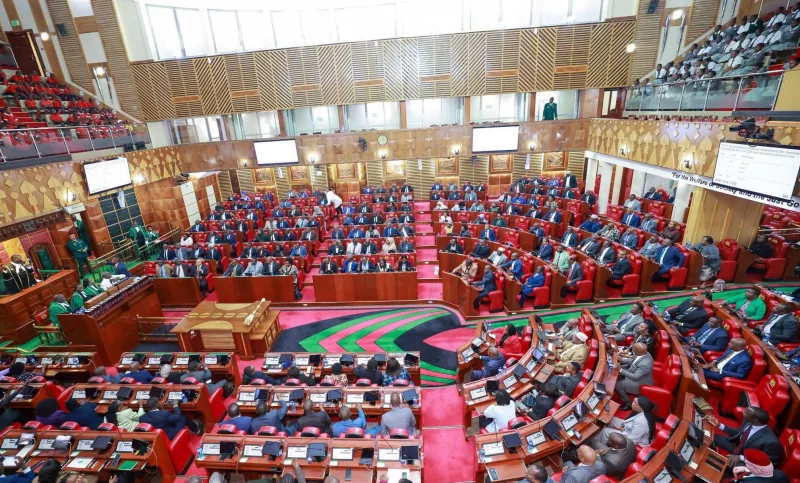
 The National Assembly passed the Basic Education (Amendment) Bill, 2025.
For thousands of children growing up in Kenya’s informal settlements, the school at the end of a narrow alley may be the only realistic path to an education.
Yet the institutions serving them have historically missed out on government capitation grants, public infrastructure development and official teacher support because they operate outside the mainstream education system.
That could change soon after the National Assembly passed the Basic Education (Amendment) Bill, 2025, paving the way for Alternative Provision for Basic Education and Training (APBET) institutions to be formally recognised.
If fully enacted into law, the legislation could unlock public funding, learning materials and structured county-level registration for thousands of vulnerable children attending schools in informal settlements and other marginalised areas.
The Bill, sponsored by Mathare MP Anthony Oluoch, seeks to close a gap that has left a significant section of learners outside the reach of government education support despite their reliance on APBET institutions.
Oluoch said the proposed changes would give practical effect to constitutional guarantees on equality, human dignity and the right to education under Articles 10, 27, 43 and 53.
In Kibra, the scale of dependence on such schools illustrates why the issue matters.
Speaking in Parliament on Wednesday, August 26, MP Mwalimu Peter Orero said the constituency has about 300 APBET institutions compared with only 11 public primary schools.
“There are about 300 of these schools, while public primary schools are only 11. Many students therefore end up in APBET schools,” he said, urging MPs to approve the legislation that would unlock resources to the children they serve.
“This is an opportunity to ensure that children in informal settlements can access education and that resources trickle down to them through recognition of their schools,” added Orero.
Seme MP James Nyikal said the exclusion of APBET schools from the formal system has created a funding deficit that ultimately affects children from vulnerable families.
“Education is a basic right in our Constitution, yet the current system does not adequately recognise APBET. In some areas, there are more children in these schools than in formal institutions, yet they are excluded from funding,” said Nyikal.
The proposed reforms would bring APBET institutions into the definition of basic education institutions and give them a place in national and county education structures.
They would also provide a framework for supporting school infrastructure and learning materials, while requiring counties to establish databases showing where APBET institutions operate.
The Bill further proposes more flexible registration requirements, potentially making it easier for legitimate schools to enter the formal system while giving authorities better information for planning, regulation and resource allocation.
Ruraka MP Moses Kajwang supported the legislation, describing recognition of APBET institutions as overdue.
“It is unfortunate that it has taken this long to recognise vulnerable children in informal settlements and rural areas who lack access to education,” she said.
For families relying on low-cost schools because of limited alternatives, the proposed law could therefore mean more than a change in regulation.
It could determine whether the classrooms their children already occupy receive the public investment, materials and oversight available to schools within the formal system.