

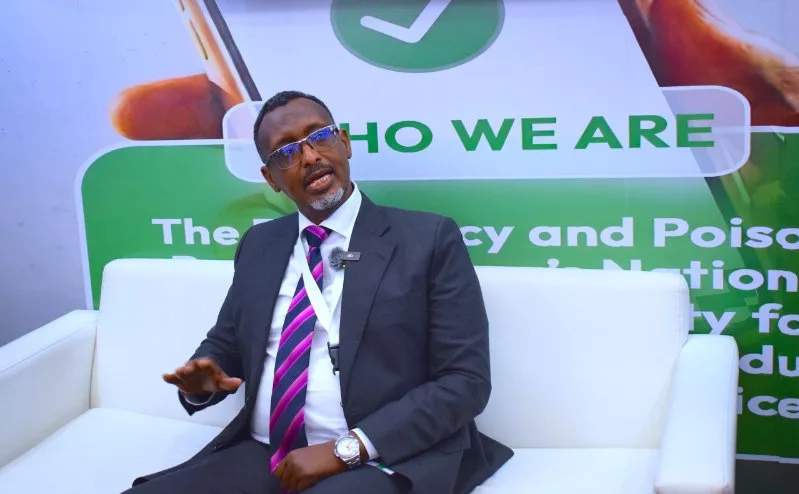
 PPB chief executive officer Dr Ahmed Mohamed said the investments show growing confidence in Kenya as a pharmaceutical manufacturing base.
Thirteen drug manufacturers have been cleared to establish new facilities to help reduce Kenya’s heavy reliance on imported drugs.
The investments came as the government seeks to produce at least half of essential health products locally.
Kenya currently imports an estimated 70 to 80 per cent of the pharmaceuticals it uses, leaving patients and the health system exposed to global supply disruptions and rising prices.
The new manufacturers are Med Aditus, Kenya Biovax Institute, Biopharma Limited in Gatundu-Thika, Full Care Limited, Tanatis Global Limited, Crown Healthcare, Regal Pharmaceuticals through its new penicillin plant, Spora International, Recon Health, the Kemri Production Facility, Zuventus Limited, Aviazure Limited and Galaxy Pharmaceuticals.
The companies are at different stages, with some constructing factories, others installing equipment, while others are developing pharmaceutical quality systems and preparing for final regulatory approval, according to the Pharmacy and Poisons Board (PPB).
PPB chief executive officer Dr Ahmed Mohamed said the investments show growing confidence in Kenya as a pharmaceutical manufacturing base.
“The entry of new manufacturers demonstrates growing confidence in Kenya’s pharmaceutical sector," he said.
"Our responsibility is to provide a clear and predictable regulatory pathway that enables these investments to progress while ensuring every locally manufactured product meets stringent standards of quality, safety and efficacy.”
The investments came at a time when Kenya is trying to transition from being largely dependent on imported medicines to becoming a major pharmaceutical production centre in Africa.
The country’s health products market is estimated at about $1.2 billion (Sh155 billion) a year, with more than $760 million (Sh98 billion) spent on imports.
Local manufacturers currently produce only about 20 per cent of the medicines on the Kenya Essential Medicines List.
This means that even when Kenya has factories capable of making medicines, much of their potential remains unused.
The government’s new Kenya Health Products and Technologies Local Manufacturing Strategy 2026-30 seeks to change this by increasing production, encouraging investment, and making local manufacturing a bigger part of public health procurement.
The Ministry of Health says Kenya has more than 30 pharmaceutical manufacturers but needs to scale up production if it is to close the pharmaceutical supply gap and become a competitive regional manufacturing hub.
The PPB is supporting the 13 incoming manufacturers through regulatory guidance and technical assistance as they move towards production.
The support includes regulatory clinics, technical meetings, training and Good Manufacturing Practice inspections.
The board also said it is helping companies strengthen pharmaceutical quality systems, prepare product dossiers, conduct validation and qualification and improve data integrity.
These checks are important because medicines made in Kenya must meet the same standards expected of imported products.
The board also carries out follow-up inspections to establish whether manufacturers have corrected problems identified during earlier inspections.
Mohamed said Kenyan companies must be able to compete outside the domestic market.
“Kenyan manufacturers must be equipped to compete beyond the domestic market. Attaining internationally recognised standards will strengthen confidence in locally produced health products and open access to regional and global procurement opportunities,” he said.
The PPB wants to increase the utilisation of existing pharmaceutical manufacturing capacity by 70 per cent while helping companies develop the technical skills needed to produce high-volume pharmaceutical ingredients and excipients locally.
The goal is therefore not simply to have more factories. It is also to ensure existing factories operate at higher capacity and produce a wider range of medicines.
“Our ambition must extend beyond packaging and producing finished medicines. Kenya needs to progressively develop the capacity to manufacture pharmaceutical ingredients and other critical inputs locally, reducing dependence on imports and strengthening the resilience of our supply chains,” Mohamed said.
However, local manufacturers face several challenges.
Kenya still has limited capacity to produce active pharmaceutical ingredients, which are the substances that make medicines work. It also has limited production of excipients, the other materials used to make tablets, capsules and other medicines.
This means manufacturers often have to import key ingredients, reducing some of the benefits of local production.
Manufacturers also face high costs of electricity and other utilities, limited access to local bioequivalence testing services, and the challenge of obtaining international certification.
Bioequivalence testing is important because it helps show that a generic medicine works in the body in the same way as the original product.
The PPB is therefore working with stakeholders to establish clearer frameworks for bioequivalence study centres and clinical research organisations in Kenya.
It is also supporting manufacturers seeking Good Manufacturing Practice certification and World Health Organisation prequalification.
WHO prequalification is particularly important for companies that want to supply medicines to international agencies and large public health programmes.
The drive is part of wider government efforts to make the country more self-reliant in health products.
In March, Health CS Aden Duale said Kenya had committed to achieving pharmaceutical self-sufficiency by 2028.
The ministry reported a 22 per cent decline in pharmaceutical import expenditure between 2024 and 2025, which it says signals early progress in expanding local production.
At the same time, the PPB is seeking to attain and sustain WHO Global Benchmarking Tool Maturity Level 3 for medicines and vaccines regulation.
The status would demonstrate that Kenya has a stable and effective regulatory system operating according to internationally recognised standards. It is also expected to improve confidence among investors and international buyers.
“A strong pharmaceutical industry must be supported by an equally strong regulatory system. Maturity level 3 will provide further assurance that medicines and vaccines regulated in Kenya meet consistent and internationally recognised standards,” Mohamed said.






