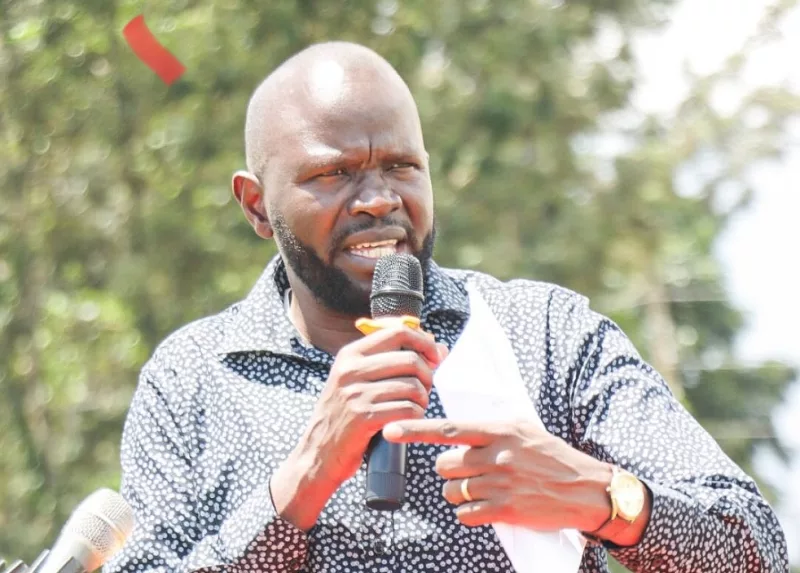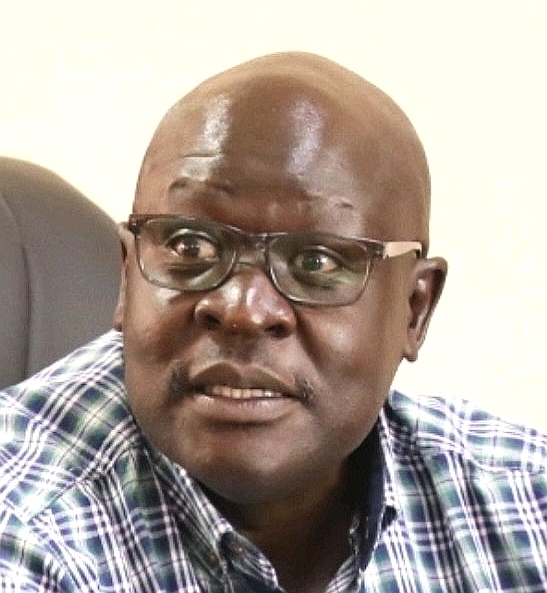
 Human rights defender David Khaemba in his office in Kakamega town/IMAGE/HILTON OTENYO
A human rights defender has written to the Ministry of Defence seeking disclosure of information on the composition of a Kenya Defence Forces (KDF) cohort that had a pass-out parade in Eldoret earlier this month.
This follows public claims of tribalism, nepotism and
favouritism in the recruitment process.
In a letter addressed to Defence Cabinet Secretary, activist David Khaemba wants the ministry to disclose the exact number of people recruited into the cohort, the number of recruits from each of the 47 counties, and their respective percentages.
He is also seeking information on the number of recruits from each region and the percentage from each ethnic community.
Khaemba wants the ministry to publish the number of shortlisted applicants and final recruits, the number of applicants rejected at each stage of the process, and the reasons for their rejection.
He is also seeking the identities or designations of
officers responsible for the recruitment exercise, as well as the policy
governing the recruitment of multiple members of the same family.
The activist has further asked for data on cases involving
siblings in recruitment cohorts and information on the mechanisms used to guard
against nepotism, favouritism, tribalism and political interference.
“Accordingly and in the public interest, I respectfully
demand that within 14 days of receipt of this letter, the ministry provide a
substantive written response and, subject to lawful limitations concerning
genuinely classified or operationally sensitive information,” the letter reads.
Khaemba has threatened to pursue legal remedies if the
ministry does not provide the requested information.
“I expect a substantive response within 14 days of receipt
of this letter. Should the ministry fail to provide a satisfactory response, I
reserve the right, in the public interest and within the constitution and the
law, to seek appropriate legal remedies,” he said.
The letter follows a social media debate sparked by the
circulation of a photograph of two people alleged to be siblings who were
recruited and graduated in the same cohort.
Social media claims have also suggested that 3,000 of the
5,000 people were from the Kalenjin community.
Khaemba, however, stressed that the figure had not been
independently verified.
“I emphasise that this letter does not present the 3,000
figure as an established fact. It is precisely because it is an allegation of
enormous public significance that the ministry must publish the official
recruitment data and either confirm or disprove it,” the letter states.
The letter, dated August 18, 2026, was copied to the Chief
of the Defence Forces, the Ethics and Anti-Corruption Commission, the
Commission on Administrative Justice, the National Cohesion and Integration
Commission, and the Kenya National Commission on Human Rights.
Khaemba said the identity, relationship and circumstances
surrounding the recruitment of the two people alleged to be siblings should be
officially verified rather than assumed.
He said the public concern generated by the allegations made
an official response necessary.
“The issue is therefore not the presence of Kalenjin youth
in KDF. The issue is whether all Kenyan youth are being given a genuinely equal
opportunity to compete. The constitution does not establish first-class and
second-class Kenyan communities,” he said.
Khaemba also called on the ministry to consider an
independent review of the recruitment process involving relevant constitutional
and oversight institutions.
The Commission on Administrative Justice acknowledged
receipt of the letter.
The commission’s legal officer in charge of access to
information, Maryann Wanjiru, said the institution had 21 days to process the
request and respond.
“Take note that the institution has a statutory 21-day
period to process your request for information and respond to you. If no
response is received from the institution within the statutory timeline, or the
decision or response given is not satisfactory, you are at liberty to invoke the
review jurisdiction of the commission by lodging an application for review
under Section 14 of the Access to Information Act, 2016, and Regulation 24 of
the Access to Information (General Regulations), 2023,” Wanjiru said.
The requested information could provide clarity on the composition of the cohort and address questions raised publicly about the recruitment process, subject to any lawful restrictions on the disclosure of sensitive information.