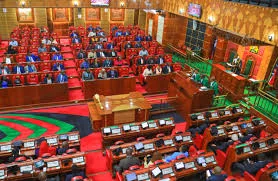
 MPs in session at Parliament Buildings
President William Ruto’s team has embarked on a fresh push to move community health promoters from stipend-based engagement to permanent and pensionable employment.
The effort has gained fresh momentum, with MPs calling for a policy framework to formally absorb the grassroots health workers into government.
This came barely weeks after Parliament approved billions of shillings to facilitate the transition of thousands of universal health coverage (UHC) workers into county employment.
Tharaka MP George Murugara has now asked the National Assembly to back a similar structured arrangement for CHPs.
He holds that the workers have become an indispensable part of the country’s primary healthcare system.
In a motion before the House, Murugara said CHPs should no longer be treated as volunteers despite performing duties that are central to the government’s UHC agenda.
He wants the national government to formulate and implement a policy framework to guide the recruitment and remuneration of CHPs across the country.
“This is a very important motion that deals with CHPs, the successors to the community health volunteers (CHVs), who served this country for a considerable period and dedicatedly,” Murugara said.
The Tharaka MP said CHPs are the first link between households and the formal health system, providing health education, disease prevention, early detection, maternal and child health support and mobilising communities to seek medical attention.
He said their current remuneration does not reflect the importance of the work they perform.
In the 2026-27 budget, the government allocated Sh3.2 billion for CHP stipends and medical insurance, while the wider health sector received Sh177.2 billion.
The allocation was part of a package aimed at strengthening UHC and preventive healthcare.
The Budget and Appropriations Committee had earlier approved Sh3.2 billion for CHP stipends, alongside Sh8.6 billion for the transition of UHC workers into county employment.
The Sh8.6 billion allocation under the County Governments Additional Allocations Bill, 2026, is intended to support the integration of UHC workers into county public service structures, effective July 1, 2026.
CHPs remain largely supported through stipends, while the UHC workers covered by the Sh8.6 billion allocation are being targeted for formal employment.
Murugara is now seeking to push the government further by creating a permanent policy and employment framework for CHPs.
The Budget Policy Statement had already acknowledged concerns over the sustainability of CHP financing.
It proposed Sh3.24 billion for the programme across all 47 counties and indicated the government planned to increase the number of CHPs from 107,801 to 120,000.
The Ministry of Health has also been signalling there are efforts towards institutionalising community health work.
In May, Public Health PS Mary Muthoni said the government was committed to fully institutionalised, paid, supplied, skilled and digitalised community health services under the Taifa Care reforms.
More than 107,000 CHPs are currently supported with monthly stipends, digital devices and medical kits.
Health CS Aden Duale separately announced plans to transition 107,000 CHPs into the Social Health Authority comprehensive medical scheme.
He said the alignment was to be done through a framework involving the national and county governments.
The government has also announced that from July 1, 2026, the 107,000 CHPs would receive comprehensive medical insurance under a 50:50 financing arrangement between the national and county governments.
Murugara, however, says medical cover and stipends are not enough.
He argued that counties often struggle to meet their share of CHP incentives, leaving some workers unpaid for long periods.
“A little of the stipends come from the national government, the rest of it is paid by the county governments and you know county governments, for the umpteenth time, will always complain they do not have exchequer, or they do not have money,” he said.
He compared the situation with that of village administrators and area managers, whose remuneration was also previously irregular.
Murugara said Parliament had made progress in formalising payments for the latter group and should now extend the same treatment to CHPs.
The motion scheduled for today seeks to anchor the workers within a predictable employment structure, potentially ending years of dependence on stipends and county-level arrangements.
The push also fits into Ruto’s Bottom-Up Economic Transformation Agenda, which places emphasis on strengthening services at the grassroots.
Murugara said the government could not claim to be implementing a bottom-up agenda while leaving thousands of workers providing essential services without proper remuneration.