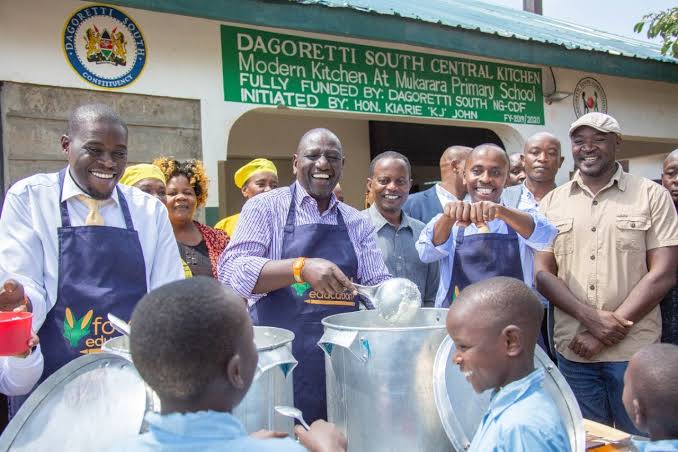
 Nairobi Governor Johnson Sakaja with President William Ruto help serve children during the launch of the school feeding programme in Nairobi. /PCS
Kenya’s school feeding programme, which targets providing meals to 10 million children by 2030, remains on course despite persistent funding challenges that have threatened its implementation over the years.
Kenya introduced school meal initiatives in 1966 through the National School Feeding Council.
This was followed by the iconic Maziwa ya Nyayo free school milk programme in 1979 and a joint midday meal programme with the World Food Programme (WFP) in 1980.
After decades of support, WFP completed its handover of the school feeding programme to the Kenyan government in 2019, leaving the State in full control of the national programme, with continued support from the United Nations.
The national programme currently feeds about 2.65 million learners in public basic education institutions.
However, funding gaps have disrupted meals for tens of thousands of vulnerable learners, particularly in Arid and Semi-Arid Lands (ASAL) counties, where consistent school attendance often depends heavily on the availability of food.
The State Department for Basic Education requires between Sh7.8 billion and Sh12.7 billion annually to sustain regular daily coverage. Yet recent budgetary allocations have fallen to less than half of the amount required.
In the 2024-25 budget proposals, Treasury initially scrapped a Sh4.9 billion allocation for school feeding.
It later bowed to pressure from MPs and allocated Sh3 billion to the programme.
“The removal of the school feeding programme from the budget is a move that will cause immense harm to a generation. In some areas, children attend school because of the food provided; it can be their only meal for the day,” Westlands MP Tim Wanyonyi said in May 2024.
“As members of Parliament, we will ensure the school feeding programme remains in the budget,” he pledged.
“We can reject the entire budget if necessary.”
The programme received the same Sh3 billion allocation in the 2025-26 financial year, despite the much higher amount required to provide consistent coverage.
The funding shortfall has had direct consequences. A performance report by the State Department for Basic Education showed that the National Council for Nomadic Education in Kenya (NACONEK) fed 2.65 million learners under the school feeding programme against a target of 2.7 million.
This left about 46,000 learners outside the programme’s targeted coverage.
As the State-run programme has struggled with inadequate funding, county governments, non-governmental organisations and public-private partnerships have stepped in with alternative models.
Nairobi’s Dishi Na County programme, spearheaded by the Nairobi county government in partnership with Food4Education, operates 17 centralised mega-kitchens and feeds more than 310,000 children in public primary and early childhood development (ECD) centres.
The programme provides meals at Sh5 per plate and uses Tap2Eat technology to manage meal distribution.
Parliament has also stepped in through a proposed School Feeding Bill, which seeks to transform school meals into a major economic opportunity for Kenyan farmers while potentially expanding access to millions more learners.
The proposed framework could create a large and predictable institutional market for food produced by Kenyan farmers while generating additional demand for workers involved in transport, storage, catering, technology and distribution.
If implemented effectively, a school feeding system that sources more food locally could keep a greater share of expenditure within rural economies.
Schools buying directly from farmers and cooperatives could potentially reduce transport and storage costs while creating a more predictable market for agricultural produce.
Such a system could also give schools access to commodities including maize, beans, vegetables and other locally produced foods at competitive prices, while providing smallholder farmers with greater certainty about demand.
The proposed model could therefore benefit more than learners. It has the potential to create a reliable institutional market for farmers, strengthen rural economies and generate employment across the food supply chain.
At the same time, major institutional programmes are seeking to modernise school kitchens by moving away from traditional and costly firewood-based cooking towards electric cooking and solar-powered facilities.
If scaled successfully, such approaches could reduce cooking costs and improve the efficiency and sustainability of school meal delivery.
The real measure of success, however, will be whether these ambitions translate into a functioning national system that guarantees regular meals for learners, affordable food for schools and a reliable market for farmers.
For the programme to move from feeding about 2.65 million learners towards its 2030 target of 10 million children, sustained financing will be critical.
So will a supply chain capable of moving food from farms to schools without interruptions.
The proposed reforms could provide part of that solution if they succeed in linking school feeding to local agricultural production.
Schools buying directly from smallholder farmers, cooperatives and farmer groups could create a cycle in which investment in school meals supports both children and rural economies.
But the immediate challenge remains funding. Until allocations come closer to what the State Department for Basic Education says is required for regular coverage, the ambition of reaching 10 million children by 2030 will remain considerably ahead of the resources available to deliver it.