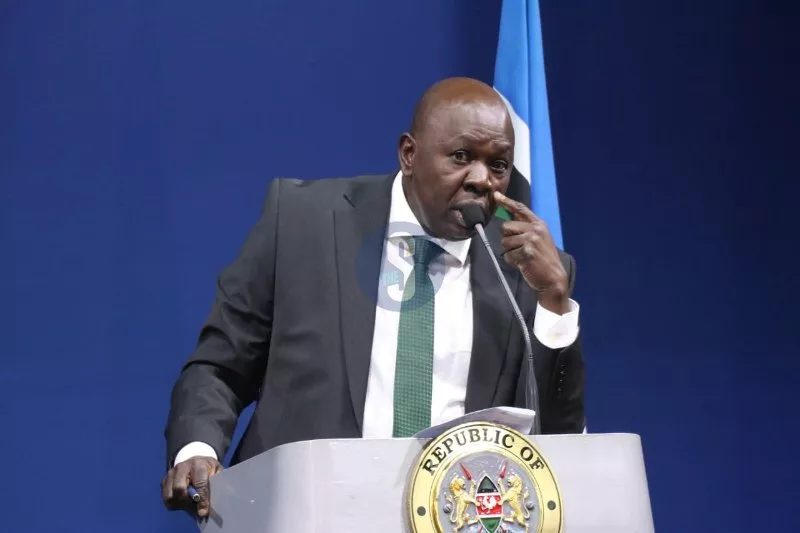
 Government spokesperson Charles Owino speaking during a press briefing on the state of the nation at Harambee Annex, Nairobi on August 26, 2026/LEAH MUKANGAI
Government Spokesperson Charles Owino has dismissed calls by opposition leaders to abolish the Social Health Authority, arguing that the health system is established in law and cannot simply be scrapped by a future administration.
Owino said the debate over the future of SHA should be based on facts and an understanding of the legislation that established the authority, rather than political statements.
Speaking during a press briefing on Wednesday, he said the idea that a future president could simply do away with SHA was unrealistic, describing it as “a dream”, “a lie” and “wishful thinking”.
“I want to tell you, whoever becomes the president, even if it is not President Ruto, cannot do away with SHA,” Owino said.
His remarks came in response to a question on how Kenyans would be cushioned if opposition leaders came to power and honoured their pledge to abolish SHA.
The newly appointed spokesperson argued that SHA should not be equated with President William Ruto, noting that it is an authority created under the Social Health Insurance Act.
“SHA is not President William Ruto. You know, people would think when you talk about SHA, you talk about President William Ruto,” he said.
He said the Social Health Authority comprises several funds created under the legislation, each with a distinct role in financing healthcare.
Owino highlighted the Social Health Insurance Fund, which he said is a contributory fund to which Kenyans make payments. He said more than 31 million Kenyans had registered under the system.
He also pointed to the Emergency, Chronic and Critical Illness Fund, which is financed through allocations from the National Treasury.
According to Owino, this fund is intended to support emergencies and critical illnesses, including cases where treatment costs exceed an individual's contributions.
The spokesperson further cited the Primary Healthcare Fund, also financed by the Treasury, which he said is intended to support primary healthcare facilities and enable Kenyans to access treatment at the first level of care.
Another component, he said, is the Hospital Development Fund, which is intended to support the development of health infrastructure.
Owino compared the hospital infrastructure component to the Constituency Development Fund, arguing that it would help improve healthcare facilities in rural areas.
He said the different components demonstrate that SHA is not a single programme that can simply be removed through a political declaration.
Owino also acknowledged that the system was still developing and that there could be challenges that need to be addressed.
He called for factual debate around SHA and said the government was prepared to correct problems identified within the system.
“We are ready, if something is wrong, we will correct it. But lying to Kenyans, no,” he said.
The government spokesperson also defended the progress of SHA, saying significant resources were being directed towards the system.
He urged Kenyans to distinguish between legitimate criticism of the healthcare system and what he described as political rhetoric about scrapping the authority.
He further took a swipe at critics, urging them to familiarise themselves with the Social Health Insurance Act and the structure of SHA before making claims about abolishing it.
Regardless of who succeeds President Ruto, he said, changes to the healthcare system would have to take into account the legal framework governing SHA.
He said the focus should instead be on improving the system and addressing areas where Kenyans experience difficulties rather than promising to abolish it altogether.