Across Africa, governments and development partners continue to invest heavily in education because of its potential to improve livelihoods, reduce inequality and create pathways out of poverty. Yet the value of education does not end when a student graduates.
Its greatest impact may begin when knowledge is translated into skills, livelihoods, businesses, services and solutions to problems within communities.
This is particularly important for young people from disadvantaged backgrounds. Giving them access to education can change the trajectory of an individual life, but connecting that education to opportunity can create an even wider multiplier effect.
A graduate who becomes an entrepreneur can create jobs. A trained professional can provide services that communities need. And a young person equipped with both knowledge and opportunity can become a source of opportunity for others.
The question, therefore, is how we move from simply educating people to empowering them to become active participants in solving society's challenges.
One example of this approach can be seen in the Equity Leaders Program (ELP) and its connection to Equity Afya, a physician-led healthcare network that is linking education, entrepreneurship and access to affordable healthcare.
The story begins long before a doctor opens a clinic. It begins with a young person who has demonstrated academic potential but may lack the financial means to pursue it.
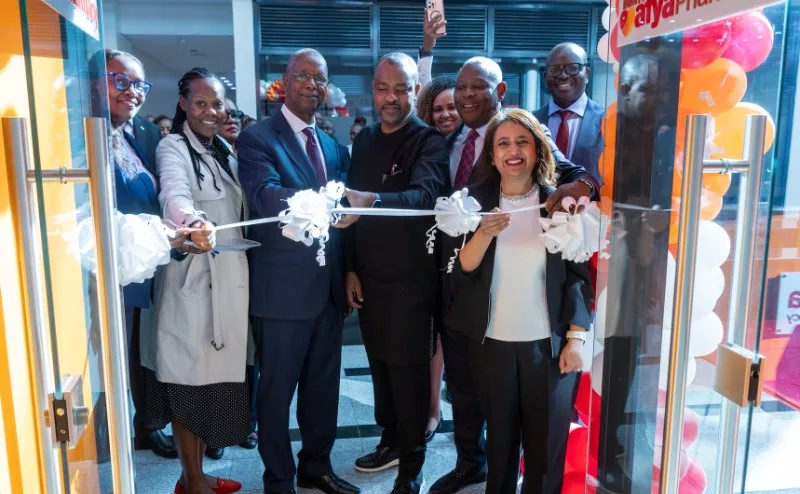
 Equity Group Holdings Chairman Prof. Isaac Macharia and Group Managing Director and CEO Dr. James Mwangi, flanked by staff and guests, during the opening of the first stand-alone pharmacy at Britam Towers in Upper Hill, Nairobi. HANDOUT
Through the Equity Group Foundation's Wings to Fly scholarship, bright students from disadvantaged backgrounds receive comprehensive secondary school scholarships. Those who progress through the Equity Leaders Program can access further support for university education and professional training, including medicine and related health courses.
For more than two decades, this approach has reflected a broader belief: education should do more than transform individual lives. It should equip people with the knowledge, skills and confidence to become contributors to their communities.
Equity Afya provides a powerful example of what that philosophy can look like when education meets an unmet societal need.
Founded in 2015 with a pilot of five medical centres, the initiative was conceived as an access programme under the Equity Group Foundation. Following a successful proof-of-concept phase, the model has grown into a network spanning all 47 counties in Kenya, with an expanding presence in the Democratic Republic of Congo.
The network currently has 156 medical centres, serves more than 120,000 patients every month and had recorded 5,333,208 cumulative visits by June 30, 2026. But the scale of the network is only part of the story.
At its core is a different way of thinking about development. The model seeks to address two challenges at once: expanding access to affordable, quality healthcare while creating sustainable professional and entrepreneurial opportunities for the doctors providing that care.
More than 80 Equity Leaders Program scholars have progressed through the medical training pipeline. After graduation, doctors can receive entrepreneurship training and start-up financing to establish an Equity Afya clinic under a shared model. This allows them to build their own practices while contributing to a wider healthcare network.
The result is a cycle in which investment in one individual can generate benefits far beyond that individual.
A scholar receives an opportunity to study. Education creates professional capability. That capability creates an opportunity for entrepreneurship. The resulting clinic expands access to healthcare, creates employment and serves families who might otherwise face significant barriers to quality medical services.
The beneficiary becomes a provider, and the opportunity begins to multiply.
This matters because healthcare access remains one of Africa's persistent development challenges. Expanding access requires more than constructing facilities. It requires models that make quality care affordable, accessible and sustainable.
The healthcare network's response is built around these three principles. Its services are priced 30 to 40 per cent below comparable private providers, while a high-volume, low-margin model is designed to sustain that affordability.
Its structure is equally deliberate. Through a hub-and-spoke model, different levels of care can be delivered closer to where people live, from nurse-led spokes focused on health promotion, maternal and child welfare and basic services, to clinical-officer-led satellites and medical-officer-led hubs offering comprehensive outpatient and specialist services.
This is important because access is not simply about building more facilities. It is about designing systems that can deliver quality care consistently and sustainably.
The model also combines local ownership by individual doctors with central systems for quality assurance, procurement, health information management and standardised pricing. Doctors can therefore run their own facilities while operating within common standards and a wider network.
In this sense, entrepreneurship becomes part of the solution to a development challenge.
The connection between the Equity Leaders Program and Equity Afya is particularly significant because it demonstrates the multiplier effect that can emerge when education is linked to opportunity.
A doctor who establishes a clinic is not simply creating a private practice. They can create a local institution that employs nurses, clinical officers, laboratory technologists, pharmacists and other professionals. The current model supports more than 1,500 employees across the network, with each clinic employing more than 10 staff on average.
The model is now extending beyond clinics. On June 17, 2026, Equity Afya launched its first standalone community pharmacy at Britam Towers in Upper Hill, Nairobi, marking the beginning of a planned regional network of 1,000 pharmacies.
The development is significant because it demonstrates how a healthcare model can continue to evolve around the needs of communities.
The impact therefore moves outward in concentric circles. It starts with the scholar, extends to the professional, reaches clinic staff and patients, and ultimately contributes to the wider local economy.
This is the deeper connection between education and development. When people are empowered with knowledge and opportunity, they can become multipliers of opportunity for others.
That principle also explains why the vision of the Equity Leaders Program extends beyond university admission. The objective cannot simply be to produce successful graduates. It must also be to cultivate people who can apply their capabilities to the problems around them.
The healthcare model's ambitions point in the same direction. Plans include reaching 1,000 clinics across the region, expanding into inpatient hospitals with a focus on maternity and delivery care, telemedicine, drug and laboratory sample delivery, specialist centres and advanced imaging, as well as 1,000 stand-alone pharmacies.
These ambitions illustrate an important development principle: sustainable solutions must be designed to grow.
The objective is not to create isolated interventions that depend indefinitely on external support. It is to build models in which local talent, entrepreneurship, systems and partnerships reinforce one another, allowing impact to expand.
For development partners, universities, governments, healthcare institutions and philanthropies, this offers an opportunity to think differently about what an investment in education can achieve.
A scholarship can produce a graduate. A leadership programme can produce a professional. But when education is connected to entrepreneurship, networks and a clearly defined societal need, a graduate can become a catalyst for wider change.
The most compelling measure of a scholarship programme, therefore, may not simply be the number of students who reach leading universities or professional institutions.
It is what those scholars do with the opportunity.
The Equity Afya experience offers one possible answer.
A young person given the opportunity to learn can become a doctor. A doctor can become an entrepreneur.
An entrepreneur can create jobs. A clinic can provide affordable healthcare. And healthier communities are better positioned to learn, work, earn and build.
This is what it means to empower scholars to solve society's problems. It is to move beyond seeing education solely as an individual investment and recognise it as a foundation for collective progress.
The journey from scholarship to social impact is rarely linear. But when education is deliberately connected to opportunity, entrepreneurship and purpose, the distance between the classroom and the community begins to disappear.
Perhaps that is the most powerful measure of an empowered scholar: not simply where they studied, but what they build, who they serve and how many others are able to move forward because they were given the opportunity to lead.
Derrick Ngaira is a Health Communications specialist.