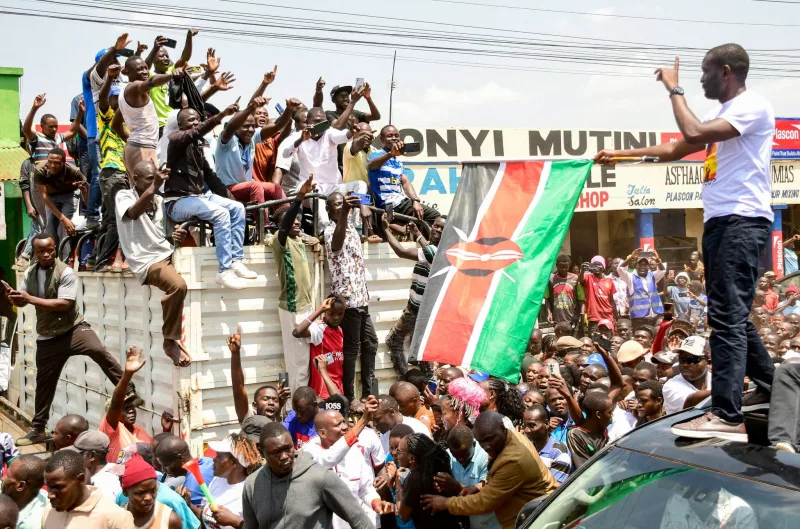
 Nairobi Senator Edwin Sifuna campaigning in Mumias Town on Sunday, August 9,2026/FILE
The Orange Democratic Movement's long-standing dominance in Western Kenya is facing a new test as the Linda Mwananchi faction, associated with Nairobi Senator Edwin Sifuna, gains momentum in the region.
ODM has dominated Luhya politics since its formation in 2005, despite several attempts to challenge its influence.
Parties such as Ford Kenya, the now-defunct Amani National Congress and the Eugene Wamalwa-led Democratic Action Party of Kenya (DAP-K) have struggled to build enough support to dislodge the Orange party in regional and national elections.
The 2022 General Election illustrated the extent of ODM's dominance.
The party won 15 parliamentary seats in Western Kenya, compared with five for its closest challenger, Ford Kenya.
That dominance, however, is now being tested by a movement that has attracted large crowds during its recent tour of the region and appears to be gaining support among sections of ODM's traditional base.
Linda Mwananchi is yet to be registered as a political party and is challenging a decision by the Registrar of Political Parties over its proposed name.
But the registration dispute has not stopped its leaders from building a political movement that could eventually operate either as a party or an umbrella coalition.
The movement emerged amid divisions within ODM over the party's working relationship with President William Ruto's Kenya Kwanza administration and its support for his re-election bid.
Sifuna and his allies have since positioned themselves on the opposing side of that political arrangement, drawing support beyond Western Kenya.
As the registration dispute continues, there have also been reports that Sifuna and his allies are considering ways to retain the Linda Mwananchi name as an umbrella coalition and use it to build a national political platform.
"The reasons that have been given to us by the Registrar do not fall within the pre-requisites that can warrant the registrar to decline reserving or allowing as to register that name," Linda Mwananchi deputy spokesperson Titus Makhanu told KTN in a recent interview.
Sifuna has indicated that the movement will pursue an alternative name if its registration bid fails.
"A name is just a name. If they close all doors, we will come here and say Tent Party of Kenya, or Maua Party, or Nyasi Party," Sifuna said at a public rally in the region.
The Registrar declined to register Linda Mwananchi as a political party on the grounds that the proposed name closely resembles that of an already registered party.
But the registration hurdle may be less significant than the political question emerging from the movement's growing support.
A Tifa survey conducted in mid-June indicates the scale of the rising prominence of Linda Mwananchi.
The poll found that Linda Mwananchi commanded 74 per cent support among ODM supporters nationally, compared with 20 per cent for the Linda Ground faction.
In Western Kenya, the survey showed that Linda Mwananchi enjoyed 89 per cent support among ODM supporters, compared with 11 per cent for Linda Ground.
In neighbouring Nyanza, where Linda Ground has a stronger base, Linda Mwananchi still commanded 58 per cent support among ODM supporters in the region, compared with 40 per cent for Linda Ground.
The poll, which sampled 2,048 Kenyan adults across all 47 counties, reported a margin of error of plus or minus 2.18 percentage points.
The wider party landscape, however, shows that ODM remains a significant political force.
Tifa ranked the Orange party as the most popular political party nationally at 20 per cent, followed by broad-based partner UDA at 17 per cent, DCP at 12 per cent, Jubilee at 10 per cent and Wiper at 7 per cent.
Nearly 28 per cent of respondents did not identify with any political party.
The findings suggest that the contest within ODM could have wider implications, particularly if the two factions eventually compete for the same voters under separate political formations.
But even then, it would be a critical mistake to write off ODM this early. The party retains an established national structure, experienced politicians, sitting MPs and a long electoral history in Western Kenya.
Its 2022 performance demonstrates the depth of its organisation in the region, while its established networks, including within the government, give it an advantage that a relatively new movement must still build.
Whereas Linda Mwananchi's crowds demonstrate political mobilisation, they do not by themselves establish electoral strength.
Further, opinion polls may provide a snapshot of voter sentiment at a particular point in time, but they do not automatically translate into votes on election day.
The Linda Mwananchi movement would still have to overcome the challenges of registration, build a durable political organisation, select competitive candidates, raise resources and work to translate its current support into a coherent electoral machine.
For ODM, the bigger concern may therefore not be whether Linda Mwananchi can immediately replace it, but whether the division can permanently erode the party's traditional base.
If the factional split persists, ODM could enter the electoral cycle with its support divided in constituencies where relatively small shifts in voter preference could potentially determine whether it wins or loses seats.
Conversely, if the party manages to resolve its internal differences or consolidate its support behind a common political strategy, its established machinery could prove difficult to dislodge.
The emerging contest is therefore less about Linda Mwananchi's large crowds today and more about whether it can turn that enthusiasm into votes.
For ODM, the test is whether its decades-old political network can withstand a revolt from within its own support base.