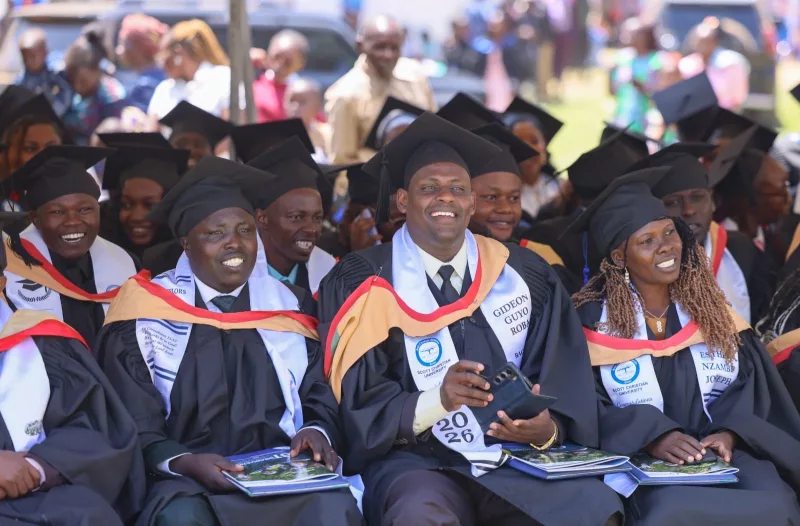
 Graduands during a past graduation ceremony. /FILE
The government has taken pride in the student-centred higher education funding model, crediting it for increased access to university and tertiary-level education by Kenyan youth regardless of their households' financial status.
Introduced in May 2023 by President William Ruto, the customised funding model supports students through tuition and upkeep via scholarships and loans based on a learner's needs, determined using a Means Testing Instrument (MTI).
The MTI evaluates variables such as family income, background, school type and family size and places students into specific bands, ranging from vulnerable and extremely needy to needy and less needy.
Vulnerable and extremely needy students receive the highest percentage of government scholarships and low-interest loans, covering up to 95 per cent or more of the costs, while less needy families shoulder a larger portion through household contributions and smaller loan allocations.
The money is channelled through the Universities Fund for scholarships and the Higher Education Loans Board (HELB) for loans to support the specific student's enrolment in their designated public university or TVET institution.
What every family pays based on level of need
Based on the MTI score, students are sorted into five distinct bands, each with a mix of non-repayable scholarships, student loans and household contributions.
The bands are structured such that as family income levels rise, state grants and loans decrease and vice versa.
Band 1: Students under this band are from households whose monthly income is below Sh5,995. They receive a 70 per cent scholarship, a 25 per cent HELB loan and Sh60,000 annual upkeep. Family contributes only 5 per cent of the cost.
Band 2: Comprises students whose household monthly income is between Sh5,995 and Sh23,670. They receive a 60 per cent scholarship, a 30 per cent HELB loan and Sh55,000 annual upkeep, while the family contributes 10 per cent.
Band 3: Students whose family monthly income ranges between Sh23,670 and Sh70,000 fall under this band. They receive a 50 per cent scholarship, a 30 per cent loan and Sh50,000 annual upkeep, while the family contributes 20 per cent.
Band 4: Students whose households' monthly income ranges between Sh70,000 and Sh120,000 are placed here. They get 40 per cent scholarships, a 30 per cent loan and Sh45,000 annual upkeep. Their families contribute 30 per cent of the cost.
Band 5: Consists of students whose family income is Sh120,000 and above. They are allocated a 30 per cent government scholarship, a 30 per cent loan and Sh40,000 annual upkeep, while the family contributes 40 per cent.
Based on the above rates, a Bachelor of Arts degree course, for instance, with an annual fee of Sh122,400 will see HELB pay Sh85,680 in scholarships and Sh30,600 in loans for Band 1 students.
Parents under this category pay Sh6,120 per year, and the student is entitled to annual upkeep of Sh60,000.
For students in Band 5 pursuing the same course, HELB pays Sh36,720 in scholarships and loans, while the parent pays Sh48,960 per year. Students receive Sh40,000 in upkeep.
Speaking at a church service in Taita Taveta on Sunday, August 23, President Ruto lauded the student-centred funding model as revolutionary, saying it has ensured no student qualified to pursue higher education misses out on the opportunity due to financial constraints.
He defended the funding model as one that has equalised access to learning and opportunities for Kenyan learners.
It replaced the old Differentiated Unit Cost (DUC) system, under which the government distributed capitation directly to universities as lump-sum operational grants rather than focusing financial support directly on individual students.
Funding amounts varied depending on the cost of the course, with programmes such as medicine and engineering receiving higher unit costs compared with humanities and arts.
The model left public universities with massive financial deficits and pending bills due to chronic underfunding and ballooning student enrolment, which left universities struggling to maintain operational stability.
"That's why we changed the old funding model which had suppressed our universities and now we have a new funding model and we are now improving it even further," Ruto said.
The Tertiary Education Placement and Funding Bill, 2026 currently before the National Assembly proposes scrapping the scholarship component and introducing a universal 100 per cent student loan model for all public universities and TVET institutions.
It seeks to dissolve HELB, the Universities Fund and the TVET Funding Board to form Tertiary Education Placement and Funding Authority (TEFA), and introduce structured repayment terms and voluntary parental savings.
The proposed law will empower TEFA to raise funds through alternative mechanisms like capital markets, Treasury bonds, pension funds and commercial partnerships rather than relying solely on Treasury.
All government-sponsored students will, starting in the 2027 academic year, get funded through loans, which they will then start repaying one year after securing employment at no more than 25 per cent of their monthly pay.
"No student will ever again go to university or TVET or KMTC and miss the opportunity to study because of money issues. We will have put in place robust plans so that no child will ever be rated based on parent's ability to pay," Ruto said.
"A child will be rated based on their intellectual capacity not financial status, the government will take care of financial issues."