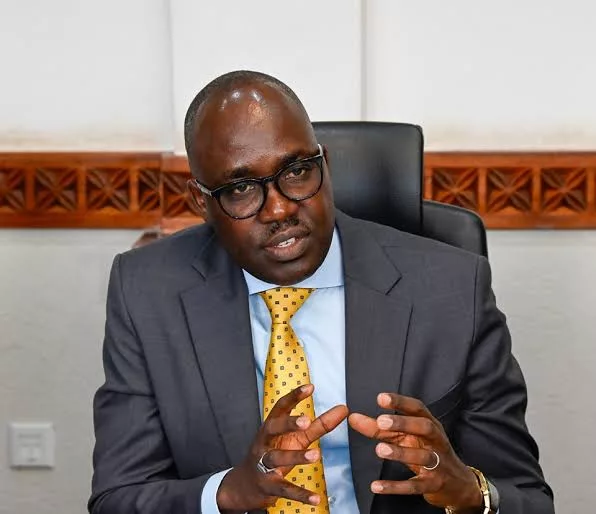
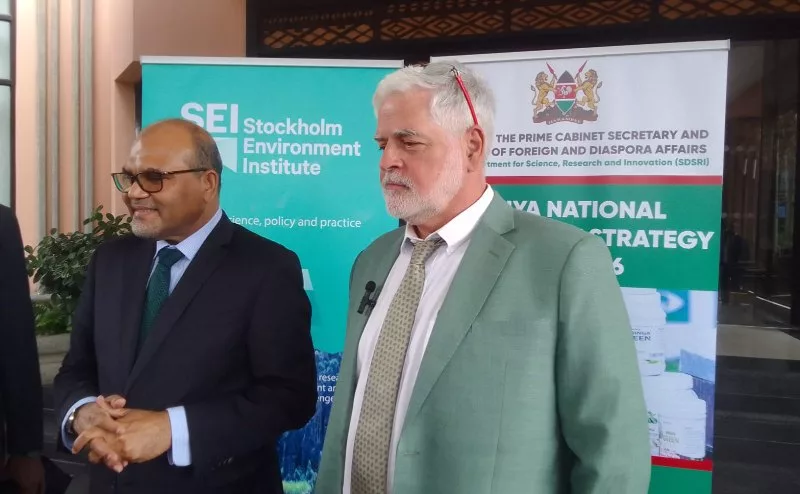
 State Department for Science, Research and Innovation Principal Secretary Prof Shaukat Abdulrazak and Stockholm Environment Institute Director Niall O’Connor speak to the media on Kenya’s bioeconomy strategy during a media engagement in Nairobi. / HANDOUT
Kenya is targeting Sh100 billion in investment in the bioeconomy over the next 10 years as the government seeks to turn biological resources, research and innovation into jobs, stronger food production and value-added products.
State Department for Science, Research and Innovation Principal Secretary Prof Shaukat Abdulrazak said the strategy will bring together government agencies, researchers, industry, private investors and regional organisations to develop the sector across the entire value chain.
He said the government wants to move beyond exporting raw biological resources by developing technologies and businesses that can create more value locally.
“Most importantly for us is how we can be able to use biology for the benefit of society,” Abdulrazak said.
The strategy covers areas including biofertilisers, bioengineering, bioinformatics and biogenomics, as well as applications in livestock, crops and human health.
Abdulrazak said Kenya's regional diversity would also shape implementation, with different parts of the country offering opportunities linked to their biological and natural resources.
He cited the Coast as an area where the strategy could be linked to the blue economy, while other regions could draw on biodiversity and indigenous knowledge to develop new products and industries.
The government is also looking at the bioeconomy as part of efforts to reduce dependence on imported food and improve productivity within agriculture.
Abdulrazak said emerging technologies, including artificial intelligence, could help farmers and other actors identify pests and diseases, improve the use of nutrients and reduce post-harvest losses.
“Under the bio-economy we will be using the nutrients more effectively and efficiently. It could be a fertilizer, it could be water and we'll be looking at specific technologies so that we can be able to maximize productivity of food as well as we are managing post-harvest losses,” he said.
The approach places small-scale farmers among the potential beneficiaries, particularly where agricultural waste or other biological materials can be turned into products with higher commercial value.
Stockholm Environment Institute (SEI) director Niall O’Connor said the institute has studied bioeconomy opportunities across Africa for about 10 years and sees potential in linking research with small businesses, farmers and policy.
He said adding value to resources produced by farmers could improve incomes compared with simply selling them as raw materials.
“This is the potential to give better income to them because we're using their resources, adding value to their resources, not just extracting their resources,” O’Connor said.
He pointed to research into banana fibre and leaves as an example, where agricultural material can be converted into sanitary products.
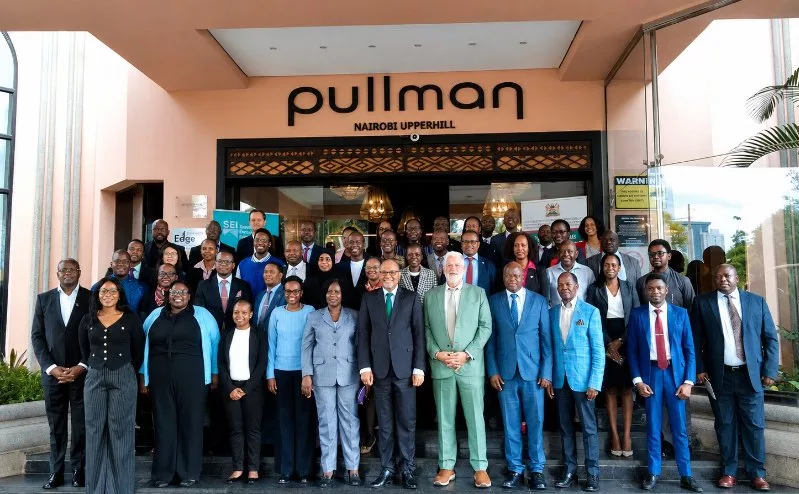 Principal Secretary for the State Department for Science, Research and Innovation Prof Shaukat Abdulrazak, Stockholm Environment Institute Director Niall O’Connor and other stakeholders pose for a photo during a media engagement on Kenya’s bioeconomy strategy in Nairobi. / HANDOUT
According to O’Connor, such innovations could help address access to products that are expensive or unavailable to some consumers while creating businesses around locally available materials.
He said research would be needed to identify alternative uses for agricultural waste, develop products and determine how they can be scaled and taken to markets beyond the local level.
The State Department plans to develop a wider research and institutional ecosystem around the sector.
Abdulrazak said Kenya's Bio Kenya project, supported by the European Union, had provided an initial foundation, with plans to build towards a centre of excellence and eventually establish a dedicated bioeconomy institute and a bioeconomy university linked to research institutions.
He said the government wants the public sector, universities and industry to work together to build the technical capacity required to support the sector.
“We are going to make sure that we continue working together,” he said.
The strategy also seeks to attract private financing, but O’Connor said that would require changes in how financial institutions assess investments involving smallholder farmers and emerging enterprises.
He said banks would need to develop ways of reducing the risks associated with such businesses and become more willing to finance the sector.
“We've got to look at ways of particularly working with banks to make them think beyond the current approaches, how do they work with smallholders, how do they de-risk investments to smallholders to encourage that whole sector to develop,” O’Connor said.
He said evidence from successful bioeconomy projects could help attract investment within Kenya and across the continent, reducing reliance on external financing and allowing more of the profits generated by the sector to remain in Africa.
The proposed Sh100 billion target is expected to support activities across the bioeconomy value chain, including research, product development, commercialisation and investment.
Abdulrazak said the wider objective was to create jobs and wealth while improving food security, food safety and food sovereignty.
“The strategy will be able to bridge the gap, be able to enhance productivity, be able to boost growth and most importantly be able to create more wealth and jobs as well,” he said.
The engagement brought together private sector and industry representatives, regional organisations and other stakeholders ahead of the launch of Kenya's bioeconomy strategy.