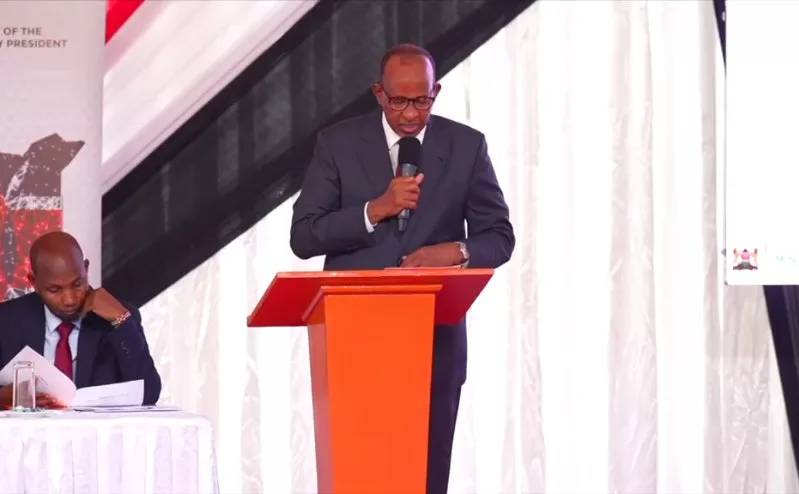
 Health CS Aden Duale speaking.
The national and county governments have reached a breakthrough agreement on the absorption of Universal Health Coverage (UHC) workers into permanent and pensionable terms, bringing an end to months of wrangling over their payroll, funding and employment status.
The agreement was reached on Monday during a special session of the Intergovernmental Budget and Economic Council (IBEC), chaired by Deputy President Kithure Kindiki at his official residence in Karen, Nairobi.
The meeting brought together governors, Cabinet and Principal Secretaries and other senior officials to resolve outstanding issues surrounding the transfer of UHC workers to county governments and the remittance of Social Health Authority (SHA) deductions by counties.
Under the agreement, eligible UHC workers will be absorbed by county governments and retained on permanent and pensionable terms, with the transition financed through the County Governments Additional Allocations (CGAA) for the 2026/27 financial year.
The Ministry of Health will also be reimbursed for salaries it has already paid to the workers for July and August, paving the way for counties to take over responsibility for their payroll from September.
The deal is expected to end a prolonged push-and-pull between the national government, county governments and UHC workers over who should employ and pay the health workers following the planned transition of the programme to the devolved units.
The dispute had raised fears of delayed salaries and possible disruption of health services, with Health CS Aden Duale warning earlier that the Ministry of Health did not have the resources to sustain payment of the workers beyond August unless counties took them onto their payrolls or the funds allocated for the programme were transferred to the ministry.
The government has set aside Sh8.6 billion, inclusive of statutory employer contributions, to facilitate the transition of about 7,786 UHC workers to permanent and pensionable employment.
The allocation was made as part of the 2026/27 financial framework after President William Ruto directed in September 2025 that UHC workers serving on contract be transitioned to permanent and pensionable terms.
The transition was subsequently incorporated into intergovernmental planning, with the National and County Governments Coordinating Summit, chaired by President Ruto on January 9, 2026, resolving that the costs associated with the exercise be factored into the 2026/27 Division of Revenue.
The Commission on Revenue Allocation subsequently provided for Sh8.6 billion to support the transition.
The Public Service Commission extended the contracts of the UHC workers to June 30, 2026, to allow the transition to county governments to take effect from July 1.
A multi-agency committee was also established in June to oversee the process, after which the Ministry of Health, working with the Ministry of Public Service and Human Capital Development, initiated the transfer of the workers from the national payroll to county payrolls.
However, the process ran into difficulties after the migrated payroll was not received for integration into county payroll systems.
The Council of Governors subsequently declined to integrate the workers into county payrolls, arguing that the funds should instead be channelled through the Division of Revenue Act mechanism.
The impasse forced the Ministry of Health to reverse the payroll transfer and temporarily retain the workers, allowing their July and August salaries to be processed.
Duale warned that the arrangement could not be sustained without a fresh financing mechanism.
“So, in July and August, my PS, Olunga, has paid the UHC staff. However, we will not be in a position to pay their September salaries because we do not have the resources,” Duale said during the meeting.
He said the immediate challenge was to agree on how the Sh8.6 billion would be disbursed and how the workers would be incorporated into county payrolls.
“Therefore, September is going to present a problem unless the entire amount that was allocated under the conditional grant is transferred to the Ministry of Health,” he warned.
Duale said the government needed to resolve three critical issues—agreeing on the disbursement mechanism for the Sh8.6 billion, integrating the UHC workers into county payrolls and ensuring continuity of salary payments and healthcare services during the transition.
“From where we sit at the Ministry of Health, a decision on these issues is very important for us today,” he said.
The IBEC resolution now provides a framework for counties to take over the workers without suffering a reduction in their equitable share.
The Council further resolved that the financing of the transition and payment of UHC workers would be provided through CGAA for the 2026/27 financial year, while money already paid by the Ministry of Health for July and August would be accounted for under the same allocation and reimbursed to the ministry effective September 1.
The Ministry of Public Service, Human Capital Development and Special Programmes will facilitate the transfer of eligible workers' payrolls to the counties, while County Public Service Boards will undertake their formal absorption.
The agreement also provides for the costs associated with the transition to be catered for in the revenue-sharing arrangements for the 2027/28 financial year, to ensure that no county loses part of its equitable share because of the absorption of the workers.
As the government moved to resolve the UHC workers' employment question, Deputy President Kindiki also called for an immediate resolution of the ongoing nurses' strike, urging the Council of Governors, the Kenya National Union of Nurses and Midwives (KNUNM) and the Salaries and Remuneration Commission (SRC) to conclude negotiations and allow nurses to return to work.
Kindiki said the industrial action had disrupted the delivery of healthcare services and warned that continued disagreement would only worsen the situation for Kenyans seeking treatment in public hospitals.
“I am aware that the Kenya National Union of Nurses and Midwives Union is on strike. This industrial action has affected the smooth delivery of health services across the country,” Kindiki said.
He urged the parties to put aside their differences and reach an agreement as quickly as possible.
“I wish to encourage the Council of Governors, in consultation with SRC, to conclude on the outstanding issues as soon as possible to facilitate resumption of services,” he said.
The appeal comes amid an ongoing standoff between county governments and nurses over outstanding employment and remuneration issues, with governors maintaining that they remain open to negotiations while urging health workers to resume duty.
The UHC workers were recruited in 2020 by the Ministry of Health in collaboration with the Public Service Commission as part of efforts to strengthen frontline healthcare delivery.
At recruitment, certificate holders were paid a monthly stipend of Sh40,000, while diploma holders received Sh50,000.
Their remuneration was subsequently aligned to the Salaries and Remuneration Commission's salary and allowances rates with effect from September 2024.
President Ruto then directed in September 2025 that the workers serving under contracts be transitioned to permanent and pensionable terms.
The directive was welcomed by the workers, but implementation became complicated by questions over which level of government would employ them, how the allocated funds would be transferred and how counties would integrate them into their payroll systems.
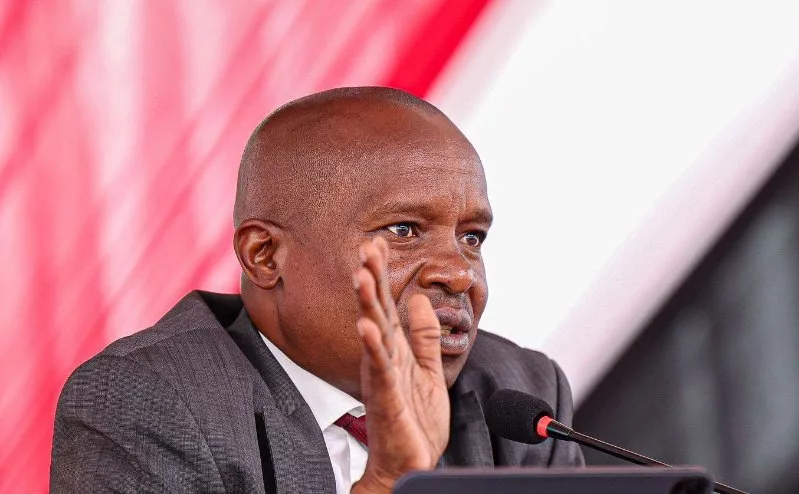 Deputy President Kithure Kindiki./STEPHEN ASTARIKO
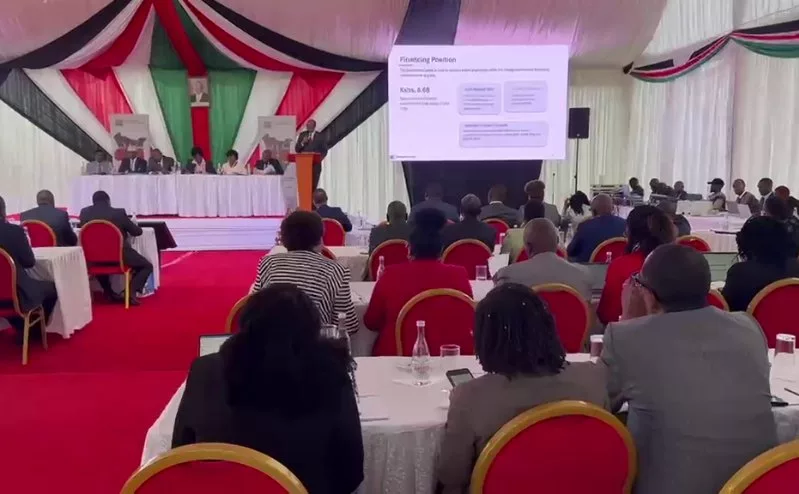 Governors and senior ministry officials at the meeting./STEPHEN ASTARIKO