

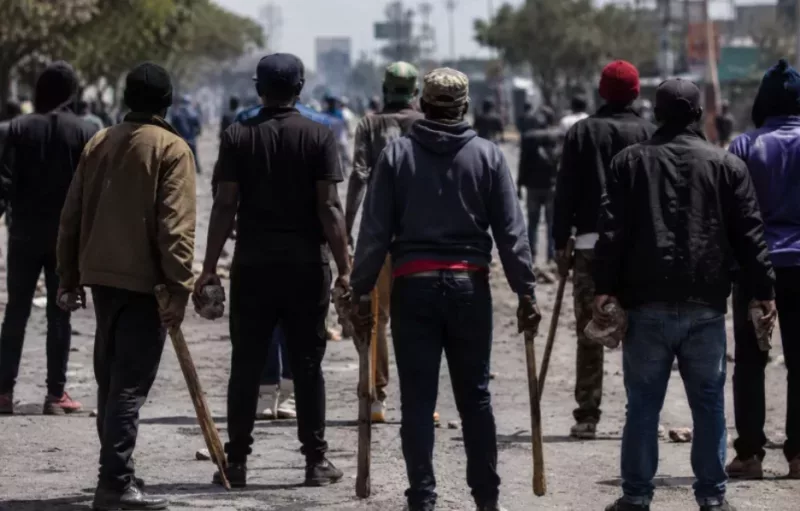
KENYA’s increasingly aggressive political campaigns and the use of goons pose a fresh threat to the economy, with investments and a slowdown in business activities among key investor concerns.
The private sector is warning that political tension could undermine investment and key economic sectors, with tourism, transport, service sector and trade becoming the biggest casualties.
Election cycles repeatedly leave a visible imprint on the economy, from the dramatic collapse in growth after the disputed 2007 presidential election to the more measured slowdowns witnessed during the 2013, 2017 and 2022 polls.
As the country moves towards the August 2027 general election, businesses are again confronting a familiar question of how much economic damage political uncertainty will inflict on a country struggling to accelerate growth, create jobs and attract private investment.
The private sector fears prolonged instability could hurt tourism, manufacturing, transport, logistics, trade and services, while companies that normally make long-term investment decisions could adopt a wait-and-see approach.
A comparison of Kenya’s five recent election cycles shows a mixed but instructive picture, with economic performance varying significantly depending on the political environment, inflationary pressures and events surrounding each poll.
In 2002, the economy recorded its weakest growth among the five election years, expanding by only about 0.5 per cent, while inflation remained relatively low at around two per cent.
The slowdown came during a major political transition as KANU’s four-decade rule came to an end.
Mwai Kibaki's ascent to power ushered in a period of stronger economic activity, with growth accelerating in subsequent years and approaching seven per cent by 2007.
The 2007 election cycle presented the sharpest contrast. Kenya entered the election with one of its strongest economies, with GDP growth reaching about 6.9 per cent in 2007 and inflation averaging 9.8 per cent.
But the disputed presidential election and the violence that followed dramatically reversed those gains. In 2008, economic growth collapsed to roughly 0.2 per cent, while inflation surged to 26.2 per cent.
The disruption of transport, agriculture, tourism, trade and manufacturing demonstrated how quickly political instability can turn into an economy-wide crisis.
By 2013, the economy had regained some stability. GDP growth stood at about 4.7 per cent, while inflation averaged 5.7 per cent.
Although investors remained cautious because of memories of the 2007-08 violence and uncertainty surrounding the first election under the 2010 Constitution, the relatively peaceful transition allowed economic activity to continue.
The 2017 election again produced a slowdown, although nowhere near the magnitude witnessed in 2008.
GDP growth eased to about 4.9 per cent, from 5.9 per cent the previous year, while inflation climbed to eight per cent.
The prolonged election period, including the repeat presidential election after the Supreme Court nullified the first result, contributed to uncertainty and weaker private-sector activity.
A severe drought also pushed up food prices, adding to inflationary pressure.
In 2022, the economy proved more resilient with GDP expanding by about 4.8 per cent, following a strong post-pandemic rebound of 7.6 per cent in 2021.
Inflation, however, remained a major concern, averaging about 7.7 per cent for the year and reaching 9.1 per cent in December as food, fuel and other commodity prices rose.
Despite the difficult global environment and subdued private-sector activity, the election passed without a repeat of the widespread violence seen in 2007-08, allowing the economy to maintain moderate growth.
The historical record therefore offers a warning for 2027, private sector players say.
Kenya is entering the next election with growth already projected to slow to 4.3 per cent in 2026 and 4.4 per cent in 2027, according to the World Bank, while inflation stood at 6.5 per cent in July 2026.
With households already under pressure from food, transport and housing costs, in the wake of the Middle East crisis, another period of political instability could amplify existing economic weaknesses.
Kenya Association of Manufacturers chief executive Tobias Alando says goonism and political uncertainty pose a significant threat to economic stability at a time when the country desperately needs productive jobs for its growing young population.
“Unlawful behaviour and violence undermine our economy and, consequently, employment opportunities for our youth,” Alando said.
The danger is a vicious economic cycle where young people without reliable employment become vulnerable to recruitment into political mobilisation and violence, he said.
Violence then scares away investment, disrupts businesses and reduces opportunities for the youth.
Security expert John Njiraini described it as the danger of a “goonism economy”, where temporary payments to young people participating in political activities come at the cost of much larger losses to the wider economy.
A company considering a new factory, hotel, warehouse or regional office can postpone the decision if executives believe the political environment is deteriorating, meaning an investor does not have to leave Kenya for the economy to suffer.
The tourism which attracted more than 2.7 million international visitors in 2025 and supports more than 1.7 million jobs, remains among the most vulnerable.
Any deterioration in Kenya's security image could therefore have an immediate effect on foreign-exchange earnings, hotel occupancy, airlines, restaurants, tour operators and thousands of small businesses.
“International visitors are unlikely to make fine distinctions between isolated political clashes and wider insecurity. Images of violent confrontations, road blockades or destruction can create a perception that Kenya is unsafe, prompting travellers to cancel or postpone trips,” said Mike Kamau, hotelier and Mombasa Continental Resort general manager.
The economic impact would extend from coastal hotels to restaurants, taxis, conference facilities, tour companies, food suppliers, curio traders, national parks and conservancies.
Domestic tourism could also weaken if Kenyans become reluctant to travel between counties during politically tense periods.
The logistics economy also faces another major risk as Kenya is the gateway for much of East and Central Africa's trade, with the Port of Mombasa serving Uganda, Rwanda, Burundi, South Sudan and parts of the Democratic Republic of Congo.
Shippers Council of Eastern Africa chief executive Agayo Ogambi warned that an unstable election could affect transit cargo.
“The forthcoming elections has the potential to affect transit cargo which account for 30 per cent of the Mombasa Port,” Ogambi said, calling for peaceful campaigns before, during and after the elections.
The Northern Corridor stretches roughly 1,700 kilometres from Mombasa through Kenya and into the wider region.
“Any prolonged disruption could increase transport costs, delay deliveries and undermine Kenya's reputation as a dependable regional logistics hub,” he said.
East African Community Affairs PS Caroline Karugu has however reassured traders that the government will work with the EAC to keep the Northern Corridor operating during the political season.
“I wish to reassure transporters and people engaging in cross-border trade that the government of Kenya, together with the East African Community, will do all it takes to ensure goods moving along the Northern Corridor are not affected by the upcoming political season,” Karugu said.
Karugu urged political leaders to protect the country’s economic interests during the campaign period.
Nairobi regional police commandant Issa Mahamud told the Star that multi-agency teams were working behind the scenes to dismantle criminal groups.
“We cannot allow a few individuals to disrupt peace and jeopardise the economy,” Mahamud said.
Interior CS Kipchumba Murkomen has promised decisive action against individuals spreading fear, saying an additional 6,000 police officers would soon be integrated into security operations.
The Kenya Private Sector Alliance and other stakeholders have warned that the growing use of hired goons could undermine democratic institutions, public safety and economic stability.
The Independent Electoral and Boundaries Commission has also expressed concern over reported political violence and alleged goonism, although it says its formal powers to address political violence are limited before the election period is officially declared.
IEBC chairman Erastus Ethekon said the electoral code of conduct becomes enforceable once the election period is gazetted and candidates registered.
Speaking during an IEBC-Kepsa meeting in Nairobi, Ethekon said the commission was less concerned about its operational preparedness than the environment in which the election would be conducted.
“Operationally, we are fine. What we are worried about is the environment in which we will hold the election. Will it be peaceful?” he asked.
Kepsa representative Vimal Shah said the country was facing a significant trust deficit, with uncertainty surrounding electoral processes fuelling anxiety among citizens and businesses.
“We are seeing a fear psychosis that is causing widespread concern about the future. There is a need for clarity of rules and a coordinated approach to conflict resolution,” Shah said.
The World Bank, in its July 2026 Kenya Economic Update, projected a slowdown in GDP growth of 4.3 per cent in 2026, down from 4.9 per cent, and 4.4 per cent in 2027.
It has warned that elections could delay private investment decisions, increase policy uncertainty and slow implementation of structural reforms.
The International Monetary Fund has similarly warned that heightened political activity and election cycles can derail fiscal discipline, slow economic growth and test efforts to contain public spending.
Political commentator Prof Patrick Lumumba has criticised what he described as a growing “goon culture”, warning that Kenya risks losing the regional respect and democratic standing it has built if hired groups are allowed to dictate the political atmosphere.
He contrasted political violence with accountability-driven movements led by young Kenyans and Gen Z, praising their demands for greater political transparency and systemic change.
The diplomatic community is also pressing for stability ahead of the polls.
Acting US ambassador to Kenya Susan Burns has held consultations with political and government actors on political stability and economic development, including Jubilee Deputy Party Leader Fred Matiang’i and Foreign Affairs Principal Secretary Korir Sing’Oei.
The young people being recruited into political violence are among those who stand to lose the most if businesses postpone investment, factories delay expansion, tourism bookings decline and employers freeze hiring.
Experts say this could create a damaging cycle in which economic hardship makes young people more vulnerable to political mobilisation, while violence arising from that mobilisation further weakens economic activity and reduces opportunities for productive employment.
Breaking that cycle, they say, will require more than security operations. It will require political leaders to recognise that economic stability is itself an election issue.
As the campaign period gathers momentum, businesses are calling for political competition that does not undermine the economic foundations on which jobs, investment, tourism and regional trade depend.






