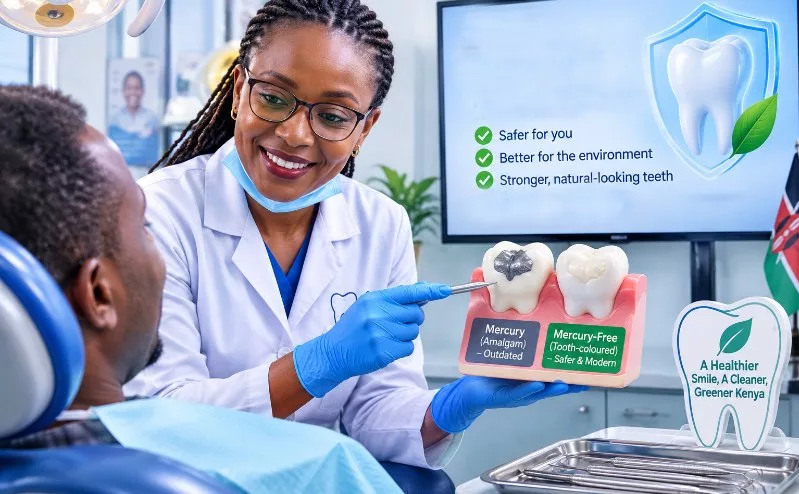
Tooth decay affects millions of Kenyans every year, making restorative dental care a daily reality in clinics across the country. Yet beyond the pain of cavities and the routine use of dental fillings, a major global shift in oral healthcare is underway.
Increasingly, the conversation is not only about replacing mercury-containing materials with safer alternatives, but also about preventing tooth decay before restorative treatment becomes necessary.
In 2025, countries meeting at the Sixth Conference of the Parties (COP6) to the Minamata Convention on Mercury agreed to phase out dental amalgam, commonly known as the "silver filling", by 2034.
The amendment, which officially takes effect in March 2027, applies to countries that are parties to the convention, including Kenya. This decision marks an important step in the global transition towards safer, mercury-free healthcare.
Why is this important?
Dental amalgam contains approximately 50 per cent mercury, a highly toxic substance with devastating health risks. Mercury exposure affects the nervous system, impairing cognitive function, memory, coordination and motor skills, while prolonged or higher levels of exposure have also been linked to kidney damage and disruption of the immune system.
Although dental amalgam is generally considered stable once placed, its mercury content has raised long-standing public health concerns because even low levels of exposure over time can contribute to the body's overall mercury burden.
Most importantly, effective mercury-free alternatives already exist and are increasingly becoming the standard of care in many parts of the world. Materials such as resin composites and glass ionomer cements provide safe and reliable options for restoring teeth affected by decay.
Resin composites are durable, tooth-coloured, and more aesthetically appealing to patients. Glass ionomer cements release fluoride, helping to protect teeth from further decay. Unlike traditional amalgam fillings, these materials support minimally invasive dentistry by preserving more of the natural tooth structure.
Advances in dental technology have made these alternatives increasingly effective, demonstrating that modern dentistry no longer needs to rely on mercury-based materials.
Yet the conversation should not stop at replacing one filling material with another. Prevention must remain at the centre of oral healthcare.
Just weeks before the Minamata Convention communicated the adoption of the phase-out amendment, the World Health Organization released new oral health guidelines promoting less invasive care, stronger prevention strategies and wider adoption of mercury-free restorative materials.
The guidelines emphasise the use of fluoride, fluoride varnish, pit-and-fissure sealants, community oral health education, and minimally invasive approaches capable of stopping tooth decay before extensive treatment becomes necessary.
This shift represents an important change in how oral health is viewed globally. Rather than focusing primarily on treating cavities, countries are increasingly investing in preventing them.
European countries such as Sweden have already successfully transitioned away from dental amalgam, eliminating its use through strict legislation and widespread adoption of mercury-free alternatives. This provides valuable lessons for countries preparing for similar transitions.
The real measure of success will be whether every public and private dental facility has the equipment, restorative materials, financing and skilled workforce needed to make mercury-free dentistry the standard of care, regardless of where a patient seeks treatment.
This would be important given the country's high burden of dental disease. According to the Kenya National Oral Health Survey, dental caries affects approximately 46.3 per cent of children and 35.5 per cent of adults. This means millions of Kenyans will continue to require restorative care, making access to safe, affordable and mercury-free alternatives increasingly important.
The country can use this transition to strengthen oral healthcare systems, promote prevention and modernise dental practice.
Achieving this will require deliberate action. Phasing out dental amalgam does not mean denying patients restorative care. It means ending the procurement and routine or situational use of mercury-containing fillings while expanding access to safe, mercury-free alternatives across both public and private health facilities.
This is not entirely new territory for Kenya; the National Oral Health Policy (2022–2030) already commits the country to phasing down dental amalgam use as part of its broader oral health strategy. What is needed now is acceleration: turning that policy commitment into a concrete implementation plan, so Kenya's transition to mercury-free dentistry keeps pace with the convention's binding 2034 deadline to phase out dental amalgam.
Dental schools and training institutions should ensure that future oral health professionals are equipped with the skills and knowledge needed to use mercury-free restorative materials effectively. Public and private health insurance schemes should ensure that safer alternatives remain affordable and accessible to all Kenyans so that cost does not become a barrier to quality and safer care.
Public awareness will also be critical. Many people still seek treatment only when they are already experiencing pain. Greater investment in oral health education can encourage regular dental check-ups, improved oral hygiene practices, reduced sugar consumption and early interventions that prevent disease before it progresses.
Ultimately, the best filling is the one that is never needed. Prevention should always be the first line of defence against tooth decay. But when treatment becomes necessary, Kenyans deserve restorative options that are safe, effective, affordable and aligned with the future of global healthcare.
Mercury-free dentistry is no longer a distant aspiration. It is a global reality. Kenya cannot afford to be left behind.
Communications and outreach officer at the Centre for Environment Justice and Development (CEJAD)