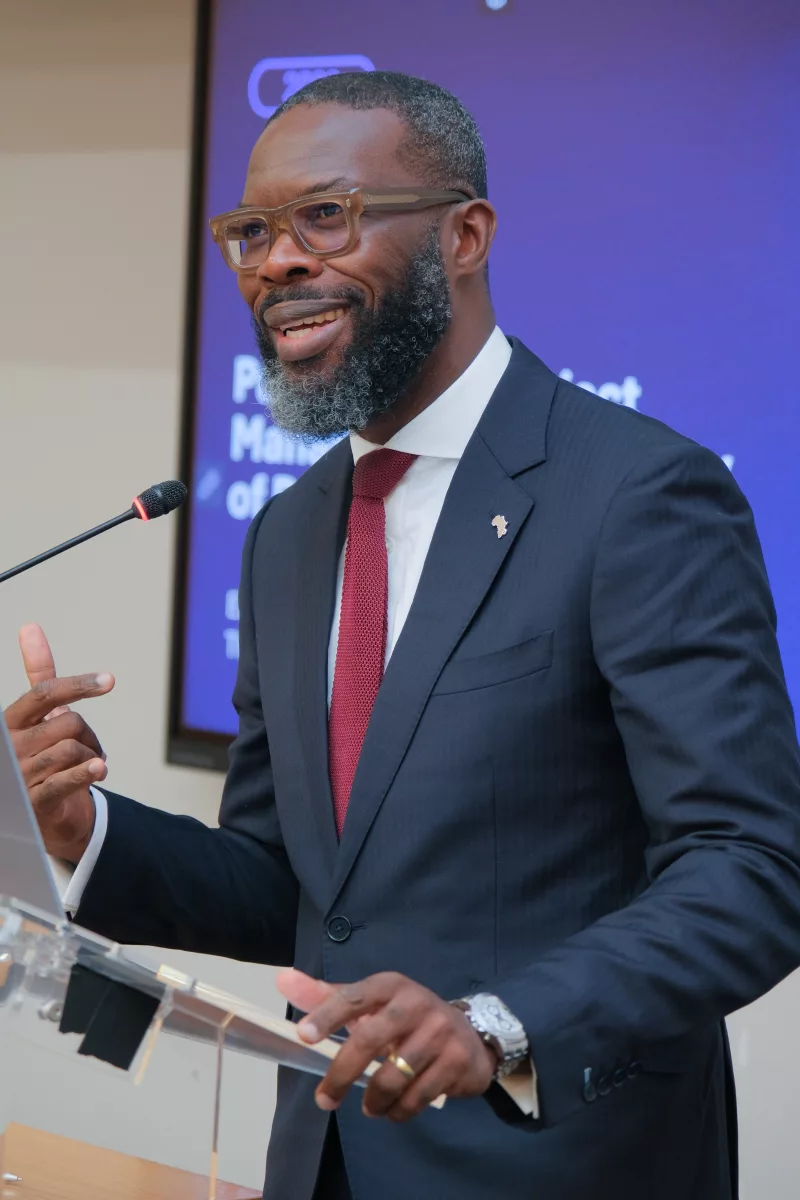
 PMI Sub-Saharan Africa managing director George Asamani during the launch in Nairobi on Monday / BRIAN OTIENO
Mega projects in Kenya and around the continent face sustainability challenges because most of those in charge do not prioritize the sustainability of the projects, a research study has said.
This could be the reason there are many stalled, abandoned, or white elephant projects across the country that have sunk billions of shillings of taxpayers’ money.
And with President William Ruto’s Vision 2060 national conversation having been launched, this could be an important part of the discussion.
The report, dubbed ‘Executing Sustainability Strategy: When Ambition Meets Reality, reveals that many organizations across 35 African countries struggle to deliver measurable sustainability outcomes.
“The study found that although 79 per cent of respondents believe sustainability is important to long-term success, only 41 per cent say it is fully integrated into projects and daily operations,” the report reads in part.
Speaking at the launch of the report in Nairobi on Monday, Project Management Institute Sub-Saharan Africa managing director George Asamani said the challenge is mostly with execution of these projects.
Asamani said the execution challenge receives far less attention than policy or funding debates.
For Africa, where projects underpin everything from infrastructure and energy development to healthcare, mining, agriculture, and digital transformation, the findings point to a challenge that is becoming increasingly difficult to ignore.
“Sustainability is no longer a separate conversation from performance. Across the continent, governments and businesses have set bold targets and made significant commitments. The real challenge is delivery,” Asamani said.
“A strategy does not build a power station, expand broadband access, or improve water security - projects do. If sustainability is not embedded into project delivery, organisations will struggle to achieve the outcomes they are aiming for," Asamani said.
The report was done by PMI, a leading authority in project management, and Green Project Management, a leading organization advancing sustainable practices within organizations.
It surveyed nearly 1,600 professionals across 35 countries and found a significant disconnect between strategic confidence and execution readiness.
While 85 per cent of sustainability executives believe their organizations will achieve their sustainability goals, only 43 per cent of Project Management Office (PMO) leaders share that confidence, according to the report.
Among project professionals responsible for implementation, just 20 per cent are extremely confident in their organization's ability to deliver, the report says.
The findings come at a time when the world is running out of time to achieve the Sustainable Development Goals (SDGs).
According to the United Nations Sustainable Development Goals Report 2025, only 35 per cent of SDG targets are currently on track or making moderate progress, while nearly half are advancing too slowly.
The UN report also reveals that 18 per cent of the targets have regressed.
The research identified sustainability as the strongest predictor of project success, ranking ahead of traditional delivery factors such as governance structures and project methodologies.
“Yet despite its demonstrated value, 59 per cent of organizations have not fully integrated sustainability into project delivery and operational decision-making,” Asamani said.
The report identified six recurring barriers that prevent organisations from successfully executing sustainability strategies.
These include difficulty quantifying sustainability benefits in business terms, weak integration into decision-making processes, unclear goals, competing delivery priorities, limited visibility into outcomes and the challenge of working against longer-term outcome horizons.
For Sub-Saharan Africa, where sustainability outcomes directly determine access to international development finance, ESG-linked investment, and climate funding, this execution gap carries particular consequences.
Organizations that cannot demonstrate measurable sustainability delivery risk being excluded from the investment flows that will define the continent's next decade of growth.
According to Asamani, many organizations continue to treat sustainability as a reporting exercise rather than a delivery discipline.
“Too often, sustainability lives in strategy documents and annual reports, but it is less visible where decisions are actually being made. The question is no longer whether sustainability matters. The question is whether organisations can deliver it consistently, project after project,” he said.
The research found that organisations most successful in delivering sustainability commitments typically share two characteristics.
These include leadership alignment around a clear definition of success and strong organizational capability to translate sustainability priorities into project-level decisions and actions.
“The next phase of sustainability leadership will be defined by execution,” Asamani said.
“As Africa continues to invest in infrastructure, energy, industrialisation, and digital transformation, the demand for professionals who can balance economic, environmental, and social outcomes will only grow.
“Building that capability is not simply good for sustainability. It is good for business, competitiveness, and ultimately good for the region’s development.
INSTANT ANALYSIS:
Kenya’s Vision 2060 is a long-term national policy framework and public dialogue that President William Ruto launched to transition Kenya into a first-world, high-income economy over the next 34 years, building upon the foundations laid by the Kenya Vision 2030.