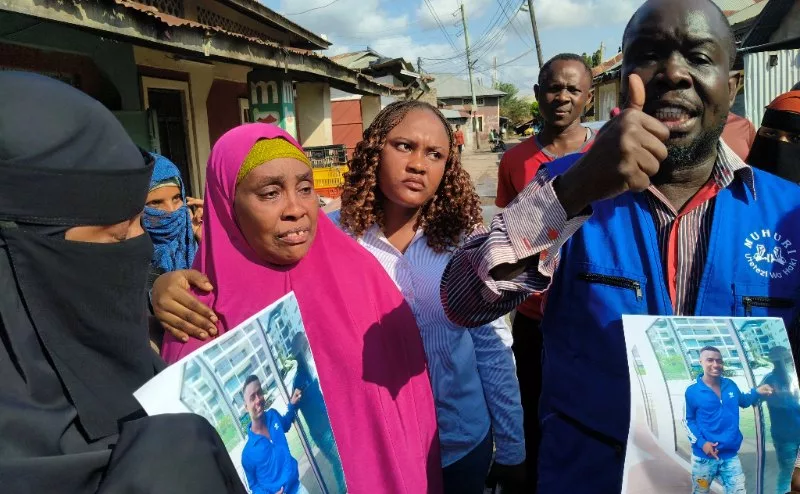
 Muhuri’s Francis Auma [R] and Fatima Jeilan [in pink buibui], mother of Musa Awes, 23 [in poster], who was taken on April 19 in Barsheba, Mombasa by unknown people, never to be seen again, address the press on July 29 / BRIAN OTIENO.
Survivors and families of victims of police abuse and enforced disappearances will today launch a national campaign in Mombasa to criminalise enforced disappearances, in conjunction with human rights defenders.
The ‘Haki Kwa Wote’ (Justice For All) campaign aims to compel the justice system in the country to fully implement the victim protection mechanisms in the country.
The launch coincides with the International Day of the Victims of Enforced Disappearances, usually marked on August 30.
The campaign seeks to draw national attention to the continued occurrence of enforced disappearances and the urgent need for legal, policy and institutional reforms to protect victims and hold perpetrators accountable.
International Justice Mission said it fully supports the campaign, which also seeks to ensure that victims and survivors are not forgotten and that the state fulfills its obligation to prevent enforced disappearances, protect victims and provide access to justice and redress.
“Justice must extend beyond prosecuting offenders. Victims and survivors should be protected, informed, supported and empowered to access effective remedies and redress,” IJM country director Vincent Chahale said in a statement yesterday.
The campaign comes at a time when Missing Voices, a group of organisations whose mission is to end enforced disappearances and extrajudicial killings in Kenya, has documented 19 cases of enforced disappearances between January and August 2026.
“This highlights the ongoing vulnerability of citizens to human rights violations,” Chahale said.
The issue received heightened public attention during the Gen Z Anti-Finance Bill 2024 protests in 2024 and 2025, when allegations of enforced disappearances and unlawful arrests sparked widespread concern nationally and internationally.
While Kenya signed the International Convention for the Protection of All Persons from Enforced Disappearance in 2007, the country has yet to ratify the treaty or enact legislation specifically criminalising enforced disappearances.
The current administration previously committed to ratifying the Convention and aligning domestic laws with its provisions, but those commitments remain outstanding.
On Thursday, President William Ruto made a U-turn and acknowledged his administration’s failure in the handling of the both the 2024 protests and its anniversary a year later.
He said no blood should have been shed during the protests.
“No Kenyan should lose their life, liberty or dignity merely for criticising government, expressing an unpopular opinion or participating in peaceful demonstration,” Ruto said.
During the 2024 protests and its subsequent anniversary matches in 2025, Ruto described the demonstrations as treasonous.
However, in a change of tune on Thursday, the head of state appeared to condemn the very actions he defended in 2024 and 2025, and directed investigations into deaths, alleged abductions and cases of excessive use of force during the protests.
As part of the campaign launch, organisers will unveil a national petition urging the government to fully implement the Victim Protection Act, 2014, adequately fund and strengthen the Victim Protection Board and operationalise the Victim Protection Trust Fund.
Despite the existence of a legal framework guaranteeing victims' rights, many survivors and affected families struggle to access information, legal aid, psychosocial support, rehabilitation services, compensation and meaningful participation in the justice process.
The Ruto administration has set aside Sh2 billion for an overall national reparations framework for verified victims and families affected by human rights violations and violence during public demonstrations.
So far, at least Sh674.1 million has been released to 505 verified victims, amid protests from other victims who say they have been forgotten.
In the first phase, some Sh448.7 million was released to 348 verified beneficiaries, before another Sh225.4 million was cleared and disbursed to 157 claimants, including 57 families of those who died and 100 individuals with injuries.
Families of the deceased got Sh3 million each, those with severe injuries got Sh1 million each, those with moderate injuries received Sh500,000 each, while those with minor injuries and economic losses received Sh50,000 each.
“Through the petition, the Haki Kwa Wote Campaign seeks to transform victim protection from a promise in law into a reality in practice,” Chahale said.
The IJM country director said they are encouraged by the courage of survivors who have come forward to share their lived experiences and advocate for legal reforms that will prevent future violations and strengthen access to justice for victims and their families.
Today’s launch event will feature testimonies from survivors and families affected by enforced disappearances, perspectives from human rights defenders and the official unveiling of the public petition.
“For countless Kenyan families, enforced disappearance means living without answers, justice or closure,” Chahale said.
Senior government officials have been invited and are expected to attend.
These include the Director of Public Prosecutions, the National Police Service, the Independent Police Oversight Authority, the Directorate of Criminal Investigations, the National Police Service Commission, the Law Society of Kenya, Missing Voices directors and the Witness Protection Agency.
INSTANT ANALYSIS:
Missing Voices documented 131 cases of extrajudicial killings and enforced disappearances in 2025. Out of these, 125 were incidents of police killings, while six were enforced disappearances. Advocates hope that criminalising the trend will help to deter future cases.