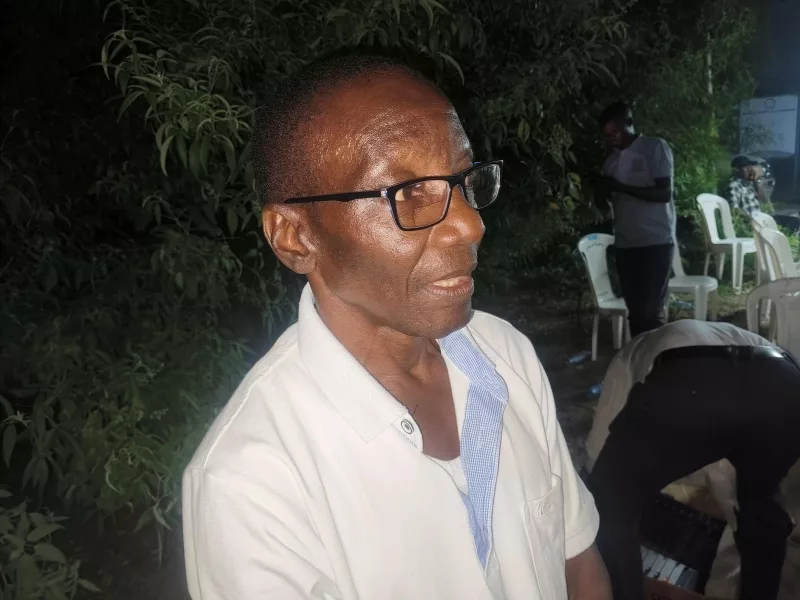
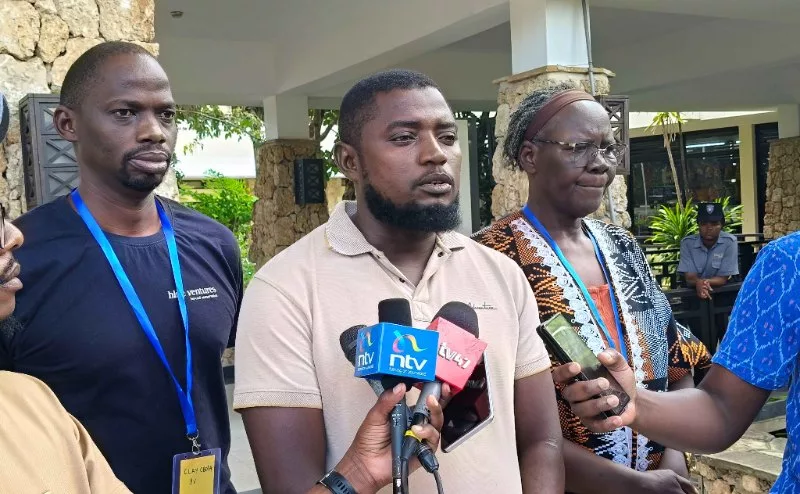
 Blue Ventures’ Clay Obota, Kipini BMU’s Omar Ahmed and Blue Ventures’ Nelly Otieno in Mombasa on Thursday / BRIAN OTIENO
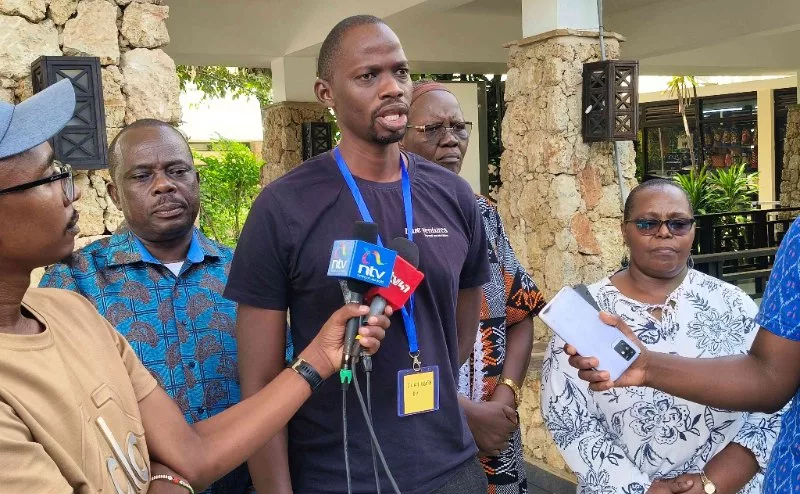 Blue Ventures’ Clay Obota in Mombasa on Thursday /BRIAN OTIENO
Kenya loses about Sh45 billion each year due to illegal, unreported and unregulated fishing in the Indian Ocean and inland waters.
Kenya Fisheries Service (KeFS) director general Daisy Muriuki said on Thursday if illegal, unreported and unregulated (IUU) fishing is not fully addressed, it will lead to even greater financial losses.
This comes as fisherfolk at the Coast lament reduced catches whenever they venture into the sea.
Kipini Beach Management Unit (BMU) chairperson Omar Ahmed said while local fishers struggle to catch fish, illegal operators—especially foreign ones—use destructive methods that deplete fish stocks.
“We need better equipment to venture into the sea and we also need more information on where the fish are found so we do not go blindly into the sea,” he said.
Climate change has also played a significant role in the depletion of stocks, Ahmed noted, observing that rising water temperatures and coastal erosion mean certain fish species are no longer found in their traditional habitats.
“Some rivers that used to carry water into the sea have been blocked and no longer bring that water. This means the marine ecosystem has been altered,” said Ahmed, who also serves as the Tana River BMU Network chairperson.
Blue Ventures, a marine conservation organisation working with local communities and partners, funds BMUs and other community groups to help mitigate the factors affecting fisheries at the local level.
The organisation’s East Africa regional director, Nelly Otieno, said on Thursday the problem is exacerbated by a lack of data and resource sharing among stakeholders in the fisheries sector.
Otieno said to ensure a thriving ocean and thriving fishers, all stakeholders must work together—starting from the household level—to ensure challenges are adequately addressed before they affect incomes, marine safety or the wider ecosystem.
Blue Ventures East Africa head of technical capacity, Clay Obota, said a lack of funding is one of the biggest challenges communities face in achieving desired fisheries and conservation outcomes.
Obota said most initiatives in the sector are currently conducted in a fragmented manner.
“We believe as an organisation that community leadership and collective action are central to achieving lasting fisheries and conservation outcomes,” he said, adding that collective action helps foster better coordination and shared learning.
Muriuki stressed the need to share data, particularly with local communities, to combat IUU fishing, enhance monitoring, control and surveillance (MCS), improve data collection and conduct better research.
“There is a need for research institutions to share their findings with communities. There is also a need for communities to understand the importance of data collection in managing fisheries resources," she said.
"Therefore, let us centralise data under the one institution mandated to manage and develop data in the fisheries sector, which is the Kenya Fisheries Service.”
However, the government is already addressing the matter, albeit on a limited scale.
“We urge all partners within the marine sector and marine fisheries research areas to come up with better ways to address these issues,” Muriuki said.
She said the government is enhancing surveillance patrols within the marine and blue economy sector, a venture that requires substantial resources.
To support this, the government has installed a Vessel Monitoring System (VMS) within a command centre at KeFS.
“If all stakeholders embrace cameras, as we highlighted in the just-concluded Our Ocean Conference, we would be able to address the IUU issue at a lower cost to the government,” the director general said.
She said IUU fishing spans industrial, semi-industrial, local and international operators, noting that parts of the waters exploited by international vessels are not monitored at all.
“That is why we are saying we need a very strong VMS to capture all of that. On the local front, when local fishers harvest fish and fail to report it, that also forms part of IUU fishing," Muriuki said.
"However, we have allocated resources to manage IUU issues so that Kenyan ratings can improve within the Indian Ocean Tuna Commission (IOTC) framework.”
She also assured the public that although the presence of multiple players in the marine sector might suggest an overlap or duplication of roles, this is not the case.
Muriuki clarified that each level of government holds a unique mandate regarding the conservation, management and development of marine resources, while non-state actors complement government efforts without infringing on official roles.
Mwakiraha Mohamed, the Kwale county BMU chairperson, emphasised the need for better coordination between local communities and government agencies.
For instance, he noted that in Vanga, where he resides, the porcupine fish (or pufferfish) is considered a delicacy.
“All types of porcupine fish are eaten. The meat is soft, has no bones and is very delicious,” Mohamed said.
This practice continues despite warnings from fisheries officers that porcupine fish are poisonous and unsafe for human consumption.
Mohamed argued that only one species of porcupine fish has a poisonous liver, while the rest are safe to eat.
Although they are rarely targeted for commercial food fishing due to their prickly skin and toxic internal organs, Mohamed explained they remain a popular local dish in Vanga, Kwale county—a point of ongoing disagreement with fisheries officers.