Nyumba Agri Products Limited has invested more than Sh6
billion in Galana-Kulalu and plans to expand its irrigation network as part of
an ambitious drive to put more than 300,000 acres under production.
Read Also
The investment is transforming the once-barren plains straddling Kilifi and Tana River counties into a large-scale commercial farming zone, with irrigation, solar energy, modern farming technology and value addition at the heart of the project.
Nyumba Agri is among private investors participating in the Galana-Kulalu Food Security Project, a public-private partnership intended to turn the vast dry lands into a major source of food for the country.
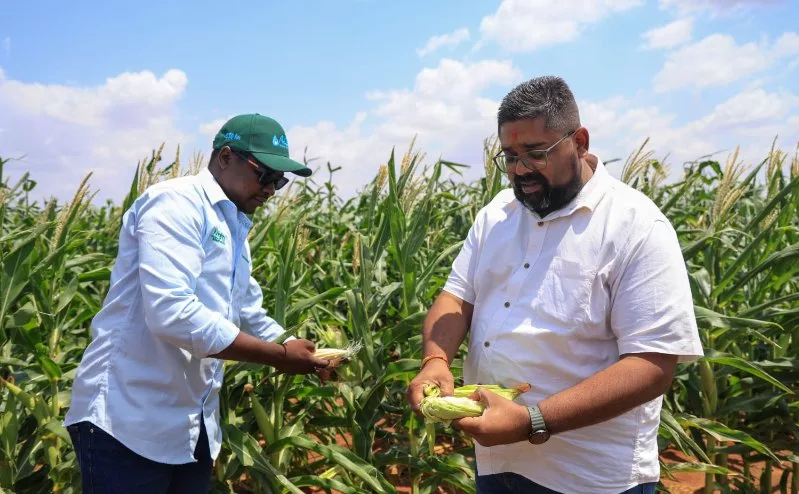
The company has established extensive maize and onion farms on land previously dominated by thorny bushes and dry vegetation. It is also expanding into cassava, soybeans and sisal as it seeks to diversify production and create additional revenue streams.
Eric Kimathi, the company’s production and operations manager, said investment in irrigation had made it possible to farm throughout the year despite the area’s harsh climate.
“Irrigation is the backbone of every farming project. It is the key point when it comes to farming,” Kimathi said.
Nyumba Agri currently has 32 centre-pivot irrigation systems, 23 of which are under cultivation. The company plans to increase the number to 78 as it opens up more land.
Each centre pivot irrigates about 120 acres, delivering water and fertiliser directly to crops through fertigation technology.
The farm currently has about 741 acres under commercial maize, 680 acres under seed maize and 766 acres under onions. Additional acreage is dedicated to cassava, soybeans and sisal.
The scale of the investment is reflected in the farm’s output. The latest commercial maize harvest averaged 7.2 tonnes per hectare, while seed maize production stood at about 4.6 tonnes per hectare.
Kimathi said the production was already making a meaningful contribution to Kenya’s food supply.
“With commercial maize averaging seven tonnes per hectare and more than 300 hectares under production, it is a significant contribution to food security,” he said.
The operation depends on a water system designed to support large-scale production in an area where rainfall is unreliable.
Water is drawn from the Galana River and stored in reservoirs and earth dams before being pumped into the irrigation network.
Solar power runs much of the system, with diesel generators used as backup. The shift to solar has also helped the company deal with limited access to the national electricity grid.
Onions have become another major investment area. Different fields are planted at staggered intervals to maintain a steady supply for harvesting. After harvesting, the onions are sorted and processed before being supplied to the local market.
Solar-powered drying technology is used to extend their shelf life and minimise post-harvest losses. Instead of throwing away smaller or lower-grade onions, the company processes them into flakes, creating an additional source of income while reducing waste.
Nyumba Agri is also investing in value addition beyond crop production. Cassava is being processed into starch and other products, while more than 1,000 acres have been set aside for sisal.
A sisal processing plant is under construction and is expected to create more jobs while keeping more of the value generated from the crop within the region.
The investment is also creating employment for communities surrounding the farm.
Pravin Kerai, the farm’s administration manager, said about 1,800 people were currently employed at the project, with most workers recruited from neighbouring communities.
Residents of Chakama, Shakahola, Baolala, Bombi, Habura and Danisa are among those who have secured jobs at the farm.
“Our main aim for this project is to feed this nation. Everything harvested here goes to the local market. We are not exporting anything,” Kerai said.
Beyond employment, the company has extended support to surrounding communities through corporate social responsibility programmes, including the provision of silage to farmers whose livestock have been affected by drought.
For workers such as Joyce Afedha and Mwalimu Karisa, the farm has provided a source of income that has helped them meet family needs and improve their livelihoods. The two have called for further expansion to create more employment opportunities.
Nyumba Agri’s expansion forms part of the wider plan to put about 300,000 acres in Galana-Kulalu under irrigation and commercial agriculture.
For years, Galana-Kulalu was associated with ambitious government plans that struggled to reach their full potential. The growing presence of private capital is now giving the project a new dimension, with commercial farmers investing in irrigation infrastructure, energy systems, processing facilities and large-scale production.
INSTANT ANALYSIS
Nyumba Agri’s Sh6 billion investment offers a glimpse of what sustained private capital, irrigation and technology could achieve in Galana-Kulalu by transforming dry land into productive farmland.
The project is significant for Kenya’s food security ambitions, particularly as it combines large-scale crop production with value addition and employment. Its expansion could provide a model for unlocking the region’s agricultural potential, although long-term success will depend on sustained investment and reliable water supplies.