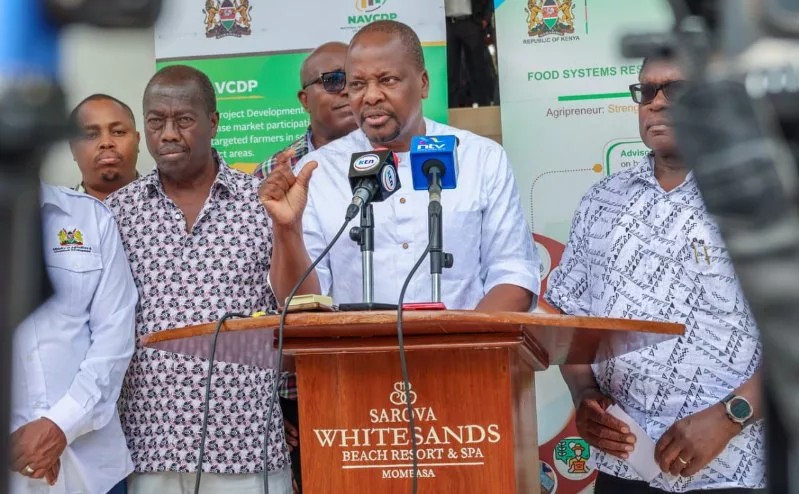
Kenya will import maize to cover an anticipated shortfall of about 25 million bags, Agriculture Cabinet Secretary Mutahi Kagwe has said.
This is as the government moves to strengthen food security amid drought and unreliable rainfall.
Kagwe said the expected deficit should not cause alarm, noting that the country had not lost its entire maize crop but would need imports to bridge the gap between production and consumption.
“It is not all the crop that has failed. We think that we are going to be short of about 25 million bags,” Kagwe said.
Kenya consumes an estimated 70 million to 75 million 90-kilogramme bags of maize annually.
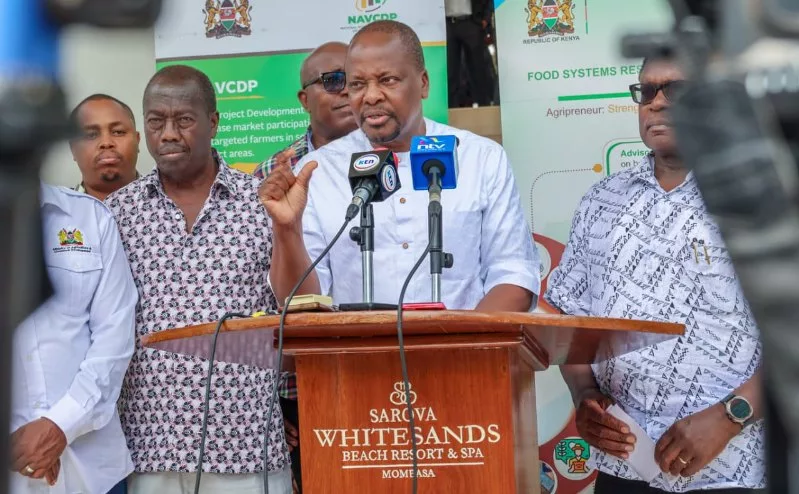
Speaking in Mombasa during the fifth joint consultative meeting involving the national and county governments and the World Bank, Kagwe said drought in key maize-growing areas had contributed to the projected shortfall.
He said the situation underscored the need for Kenya to reduce its dependence on rain-fed agriculture and increase investment in irrigation to make food production more reliable.
“We need to move more into irrigation-fed agriculture so that the kind of climatic changes that are happening will not impact us as much as they are at this time,” he said.
Kagwe identified the Galana-Kulalu irrigation project as one of the areas that could help increase food production and reduce the impact of climate change on agriculture.
He also cited Baringo, Garissa and Tana River counties as having large tracts of land that could be brought under cultivation through expanded irrigation infrastructure.
The CS said the government was pursuing a broader transformation of agriculture focused on increasing productivity, promoting value addition, attracting investment and creating employment.
He said farmers should be supported to produce more from the land they already cultivate while earning better returns through processing and value addition.
“We want each farmer to produce more than they have been producing within the same setup,” Kagwe said.
He said the government was also seeking to bring more young people into agriculture by promoting technology, artificial intelligence and modern farming methods.
“We want the central part of agriculture to be managed and executed by youth so that we can also infuse new ways of doing agriculture,” he said.
Kagwe said the AgriConnect initiative would bring together the national and county governments, the World Bank and the private sector to improve the business environment, create jobs and expand investment opportunities in agriculture.
The three-day Mombasa meeting is reviewing the implementation of the Food Systems Resilience Project (FSRP) and the National Agricultural Value Chain Development Project, while preparing for the next phase of programmes under AgriConnect.
Kagwe said the government would also work with the National Treasury to review taxation affecting farmers and agribusinesses, particularly multiple taxes and bureaucratic requirements that raise the cost of investment.
He said the reforms were aimed at making agriculture more commercially viable while improving farmers’ incomes.
Bungoma Governor Kenneth Lusaka, who chairs the Council of Governors’ Agriculture, Livestock and Fisheries Committee, supported the push for greater youth participation.
Lusaka said many farmers were ageing and urged the government to create more opportunities for young people in farming and agribusiness.
He said technologies such as drones and other smart farming solutions could help make agriculture more attractive to the youth.
Lusaka also urged young people to explore opportunities beyond primary production, including value addition, processing and marketing.
He cautioned leaders against allowing the 2027 election campaigns to distract the country from development priorities, particularly food production.
“Elections will come and go and Kenya will still be there,” Lusaka said.
INSTANT ANALYSIS
Kenya’s planned maize imports highlight the continued vulnerability of the country’s food supply to drought and dependence on rain-fed agriculture. Agriculture CS Mutahi Kagwe estimates a deficit of about 25 million 90-kilogramme bags against annual consumption of up to 75 million bags. While imports will provide a short-term solution, Kagwe is advocating expanded irrigation as a long-term response to climate-related production shocks.