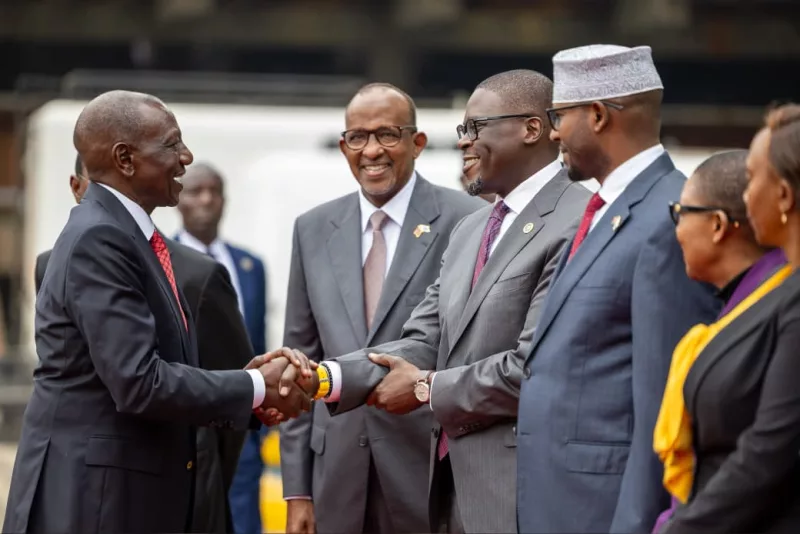
 President William Ruto greets Nairobi Governor Johnson Sakaja during the National Health Summit on August 18, 2026 / PCS
The Kenya Medical Supplies Authority (Kemsa) has received a
Sh10 billion loan to help it buy and stock drugs and other medical supplies in
its stores.
Read Also
The government said the funding would help end shortages of essential medicines and vaccines that have troubled hospitals and clinics across the country for many years.
President William Ruto announced the loan on Tuesday during the opening of the Kenya Health Summit 2026 at the Kenyatta International Convention Centre (KICC) in Nairobi.
The two-day summit, held under the theme Reforms Delivered, Health as a Right, has brought together the national government, all 47 county governments, Members of Parliament, health workers and development partners to assess how far Kenya has come in providing every citizen with access to healthcare.
Ruto said Kemsa used to struggle to supply hospitals with enough medicine, but this had now greatly improved.
He said the government first injected Sh1.5 billion into Kemsa to strengthen it before adding the Sh10 billion loan to ensure the agency could continue buying enough drugs for the whole country.
“Kemsa's order-fill rate has risen from approximately 40 per cent to 91 per cent,” Ruto said. “That is commendable progress, but our destination is 100 per cent, and that is why we have recapitalised Kemsa and extended a credit line to strengthen the supply chain.”
The order-fill rate refers to the proportion of drugs requested by a hospital that are actually delivered. A low rate means patients often miss out on medicines even when they have been ordered.
In his speech, Ruto also said 32.3 million Kenyans were now registered with the Social Health Authority (SHA), up from about eight million under the old NHIF. He added that more than eight million people had already received treatment through the programme.
Health Cabinet Secretary Aden Duale gave more details on how the additional funding had changed operations at Kemsa and how it linked to SHA, the body that manages Taifa Care, the government’s universal health cover programme.
He said Kemsa now supplies more than 11,400 health facilities across the country, with more than half of everything it distributes going to small dispensaries and health centres where most Kenyans seek treatment.
“Today, Kemsa supplies more than 11,400 health facilities, and 54 per cent of everything it distributes goes to primary health care at Level 2 and Level 3, the dispensaries and the health centres, where most Kenyans seek care,” Duale said.
“What this means for the modern Kenya is very simple. The mother who works at a dispensary with a prescription in her hand now finds the medicine at the end of the queue, and not a referral to a chemist she cannot afford.”
Duale also spoke about how SHA is paying for expensive medical equipment in counties that previously did not have it.
He said the government had installed equipment worth Sh9.68 billion in 251 health facilities across 44 counties. The equipment includes CT scan machines, MRI machines, digital X-ray machines and ultrasound machines.
“Not long ago, a Kenyan who needed a CT scan had two options: travel to Nairobi or go without a diagnosis,” Duale said.
“Today, that equipment is available in the great majority of our counties, and it is paid for by Taifa Care, not by the national government and not by our county governments.”
National Assembly Speaker Moses Wetang’ula also addressed the summit, focusing on the laws that made the health reforms possible.
He reminded delegates that Parliament passed four new health laws in 2023, which President Ruto signed on October 19 that year.
These are the Primary Health Care Act, the Facility Improvement Financing Act, the Digital Health Act and the Social Health Insurance Act. Together, they replaced the old National Hospital Insurance Fund (NHIF) with the Social Health Authority.
“Four statutes passed in one session of Parliament was unprecedented,” Wetang’ula said. “It is the most consequential body of social legislation enacted by any Parliament in Kenya since independence.”
Wetang’ula said the reforms did not come without resistance, as some people benefited from the weaknesses of the old system. However, he said most Kenyans supported the changes.
“These four health bills were met with robust public debate. There were those who benefited from the gaps, flaws, and shortcomings of the status quo who did not welcome the reforms,” Wetang’ula said.
The summit continues on Wednesday with sessions on health financing, primary healthcare, the health workforce and digital health. It will close with a Presidential Town Hall, where Kenyans will share their own experiences with the health system.
INSTANT ANALYSIS
The Sh10 billion credit line is a significant attempt to address one of Kenya’s most persistent healthcare problems: medicine shortages in public facilities. Raising Kemsa’s order-fill rate from 40 to 91 per cent suggests meaningful improvement, but the government’s 100 per cent target will test whether the investment can deliver consistently.
The wider reforms also point to a shift towards primary healthcare, with more supplies reaching dispensaries and health centres. However, the real measure of success will be whether patients experience fewer stock-outs and easier access to treatment.