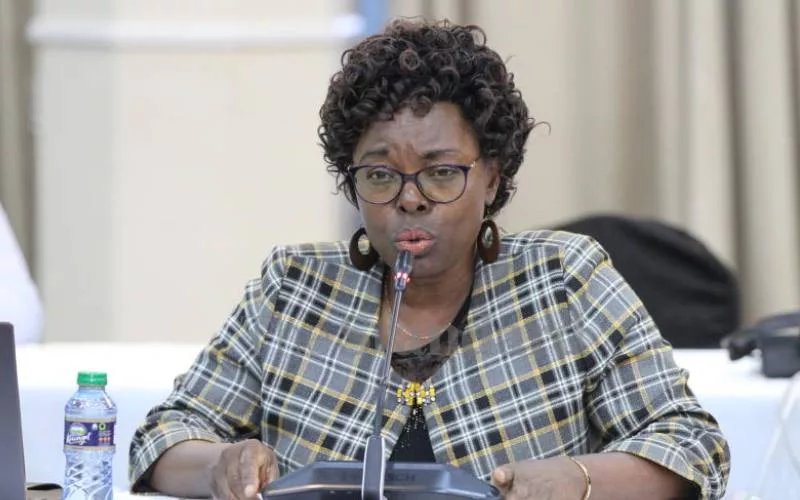
 Controller of Budget Margaret Nyakang'o
MPs have raised concern over the billions of shillings the government pays in commitment fees on loans, some of which are yet to be disbursed.
Controller of Budget Margaret Nyakang’o told MPs the government has spent Sh20.06 billion in commitment fees over the last 10 years, despite a significant portion of the contracted loans remaining undisbursed.
Nyakang’o was appearing before the National Assembly’s Public Debt and Privatisation Committee to account for the amount the country has spent on commitment fees from 2015-16 to 2025-26.
According to Nyakang’o, the government had received Sh764.8 billion in loan disbursements over the period, while another Sh1.277 trillion remained undisbursed but continued to attract commitment fees.
“In total over the 10 years we got Sh20.06 billion as commitment fees. In some cases, commitment fees are paid for loans that have not been disbursed,” Nyakang’o said.
She said the commitment fee alone could pay fees for 627,000 learners in primary school at the current rate of Sh2,020 per learner.
“If we put the Sh20.6 billion to that use (sponsoring primary school learners) we could provide 627,000 primary school learners, that is what we are losing,” Nyakang’o said.
She said the commitment fees have reduced fiscal space, as the recurring fees compete for scarce public resources that could otherwise be allocated to priority programmes and services.
“It is important to point out that commitment fees are not just unavoidable costs but should now be viewed as a symptom of inefficiencies that need to be addressed,” Nyakang'o said.
“The continued incurrence of commitment fees reflects a combination of persistent undisbursed external financing, fiscal constraints, weaknesses in loan and project planning, and operational delays in project implementation.”
The revelations have raised questions among lawmakers over the cost of maintaining loan commitments before the funds are released for use.
MPs questioned why taxpayers should continue paying charges on funds that the government has not received, amid growing pressure to contain public debt and reduce unnecessary expenditure.
Kinangop MP Kwenya Thuku said it was time action was taken against those who commit the government to loans even when the line ministry is not ready for the project.
“The public debt has been a thorn for every Kenyan. We borrow money and still remain in the coffers of lenders and we keep paying commitment fees," he said.
"I’m perturbed by the figures, much as we are pointing out these issues, we have placed the cart before the horse, that is, we commit the money before we study the intended project, we are losing a lot of money.”
“Some of the loans are negotiated even before the feasibility study is done, this must be stopped,” Baringo North MP Joseph Makilap said.
The CoB, in response, explained that the National Treasury negotiates on behalf of the government, but the country’s governance processes have not been watertight.
“There are times that the top people sign for the loans even before the technical people have assessed the project, yet there are a lot of factors that need to be considered. The decision to borrow is done before a cost benefit analysis is done,” she said.
The committee sought further details on the individual loans attracting the fees, the reasons for delays in disbursement and whether the government can renegotiate or cancel facilities that have remained undrawn for extended periods.
Instant Analysis
The committee sought further details on the individual loans attracting the fees, the reasons for delays in disbursement and whether the government can renegotiate or cancel facilities that have remained undrawn for extended periods.