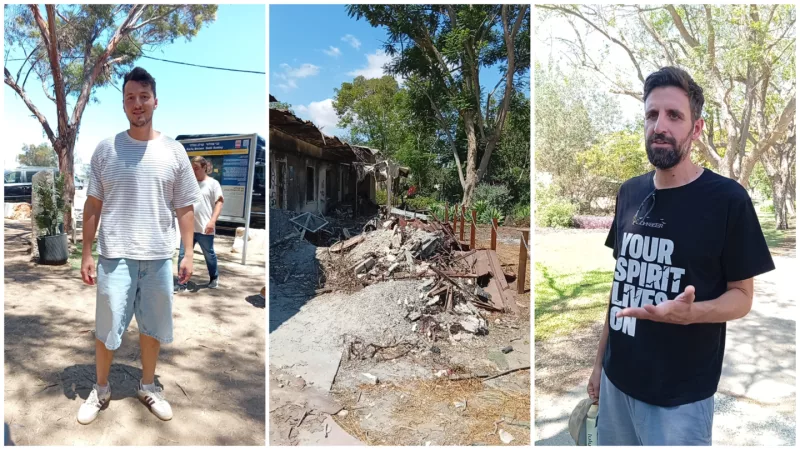
The road to Kibbutz Nir Oz is deceptively peaceful. Nearly 100km south of Jerusalem, neat rows of citrus trees and open farmland stretch towards the Gaza border. From a distance, Nir Oz resembles any other quiet Israeli farming community. Birds still sing. The wind still rustles through the trees. But as I stepped through its gates, it became painfully clear that this was no ordinary village.
The silence was overwhelming. Bullet holes scarred front doors. Windows were shattered by gunfire. Homes stood blackened by flames, their walls frozen in time. Children’s bicycles lay abandoned in courtyards where laughter once echoed. Family photographs still clung to smoke-stained walls, silent reminders of lives forever changed.
Every building told a story. Every doorway carried the scars of October 7, 2023.
It was here that I met Barak Morag. Standing outside what remained of his home, Morag spoke calmly, though the memories remain anything but.
Speaking to the Star, he recalled how his family rushed into the reinforced safe room as rocket sirens pierced the early morning sky. At first, they believed it was another rocket attack, something Israelis living near the Gaza border had learned to endure.
“We heard the sirens and locked ourselves inside,” he said.
But this time was different. Armed Hamas militants entered the kibbutz. They moved from house to house, fired at doors, shattered windows and set homes ablaze.
Trapped inside the safe room with his wife and children, Morag listened as gunfire echoed through the neighbourhood. His wife had insisted years earlier on installing an extra bolt on the safe-room door, a decision he believes saved their lives.
Inside the reinforced safe room, known in Israel as a mamad, they waited, convinced that the thick concrete walls would shield them until the rocket attack ended. For families living near the Gaza border, these rooms are built into homes as protection against years of cross-border rocket fire.
But October 7 was unlike anything they had prepared for. Soon, the sounds outside changed. The distant explosions were replaced by footsteps. Voices. Then bursts of automatic gunfire.
From inside the sealed room, Barak could hear armed men moving through the house.
“They tried to convince us to come out,” he recalled. “They told us they wouldn’t hurt us.”
His family remained silent. Moments later, smoke began seeping beneath the safe-room door. The attackers had set the house on fire.
As thick smoke filled the room, survival became a race against time. His children repeatedly drifted in and out of consciousness from smoke inhalation.
“My wife and I kept waking them up,” Barak said. “Every time they closed their eyes, we feared they would never wake up again.”
Hours later, Israeli soldiers reached the neighbourhood and rescued the family. But for Barak, escape was only the beginning of another nightmare. His father-in-law and brother-in-law were missing.
For weeks, the family believed they had been taken hostage into Gaza. Then came the devastating confirmation: both had been killed during the attack, their remains identified weeks later.
“I walked out with only my family, my phone, a T-shirt and my boxers,” Barak said. “Everything else was gone.”
Walking through Nir Oz felt less like visiting a village and more like entering a museum of grief. Every house carried its own story. Some had Israeli flags tied to broken fences.
Others displayed photographs of residents who were killed or kidnapped. Burnt furniture remained untouched. Charred kitchens stood frozen in time. The silence was overwhelming. Only birds interrupted the stillness.
Yet behind every damaged doorway lived a memory of courage, survival or unimaginable loss.
FROZEN FESTIVAL
As I walked through the deserted kibbutz, I kept wondering: How could an entire community be overwhelmed within hours?
The answer, I would later discover, lay just a few kilometres away. About two kilometres from the Gaza border, thousands of young people had gathered overnight to celebrate life at the Nova Music Festival.
While families in Nir Oz were barricading themselves inside reinforced safe rooms, music was still playing in the desert.
Neither group knew that within minutes, their lives would become forever intertwined by the same attack.
The drive from Nir Oz to the Nova Music Festival memorial is short. Emotionally, it feels endless.
As our vehicle wound through the quiet roads of southern Israel, the landscape remained almost unchanged. Endless farmland stretched towards the horizon. Fields of wheat swayed gently under the summer breeze.
It was difficult to believe that less than three years earlier, these same roads had become escape routes for thousands of terrified young people running for their lives.
Then the memorial appeared, hundreds of photographs, Israeli flags, fresh flowers, burning candles. Wooden plaques carrying names, dreams and birthdays that would never again be celebrated.
The music had been replaced by silence. Every portrait smiled back at visitors, capturing moments before October 7 forever changed the lives of their families.
Standing among those photographs was Atir Vinnikov, one of the survivors who had returned to the place where he almost lost his life.
Atir chose to come back not to relive his trauma but to ensure the world understood what happened there.
The 25-year-old paused repeatedly during the interview as he looked across the memorial.
“Everything you see today was different,” he said. “There were no paved roads, no memorials, no photographs. It was just one huge festival ground filled with music.”
He had arrived shortly after 1am with 20 friends.
Like thousands of others, he had travelled to Nova for one final celebration before beginning a new chapter of life.
“I wasn’t even a festival person,” he laughed softly. “My friends convinced me to come.”
They danced. They laughed. They watched strangers become friends under the desert sky.
Nobody imagined the sunrise would become one of the darkest mornings in Israeli history.
At exactly 6.31am, the music stopped. Festival security interrupted the celebration, warning everyone that rockets had been launched from Gaza.
For most Israelis present, rocket alarms were sadly familiar.
At first, nobody panicked. “We thought it was another rocket attack,” Atir recalled.
Some people even shouted at organisers, demanding refunds after the music was stopped.
NO ORDINARY ATTACK
Within minutes, however, the explosions intensified. Hundreds of rockets streaked across the sky as Israel’s Iron Dome intercepted many of them overhead.
Fear slowly replaced confusion. Thousands rushed towards their vehicles. Roads quickly became paralysed by traffic.
Then came the first whispers. Someone had been shot. Another was desperately sharing her location, begging friends to rescue her.
That was the moment Atir realised this was no ordinary rocket attack. As vehicles stood motionless, he stepped onto the road and saw young men and women lying wounded, receiving emergency first aid.
Before he could fully process what was happening, a police officer staggered past.
His uniform was soaked in blood. Bullet wounds covered his chest.
With the little strength he had left, the officer screamed one desperate command.
“Run east... into the fields!”
For Atir, years of military training immediately took over.
The moment his feet touched the dry desert soil, bursts of automatic gunfire erupted behind him.
Turning around, he saw armed Hamas fighters advancing towards the festival, firing relentlessly into crowds of fleeing civilians.
Within seconds, survival instincts replaced celebration. Cars were abandoned. Phones were left behind. Shoes, bags and tents remained scattered across the festival grounds.
Everything that had mattered only minutes earlier became meaningless. Life itself became the only priority.
Running through the open fields under the scorching October sun, Atir and one of his closest friends from the military covered nearly 8km without knowing where safety lay.
Behind them, gunfire continued. Ahead of them stretched nothing but dry farmland.
As exhaustion and dehydration set in, another battle began. Finding water.
“We had been dancing all night,” he recalled. “The sun was already high. We knew if we collapsed from dehydration, nobody would find us.”
Then came what Atir still describes as a miracle. In the distance stood a small agricultural farm. At first, they hesitated.
Workers with their faces covered appeared through the heat haze. For a terrifying moment, they believed they had found more attackers. Instead, they found salvation.
An Israeli Bedouin farmer named Yunus welcomed the terrified strangers inside without hesitation. He offered them water, fruit and a place to breathe.
For the first time since sunrise, hope returned. It lasted only minutes. Suddenly, Yunus burst into the room.
“They’re here!” he shouted. Outside, armed Hamas fighters had reached the farm.
There was nowhere left to run.
The eight survivors squeezed beneath the raised foundations of the building, pressing themselves into the dirt as footsteps echoed above them.
Atir could hear angry voices shouting repeatedly in Arabic. The demand was unmistakable. “Bring out the Jews.”
What happened next still leaves him searching for words. Yunus, a man who had met the survivors barely an hour earlier, stood between them and death.
Risking his own life, he repeatedly insisted there were no Jews on the property.
For more than 10 agonising minutes, he argued with the gunmen while the terrified group remained hidden beneath the floorboards, scarcely daring to breathe. Against all odds, the attackers eventually left.
To this day, Atir believes Yunus’s courage saved eight lives.
“I still struggle to understand it,” he told me quietly. “He had five children waiting for him at home, but he chose to protect complete strangers.”
REGIONAL WAR
As he finished speaking, silence returned to the memorial. Around us, families continued placing flowers beneath photographs of sons, daughters, brothers and sisters who never escaped the festival grounds.
According to Israeli authorities, 378 people were killed at the Nova Music Festival, while dozens were abducted and taken into Gaza.
Standing there, I realised Nova is no longer just a place. It has become a symbol. A place where music gave way to mourning. Where sunrise became synonymous with loss. And where the memories of those who survived echo long after the last song faded into silence.
For survivors like Barak and Atir, October 7 is remembered through deeply personal moments of fear and loss. For Israeli officials, however, the attack also reshaped the country’s military and political outlook.
Seeking answers beyond the survivors’ accounts, I later spoke to Eylon Levy, the former spokesperson of Israeli Prime Minister Benjamin Netanyahu.
Levy argued that the October 7 assault was intended to achieve far more than a single cross-border raid.
“The goal was not to raid Israeli villages, kill people and then return to Gaza,” he said. “It was to trigger a much wider regional war that would ultimately destroy Israel.”
Levy described Hamas as a militant Islamist group whose objective, he said, extended beyond the attacks carried out that morning.
His remarks reflect the Israeli government’s longstanding position that the October 7 assault fundamentally changed the country’s security calculations and marked a turning point in the conflict.
Within hours of the attack, Israel declared war on Hamas, saying its objective was to dismantle the group’s military capabilities, recover hostages taken into Gaza and prevent another attack of similar scale.
The ensuing war has transformed Gaza into one of the world’s most devastated conflict zones. According to Gaza health authorities, tens of thousands of Palestinians have been killed since the war began, while the conflict has displaced much of the population and triggered a severe humanitarian crisis.
While a fragile cease-fire took effect in October and all living and dead hostages have been recovered, near-daily Israeli military strikes and exchanges persist, worsening the humanitarian situation.
For the survivors I met, however, geopolitics often felt secondary.
Barak still remembers the smoke that seeped beneath the safe-room door.
Atir still remembers running across open fields as bullets tore through the morning air.
For both men, October 7 is not measured by military operations or political statements.
It is measured by the loved ones who never came home.
As I drove back towards Jerusalem, the desert stretched endlessly beneath the evening sun.
The same roads that had carried festival-goers to a night of music now lead visitors to memorials. The same villages that once echoed with children’s laughter now stand scarred by bullet holes and fire.
Perhaps that is the deepest wound October 7 left behind. Not only the buildings it destroyed but also the ordinary lives it changed forever.