
It is barely 6 am on “Pewa Street” in Nairobi’s Umoja estate, a street famous for having more than 200 wines and spirits outlets and dingy bars in a stretch of 300 metres, but the alley is already alive with a desperate queue.
Young men, their eyes bloodshot and shoulders hunched against the morning chill, line up outside a cramped liquor store waiting for their first drink of the day.
Peter*, 28, stands near the front. His hands shake until he receives a Sh20 tot of clear spirit poured into a flimsy plastic tumbler. He downs it in one gulp.
“I cannot function without this,” he mumbles. “I earn about Sh300 a day carrying luggage at Umoja Market. We cannot afford drinks in the bar, so we come here for what we can afford.”
Nearby, a young man lies motionless on the pavement, wrapped in a faded jacket after a night of drinking.
These are the casualties of Kenya’s vast multibillion-shilling underground alcohol economy, a shadow market that is generating billions for rogue operators while leaving behind addiction, illness, sometimes death, lost revenue and unfair competition for legitimate manufacturers.
Kenya’s illicit alcohol market has evolved from traditional informal brews into an organised network involving counterfeit and illicit spirits, smuggled ethanol, tax-leaked production and dangerous home brews.
Illicit alcohol means any alcoholic beverage produced, sold, distributed or smuggled outside of government rules, legal manufacturing standards, and tax laws.
A 2025 Euromonitor International study commissioned by the Alcoholic Beverages Association of Kenya, and cited by the Anti-Counterfeit Authority, found illicit alcohol accounted for 60 per cent of Kenya’s alcohol market by volume in 2024.
This was up from 59 per cent in 2022. Between 2022 and 2024, illicit alcohol volumes grew 27 per cent.
The shadow sector is estimated at Sh203 billion and cost the National Treasury about Sh120 billion in lost fiscal revenue in 2024, going into 2025. Illegal artisanal brews alone accounted for an estimated Sh72 billion to Sh80.7 billion in tax leakage.
“The problem of substandard, counterfeit and unsafe alcoholic beverages is significant, and apart from the industry, the impact on government revenue has been dire,” Kenya Association of Manufacturers chief executive Tobias Alando says.
ACA data shows alcoholic beverages have a 19 per cent counterfeit prevalence rate, second only to automotive spare parts at 21 per cent.
Consumer perception of counterfeit products is also high, with wine at 50.12 per cent, beer 47.44 per cent, whiskey 42.68 per cent and vodka 36.95 per cent.
According to ACA chief executive Robi Mbugua, the illegal market operates through several channels, including under-declared production by licensed manufacturers, counterfeit brands and smuggled alcohol.
Counterfeiters collect genuine bottles, replicate labels and security seals and clone Kenya Revenue Authority tax stamps before filling them with cheap or dangerous liquor.
Kariobangi Light Industries has emerged as a key Nairobi hub, where authorities have repeatedly uncovered illegal distilleries, counterfeit labels, fake stamps and stockpiles of discarded branded bottles.
Smuggled ethanol feeds these operations. Authorities have identified routes through Isebania and Shimoni on the Kenya-Tanzania border, Mbale, Lwakhakha and Busia on the Uganda border, and Moyale on the Ethiopian frontier.
Smugglers reportedly hide 200-litre drums and jerrycans in cargo, use motorbikes on unmonitored routes or make false declarations at official border posts.
The economics are compelling. Undenatured ethanol costs about $1 (Sh129) per litre in Kenya because of excise taxes, compared with about $0.30 (Sh38) in Uganda for instance.
The price gap gives criminal networks an incentive to move cheap ethanol across borders, process it illegally and sell it below the price of legitimate products.
The trade has also moved online, with counterfeit alcohol marketed through social media and encrypted WhatsApp groups.
One of the biggest threats to legitimate manufacturers is the illegal reuse of genuine branded bottles.
“Unscrupulous bar operators, backyard distillers and criminal networks purchase or collect empty branded bottles from entertainment venues,” Alando says. “The bottles are washed, refilled with cheap liquor or industrial-grade ethanol, and sealed with fake tax stamps.”
The use of genuine packaging makes the fraud particularly difficult for consumers to detect and leaves legitimate brands exposed to reputational damage.
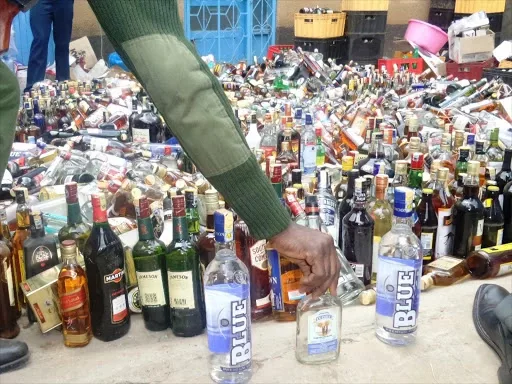
Recent multi-agency operations have uncovered illegal packaging plants holding hundreds of empty branded spirits bottles intended for refilling.
The crisis is amplified by poverty and the affordability of illicit alcohol.
Official data shows 4.7 million Kenyans aged 15 to 65 use substances, while 3.2 million regularly consume alcohol.
Euromonitor found illicit alcohol sells between 10 and 80 per cent below legal products, with mainstream illicit spirits up to 38 per cent cheaper.
Ninety-four per cent of consumers surveyed considered illicit alcohol cheaper, while 74 per cent identified price as their main reason for buying it.
Retail Trade Association of Kenya chief executive Wambui Mbarire says taxation has unintentionally pushed consumers towards the underground market.
“Repeated tax increases on alcohol have created a situation where nearly half, about 44 per cent, of all alcohol consumed in Kenya is now illicit,” Mbarire says. “When you price legal alcohol beyond the reach of low-income earners, demand does not vanish. It simply migrates to untaxed, dangerous alternatives.”
Alando echoed these sentiments, saying legitimate manufacturers face excise taxes, licensing fees and compliance costs that illegal operators avoid.
“This is not just about counterfeit products; it is about a fundamentally uneven operating environment,” he said.
The formal alcohol industry contributes 2.27 per cent of total exchequer excise revenue and supports an estimated 400,000 direct and indirect jobs across agriculture, logistics, packaging and retail.
Kenya exported $8.6 million (about Sh1.1 billion) worth of alcoholic beverages in 2025 to EAC, COMESA and SADC markets.
Behind the economic figures is an even darker human cost.
The World Health Organization estimates alcohol consumption kills at least 14,000 Kenyans every year through non-communicable diseases, traffic crashes, violence and acute toxicity.
A Nairobi-based public health expert and consultant physician says hospitals are increasingly confronted with severe emergencies associated with dangerous alcohol.
“Adulterants like industrial methanol are absorbed rapidly. Methanol metabolises into formic acid, a potent toxin that attacks the optic nerve, causing permanent blindness and destroys kidney and liver tissues within hours,” the expert said.
Consumer advocates say the poor are bearing the greatest burden.
“Over 50 per cent of alcohol outlets sell fake or adulterated brews,” said the Consumer Federation of Kenya secretary general Stephen Mutoro. “These drinks are repackaged into sachets and recycled bottles bearing the logos of well-known brewers and sold to unsuspecting buyers living below the poverty line.”
Euromonitor found 61 per cent of consumers surveyed identified bodily harm and health risks as the primary impact of illicit alcohol, while 27 per cent cited death.
The problem is increasingly spilling into international markets.
In July, the United Kingdom issued a travel advisory urging citizens visiting Kenya to avoid homemade, unsealed or unusually cheap alcoholic drinks and to buy alcohol only from trusted, licensed outlets.
On August 5, Rwanda’s Food and Drugs Authority announced a temporary suspension and recall of five Kenyan alcoholic beverage brands.
The development has raised concerns over Kenya’s export reputation, even as legitimate manufacturers and regulators defend the safety of compliant products.
East African Breweries PLC said product safety and quality are its highest priorities and that its products undergo rigorous testing and verification. The company said it was engaging the Rwanda FDA over the concerns.
"EABL operates robust quality assurance and food safety management systems across our supply chain. Our products undergo rigorous testing and verification processes,” it said.
The Kenya Bureau of Standards said targeted factory audits and laboratory tests conducted between August 7 and 10 showed the five affected brands complied with applicable East African standards.
KEBS managing director Esther Ngari said Kenya currently has 42 certified alcoholic beverage firms covering 281 products.
“Certification requires rigorous factory inspections and laboratory testing before issuing the Standardization Mark,” Ngari said, adding that compliance is monitored through unannounced factory visits, batch testing and market surveillance.
In the 2024-25 financial year, KEBS sampled and tested 69 potable spirit products, all of which met safety standards.
The regulator said the most common non-compliances among legal manufacturers involved ethanol-content variations and labelling errors rather than toxic contamination. Most tested products passed methanol safety parameters.
For serious violations, KEBS can suspend certification, order recalls, close facilities and initiate prosecution.
Meanwhile, multi-agency teams involving police, the Directorate of Criminal Investigations, KRA, ACA, KEBS and NACADA continue raids against illicit distilleries and illegal stocks.
KRA has urged consumers to verify excise stamps through mobile tracking tools and report suspected illicit operators.
But enforcement agencies face a formidable challenge with industry saying Kenya cannot raid its way out of a Sh203 billion market.
Sector players, regulators and consumer groups argue that the response must combine enforcement with structural reforms.
A key proposal is an integrated traceability system linking ACA’s recordation platform with KRA’s iCMS, KEBS conformity databases, KIPI’s intellectual-property register, NACADA licensing systems and county business permits.
Smartphone-based track-and-trace technology, which are in place, could allow consumers to verify tax stamps instantly.
Authorities also need tighter monitoring of undenatured industrial ethanol from sugar millers through transport and border entry points, while East African Community countries could harmonise tax policies to reduce price arbitrage, industry players say.
They have also proposed joint intelligence units and body-worn cameras for enforcement officers at high-risk border posts including Busia, Malaba, Namanga, Lunga Lunga, Moyale and Isibania.
The focus, they argue, must move beyond street vendors and distillers to the financiers, chemical suppliers, packaging recyclers and masterminds who make the business profitable.
Until Kenya closes the price gap between legal and illicit alcohol, seals porous borders, strengthens product traceability and dismantles organised counterfeiting networks, vulnerable consumers will remain exposed, experts say.







