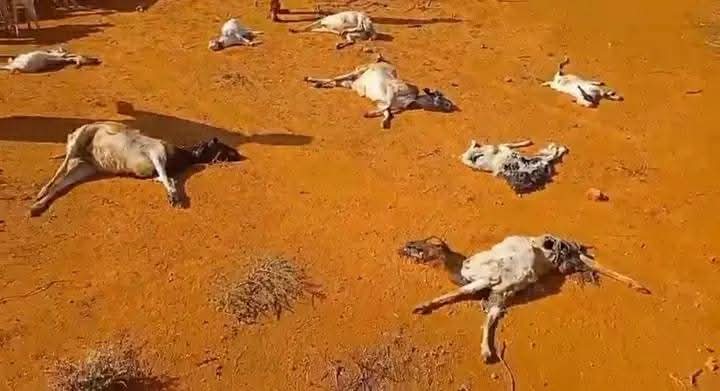
 Carcasses of goats and sheep lie across arid rangelands in Wajir county, reflecting the heavy livestock losses and deepening livelihood crisis caused by the prolonged drought /KNA
Kenya's arid and semi-arid lands cover some 489,000 square kilometres - more than 80 per cent of the country's landmass and home to 36 per cent of its people.
It is the largest asset the republic owns, and almost none of it has a price, because almost none of it has a title.
Every investment
pitch for the North eventually runs into that same wall. A developer wants a
wind farm, a mineral processing plant, a carbon project with a 30-year lease,
and each needs the one thing the North cannot readily supply: a landowner with
a title deed to sign. Without a clear owner, there is no collateral, and
without collateral no bankable project.
The 2010 Constitution recognised community land as one of Kenya's three forms of tenure, equal to public and private land, and the Community Land Act of 2016 gave it effect.
Communities would map their boundaries, elect management committees and receive collective title. Roughly two-thirds of Kenya's landmass is community land, home to some of its poorest citizens, and for the first time their claim to it would be as solid as a Nairobi title deed.
A decade later, that promise is largely unkept. By most estimates, only about 15 per cent of community land has been registered. The Ministry of Lands, which in 2019 set itself the goal of documenting all community land by the end of 2024, has quietly let the deadline slip.
Progress is real but slow - 60 title deeds in Samburu East, half a million hectares (1.23 million acres) still in process in Samburu North - drops against a drought.
The carbon market, potentially the north's most valuable new export, turns on exactly this question of who holds the land - and the danger is no longer hypothetical. In January 2025, the Environment and Land Court shut down two of the Northern Rangelands Trust's conservancies in Isiolo.
It ruled in favour of 165 pastoralists, saying the conservancies had been established on unregistered community land without consent - a judgment that imperils the world's largest soil-carbon project.
Months later, it voided the 76,602-acre Kamuthe conservancy in Garissa on the same grounds. Where title is unclear, even well-financed projects are built on sand.
This injustice reaches into the towns too. In Garissa, Wajir, Mandera, Marsabit and Moyale, families have built homes and businesses over generations on land that was never formally adjudicated, and so hold allotment letters, or nothing.
By contrast, a resident of Nakuru or Nyeri would hold freehold title. The plot is theirs in every practical sense but the one a bank recognises.
A trader cannot pledge his shop to expand it; a landlord cannot realise the value of a building whose ground is legally undefined. The same asset that anchors a mortgage in a town in other parts of Kenya is dead capital in a northern one.
That this pattern tracks so precisely onto the region marginalised for 60 years is hard to read as coincidence: adjudication reached the high-potential areas decades ago and has still not arrived in the North!
Why has so little moved? Part is capacity: registration is painstaking, county land offices thinly staffed, and demarcating one community's boundaries can take years of disputed edges.
Part is design, the Act requiring communities to formally constitute themselves before they can register. But part is a vacuum of leadership. W
here national and county authorities have offered little guidance, the process has been left open to infighting among community factions and to local elites bent on skewing registration for private gain at the expense of the majority pastoralists.
And part, one suspects, is will: unregistered land is held in trust by county governments, which may lease and earn from it meanwhile. Untitled land is a resource some would rather manage than surrender.
Yet there is a ready remedy. Fund registration as national infrastructure, because that is what it is: mass demarcation, staffed county land offices, and the geo-referencing the ministry has begun.
Extend adjudication to the Asal towns and convert long-standing allotment letters into freehold title, so the urban plot becomes bankable. Simplify the path from community formation to title, so a claim does not die in procedure.
And make free, prior and informed consent a hard condition of every lease on community land, carbon projects included.
It is tempting to see titling as a technicality, the housekeeping that can wait behind the wind farms and pipelines. It is the opposite: the foundation stone.
Every argument about northern potential - energy, minerals, gums and resins, carbon, tourism - assumes someone can lawfully own, pledge and benefit from the land beneath the opportunity.
Until the communities of the north hold title to their own ground, they will keep watching investors arrive, survey the possibilities, and leave for somewhere the paperwork exists.
Land, in Kenya, has always been an instrument of power as much as a means of livelihood, and the North has been on the losing side of it for 60 years.
A country cannot ask capital to build on ground it refuses to let anyone own. The North does not need another promise. It needs the one already made in 2010, and again in 2016, finally kept.
Dr Abduba Ido is a governance, management and institutional development specialist with a focus on ASAL development ([email protected])