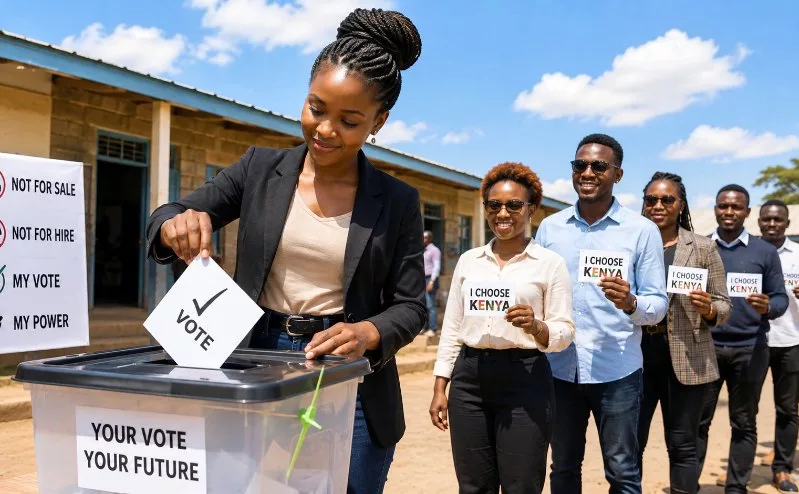
Perhaps the greatest political revolution taking place in Kenya is not happening in Parliament, in courtrooms or even on the streets. It is happening in the mind of the Kenyan voter.
For decades, Kenya’s political class has operated on one dangerous assumption: that every Kenyan has a price. That if you are poor enough, desperate enough or forgotten enough, your vote can be bought.
Every election season, the script remains painfully familiar. A few notes exchanged in a crowd. A branded T-shirt. A mattress. A gas cooker. A pair of shoes. The gifts change but the message remains the same: Your vote is for sale.
It is one of the greatest insults ever directed at the Kenyan people. Because beneath every handout lies an assumption that is far more offensive than the gift itself. It says, “We do not believe you can think for yourself.” It says your convictions can be bought, your dignity negotiated and your future discounted.
But something is changing, and undeniably so. We saw it in Ol Kalou. There were campaign ‘gifts’ in the form of mattresses, shoes, gas cookers. There were promises, and there was money.
Yet when voters walked behind the secrecy of the ballot, many left the politics of patronage outside and voted according to their conscience. The ballot proved more valuable than the handout. That should concern every politician who has built a career on the belief that loyalty can be purchased. That is not just an election result, it is a mindset shift.
It tells us that a growing number of Kenyans are beginning to separate charity from choice, gifts from governance and campaigns from conviction. They understand that accepting a ‘gift’ does not mean surrendering their independence; that a vote belongs to the voter alone. And perhaps that is the beginning of a more mature democracy.
The same shift is visible elsewhere. Look at the Linda Mwananchi movement. Look at Edwin Sifuna’s rallies. Instead of the familiar image of politicians digging into deep pockets to attract supporters, Kenyans have been reaching into their own pockets to contribute to a cause they believe in. Ten shillings. Fifty shillings. One hundred shillings. Whatever they can afford. At one rally, supporters publicly walked up and handed Sifuna campaign contributions in full view of everyone.
Pause and think about what that means. For decades, money flowed in one direction: from politicians to voters. Today, many Kenyans are saying something radically different: we will finance the politics we believe in. That is more than fundraising; it is a psychological revolution.
It says the voter no longer wants to be bought. The voter wants ownership. Citizens are no longer waiting for wealthy political patrons to finance change; they are choosing to invest in it themselves.
That is how democracies grow.
The tragedy is that parts of the political class still have not noticed that the country is changing. They are still asking Kenyans to exchange five years of governance for gifts that may not last five months.
Think about that. This nation was not handed to us. It was paid for. Paid for by those who stood before us. Our ancestors whose blood, sweat, tears and dignity became the foundation upon which we stand as free citizens today. They resisted colonial rule. They endured detention, torture, humiliation and death so that one day, a Kenyan would walk into a polling station owing allegiance to no king, no coloniser and no politician.
That is the inheritance they left us.
So imagine the arrogance. Imagine the sheer contempt it takes for a leader to believe that a Kenyan will betray that inheritance for a handout. Imagine believing that the sacrifices of those who came before us, the very people whose courage secured our right to choose our own leaders, can be exchanged for a mattress, a gas cooker or a pair of shoes that will probably not survive the year.
It is the ultimate insult to the electorate. It insults not only those casting the ballot today, but also the men and women whose sacrifices made that ballot possible. Perhaps that is why the old formula is beginning to fail. The Kenyan voter is changing.
People are beginning to understand that leaders are not benefactors, they are public servants. Development is not a favour bestowed during campaigns, it is an obligation paid for by taxpayers. Public money is not personal generosity, it belongs to the people.
Most importantly, Kenyans are beginning to understand that a vote is not a commodity, it is power. Power to determine whether hospitals function or fail. Whether schools educate or neglect. Whether corruption is rewarded or punished. Whether our children inherit opportunity or disappointment.
That power is simply too valuable to exchange for temporary gifts. No mattress can secure your child’s future. No gas cooker can fix a broken healthcare system. No pair of shoes can build a functioning economy. No envelope of cash can compensate for five years of failed leadership.
The Kenyan voter is beginning to understand this truth. That is why the greatest political contest in this country is no longer between parties or personalities. It is between two ideas: the old politics of patronage and the new politics of principle.
One believes citizens can be bought. The other believes citizens can think. The signs suggest that, slowly but surely, Kenyans are choosing the latter.
That should encourage every believer in democracy, and terrify every politician who still mistakes poverty for ignorance. Because once a people understand the true value of their vote, it becomes almost impossible to buy it. And perhaps that will be Kenya’s greatest political victory of all: not the election of one leader over another, but the emergence of an electorate that finally knows its worth.