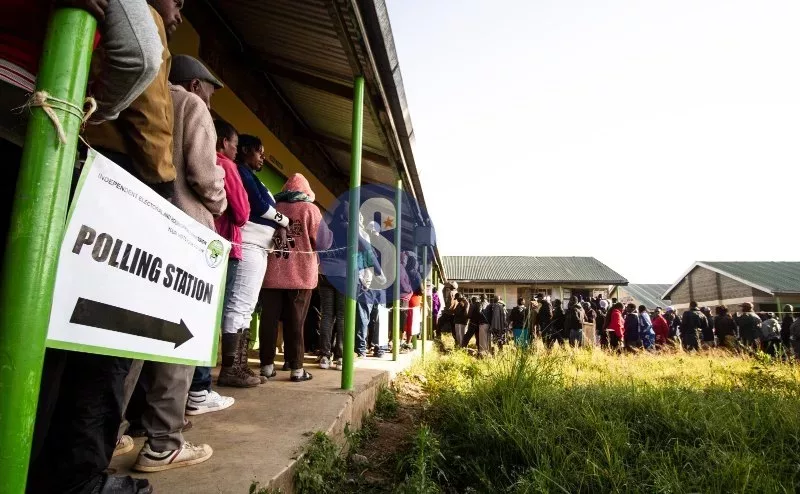
 Voters queue at one of the polling stations during the Ol Kalou by-election in Nyandarua county on July 16, 2026
Of course, this is about Justice Mugure Thande’s decision that there ought to have been elections on Tuesday this week, August 11.
Consider the following statements, deliberately not involving the constitution. Assuming each statement (obviously not by the same person) was made on August 1 this year, what did the word “year” or “years” mean in each statement?
“We are planning to have our wedding in June next year.”
Today is our wedding anniversary; we are celebrating 20 years of marriage.”
Clearly the first speaker was referring to the year 2027. That can be called a “calendar year” meaning one beginning on the first day of the year according to the specific calendar the country or community uses, and running to its last day – in our case running from January 1 to December 31. Let’s call this “the first sense”.
The second speaker referred to a period of 20 years. Each of those 20 years comprised 365 days (366 when a leap year was involved), running from August 1 to August 1 and together they amounted to a time period of 20 years from August 1, 2006 to the same date in 2026.
The law
Turning to election dates: the relevant constitutional provision is Article 101(1): “A general election of members of Parliament shall be held on the second Tuesday in August in every fifth year”. All other elections are supposed to be on the same day (we need not worry here about the few possible exceptions).
What do you think is a “year” in the phrase “in every fifth year”? As a matter of common sense, it must mean year in the first sense – that is a calendar year like 2026.
Just as there is an election for the American House of Representatives in November this year, after one in 2024, because their constitution says “The House of Representatives shall be composed of Members chosen every second Year”.
Yet Justice Thande decided that the fifth year will end at the last moment of August 8, 2027. Earlier cases have used similar reasoning, equally wrongly in my view. How did lawyers and judges manage so to scramble the straightforward language of Article 101(1)? And is it a problem?
The problems
The case leaves us with at least three problems (not including the very considerable cost of having elections more frequently). Firstly, the court’s reading of the constitution does not correspond to what people reading the constitution would understand it to mean. And those who voted for the constitution in the 2010 referendum surely had the same impression.
Secondly, the practical result of the court’s reasoning would be that elections will not (usually) take place when the drafters of the constitution clearly intended.
Justice Thande suspended her judgment until after the next election which will surely be held on August 10, 2027. However, the third problem is that - if her reasoning is applied in future - the following four elections would be held in 2031, 2035, 2039 and 2044. Y
ou will immediately see that the intervals between elections would be four years except between 2039 and 2044 when it would be five years. This would be the pattern into the future: generally we would have elections every four years, but occasionally only after five years.
This is because the date on a second Tuesday in August may be anything between eighth and 14th, and in most years has a lower date number than in the previous year. In 2030 to 2034 second Tuesdays will be successively the 13th, 12th, 10th, ninth and August 8.
To confuse you further: in 2031 the election date would be August 12th and in 2036 (five years on) the second Tuesday in August will also be 12th but the election would have to be held in 2035 because the fifth year in Justice Thande’s reckoning will have ended at midnight, the moment August 12, 2036 began.
How did the court get here?
To repeat: for Justice Thande the fifth year after the 2022 election is not simply 2027 but ninth 2026 to midnight on August 8, 2027. The second Tuesday in August in 2027 will be August 10th (24 hours outside the fifth year according to the judge’s definition of “year”). The only second Tuesday in August within the fifth year was for her August 11,2026.
The source of this scrambled concept of a year according to some lawyers (some for political reasons) and judges (hopefully not for political reasons) is Article 259(5). “In calculating time between two events for any purpose under this constitution, if the time is expressed … as years, the period of time ends at the beginning of the date of the relevant year that corresponds to the date on which the period began.”
Why is this in the constitution? The constitution uses “year” in the second sense – that is a period of time measured in years – in many contexts. It might be how long a person wanting to take Kenyan nationality has been married to a Kenyan, or how long ago they committed a criminal offence that stands in the way of their doing something such as registering as a voter. It may be necessary to know exactly when the period ended. That is what Article 259(5) is for.
But the constitution drafters used another – perfectly clear - technique to say when elections are to be held, using the first meaning of “year”. Article 259(5) is irrelevant. The drafters did not foresee the perverse interpretations to come, or they would probably have follow the Canadian example and use the word “calendar” before “year” when specifying election dates.
Legislative history
The task of interpretation of any law is to decide what was intended. The old constitution said “Parliament, unless sooner dissolved, shall continue for five years from the date when the National Assembly first meets.”
It is legitimate to look at documents reflecting the decisions on law, like the proceedings of the Bomas National Constitutional Conference and reports of constitution making agencies, to decide what was intended in the new Constitution.
The phrase “every fifth year” appeared first in the Bomas draft in 2004. Not then, nor at any later time, was there any indication of an intention to depart from the familiar five year electoral cycle. Indeed it was intended to be more firmly established because governments would no longer be able to dissolve Parliament prematurely. “The life of each House of Parliament is five years from the date of its first sitting after an election,” the Bomas Draft also said.
Article 177(4): “A county assembly is elected for a term of five years”, has been there ever since the Bomas draft. It surely indicates an assumption on the part of the constitution makers that elections would normally be held every five years.
The nonsense of elections sometimes being after four years and sometimes after five ought to have made those judges and lawyers think hard about whether this is what the drafters intended.
Finally
It’s regrettable that apparently the lawyers for government agencies were unable to see - or to get across to the judge - the common sense meaning. Somehow lawyers can look for complex meanings as though they are somehow more “legal”.
And – as Senator Okiya Omtatah has said - regrettable that no-one seems to have realised that a case he brought in 2018 was dismissed because the issue had already been decided in court. However, those earlier cases had similar muddled thinking including one in the Court of Appeal (cited by Justice Thande).
A final thought: the 2013 election was correctly timed according to the Constitution; the 2017 election ought to have been in 2018.