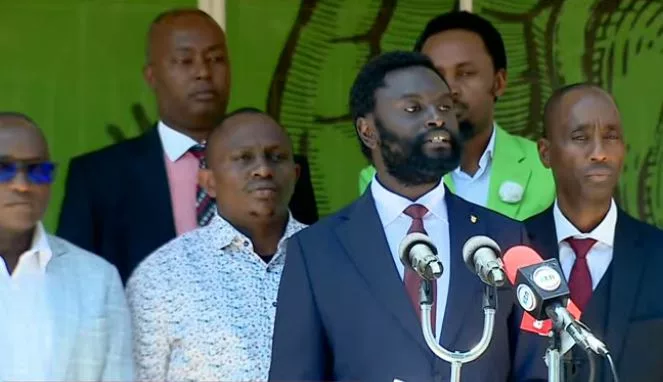
 Nyandarua Senator John Methu speaks at the DCP party HQ in Nairobi on August 13, 2026./SCREENGRAB
Nyandarua Senator John Methu has challenged President William Ruto to publish a detailed scorecard showing what his administration has delivered since taking power in 2022.
Speaking on Thursday at the DCP headquarters in Nairobi, Methu questioned whether the promises made to Kenyans have translated into measurable improvements in their lives.
Methu asked the President to identify at least one of the promises made during the 2022 election campaign that has been delivered after four years.
“Of all the promises William Ruto made to Kenyans in 2022, which one, just one, has been delivered after four years? Publish the scorecard,” Methu said.
He further challenged the administration to demonstrate what ordinary Kenyans have gained from its policies and programmes.
“If Ruto deserves another term, what measurable improvement has the ordinary Kenyan seen?” he asked.
Methu’s remarks come amid renewed debate over the performance of the Kenya Kwanza administration ahead of the 2027 General Election.
Ruto’s administration has previously published its own performance scorecards highlighting achievements under the Bottom-Up Economic Transformation Agenda (BETA).
A government scorecard covering the first three years of the administration cited progress in areas including affordable housing, overseas jobs, road construction, social protection and SHA registration. (Government Delivery Unit)
The President has also recently highlighted what he describes as improvements in Kenya’s macroeconomic position, including lower inflation, stronger foreign exchange reserves and reduced borrowing costs.
In a July 2026 address, Ruto also pointed to foreign direct investment and Kenya’s competitiveness ranking as indicators of progress since 2022.
Deputy President Kithure Kindiki, while speaking during the launch of the National Beyond 2030 Conversation on Wednesday, cited economic performance as one of the areas where the government had made progress, saying foreign exchange reserves had risen to $15.1 billion, which he described as the highest in the country’s history.
Kindiki also said inflation had fallen from 9.6 per cent when the administration took office to below six per cent, while Kenya attracted $3.2 billion in foreign direct investment last year.
He added that Central Bank lending rates to commercial banks had fallen from 13.5 per cent to 8.7 per cent, which he said would enable the private sector to access credit.
The Deputy President also highlighted agriculture as another area where the administration had recorded progress.
He said the government had registered 7.2 million farmers, providing information on their location, crops, farm sizes and fertiliser requirements.
“We used to work on guesswork. We didn't know how many farmers we have, where they are, what they grow, the size of their farms, the kind of fertiliser they need,” Kindiki said.
He said maize production had increased from 44 million bags in 2022 to 75 million bags last year.
Kindiki further said tea production had increased from Sh138 billion in 2022 to Sh215 billion last year, while sugar production rose from 472,000 metric tonnes to 815,000 metric tonnes over the same period.
He also said Kenya had become Africa’s largest producer of processed milk, with production increasing from 4.6 billion litres in 2022 to 5.5 billion litres last year.
On education, Kindiki said government funding had increased from Sh500 billion in 2022 to Sh784 billion this year.
He said 100,000 teachers had been employed and 23,000 classrooms constructed.
The Deputy President also pointed to progress in healthcare, saying the number of Kenyans with public medical insurance coverage had risen from eight million under NHIF to 32.2 million.
On infrastructure, he said the government had paid Sh177 billion in pending bills owed to road contractors, allowing stalled projects covering about 6,000 kilometres across the 47 counties to resume.
Kindiki also cited increased electricity connectivity, saying the number of connected households had risen to 10.3 million from 8.9 million.
The target, he said, is to connect all 15.6 million households within four years.
The government has also invested in job creation, with Kindiki saying 650,000 Kenyans were working through the affordable housing programme, while about 300,000 were earning through digital jobs under the Ajira programme.
He said more than 30,000 kilometres of fibre-optic cable had been built to expand connectivity, while 382 ICT hubs had been completed and another 416 were under construction.
Kindiki, however, warned that Kenya’s progress could be undermined if successive administrations abandon policies and projects when governments change.
“The biggest threat of African countries, the biggest threat of developing countries, is policy disruption,” he said.
However, Methu said the government should be judged by whether its claims and promises have translated into tangible changes for Kenyans.
He also defended statements made by former Deputy President Rigathi Gachagua regarding the government’s performance, saying his former position should not be used to dismiss what he says.
“If a former Deputy President, having served inside an administration, tells the people of Kenya that certain things have happened, were happening, or are happening, the question is not whether he was there. The question is, is what he is saying true or false?” Methu said.
His comments come as political parties and leaders begin positioning themselves ahead of the 2027 elections, with the performance of the Ruto administration expected to form a central part of the political debate.