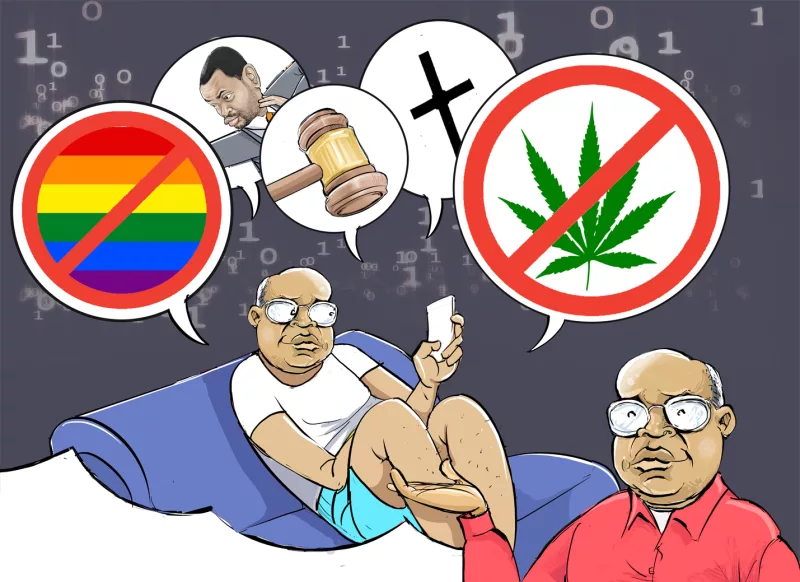
I was sprawled on the couch at home, one leg hanging off the armrest, phone inches from my face, laughing like I’d just heard the funniest joke of the year. It wasn’t even the TikTok video that got me, it was the comment section.
You know those TikTok videos where the real show is unfolding at the comment section? That’s where I was. Someone had dropped that viral sticker of the typical Kenyan drunk uncle at a family gathering squinting his eyes. Another followed with that clipped reaction of a woman blinking rapidly while aggressively chewing, like she’s buffering in real life. One after the other. Perfect timing. Perfect chaos.
I was crying laughing. Proper, uncontrollable laughter. At some point, I even forgot what the original video was about. And maybe that’s the point — or maybe that’s the problem. Because lately, I’ve started noticing how easily those same reactions slip into places they don’t quite belong. Not because people are intentionally being cruel, but because we’ve gotten so used to responding this way that it’s almost automatic.
The shift hit me hardest during a recent TikTok trend that was circulating here in Kenya. It used that popular Christian sound: “Kijana kanipenda, kanichukua, kanitengeneza,” a song that usually carries this soft, hopeful energy about love and transformation.
Instead of cute couple videos or glow-ups, however, some women flipped it. They posted photos of themselves after being beaten, with bruised faces, swollen lips, darkened eyes. No captions. Just the images and that hauntingly gentle song playing in the background.
I remember sitting up a little straighter when I saw the first one. It didn’t feel like content; it felt like a confession without words. Then I opened the comments. One sticker after another. The reactions kept coming, stacked on top of each other, racking up likes. And suddenly, the weight of the video felt… diluted. Not erased, but softened into something easier to scroll past.
It unsettled me, not because people were laughing outright, but because the response felt detached. Like we were watching, reacting, but not really absorbing. And once I saw it, I couldn’t unsee it.
Even in my own spaces, I’ve seen it happen. In one of our WhatsApp group chats, someone shared that a former classmate had dropped out of campus because of fees. Before anyone could even respond properly, a sticker popped up, one of those resigned, philosophical expressions, like ‘life is tough’. A few laughing reactions followed. And then silence. The topic died there. No one asked how she was doing. No one suggested reaching out. It just… passed.
When I asked Kevin Ngaluma, 22, from Juja, about it, he didn’t see the issue. “Those stickers aren’t always jokes,” he told me. “Sometimes it’s just how we handle shock or stress. Not everything has to be serious-serious. If you take everything in, you’ll just burn out.”
And he’s not wrong. There’s a kind of emotional self-defence in how we interact online. Kenya right now isn’t exactly light. Between economic pressure, unemployment and just the general unpredictability of life, humour becomes a release valve. A quick way to say, “This is a lot” without sitting in how much it actually is.
But Amina Hassan, 21, from Nairobi West, pushed back on that. “I think we’ve gotten too comfortable not engaging,” she said. “It’s easier to drop a reaction than to actually say something meaningful. But when it’s something serious, that silence, or that surface-level reaction, feels loud.”
That word stuck with me: comfortable. Because that’s what meme culture has given us: comfort. A shared, fast-moving language, where everything can be reacted to instantly. Where nothing lingers too long. Where even the heaviest moments can be softened by a well-timed facial expression clipped from a viral video.
But comfort can come at a cost. Research on digital behaviour has shown that constant exposure to emotional content, especially when consumed quickly and repeatedly, can reduce our sensitivity over time. Not because we don’t care, but because we are overwhelmed. So we adapt. We skim. We react. We move on. And in that process, the line between what deserves a laugh and what deserves a pause starts to blur.
I still love those comment sections. I still laugh at those stickers. I probably will tonight, lying in the same spot on that couch, phone glowing in the dark. But now, every once in a while, I catch myself hesitating before reacting.
Because not every moment is meant to be processed through humour. Some moments are asking for something slower. Heavier. More human. And if we keep responding to everything the same way, we risk turning real experiences, such as pain, struggle and survival, into just another part of the scroll. Something to react to. And then forget.