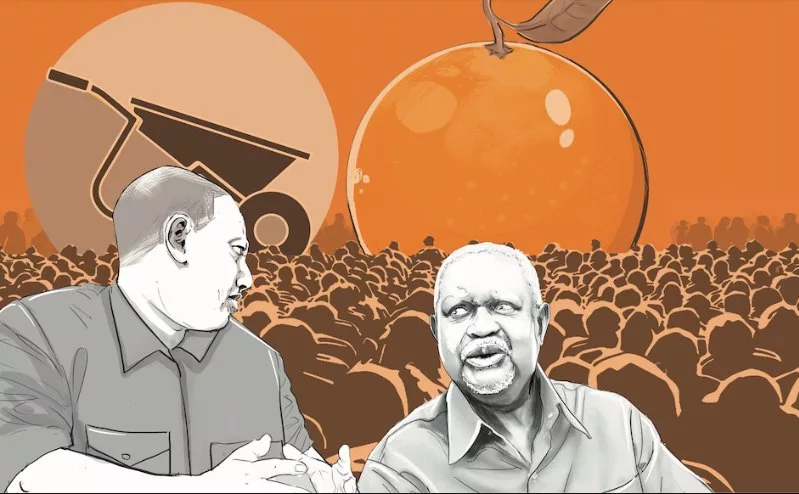
As the Naivasha retreat draws to a close with exactly one year remaining until the 2027 polls, over 250 members of the National Assembly and 45 senators, alongside the executive, march out with a single, unified order.
The largest political war council since 2007 has delivered a clear directive: President William Ruto again. Led by the President himself and ODM leader Oburu Oginga, the assembly was nothing less than a declaration of total political war. The case for a formal UDA-ODM coalition is not merely a matter of convenience; it represents the path to national political dominance.
For years, these two political formations stood as adversaries. They fought in the courts, on the streets and at the ballot box. The Naivasha gathering would have been unthinkable just two years ago. Yet, as the late Raila Odinga wisely counselled, "An imperfect nation making efforts to become a more perfect union is preferable to a nation that went under." His decision was not one of weakness, but of profound strength, aimed at saving this country from the abyss of endless political conflict.
Politics is ultimately about numbers, and the numbers are stark. ODM chairperson Gladys Wanga places the coalition's potential at 17 million votes. With 6.5 million new voters expected to participate, a UDA-ODM ticket commands the majority. President Ruto's target of a three-million-vote landslide is only achievable through a formidable coalition, and this is it.
The strategic arithmetic that truly unsettles the coalition’s opponents, however, runs much deeper. First, legislative supremacy: a formal coalition secures a parliamentary supermajority, shielding the executive from sabotage and enabling policy passage without extensive horse-trading.
Second, ethnic arithmetic is fundamentally rewritten, bridging Rift Valley, Coastal, Western, Northern and Nyanza regions, rendering regional polarisation obsolete and neutralising the opposition's tribal playbook. Third, post-election stability: a landslide of this magnitude leaves no room for disputed results, locking in investor confidence and market certainty.
Fourth, resource efficiency: unified campaigning eliminates duplication and allows surgical targeting of swing voters. Fifth, international signalling: multilateral partners crave predictability; a coalition spanning the political divide signals that Kenya is mature, stable and open for business.
Perhaps the most compelling case for the coalition lies in the protection of Ruto's transformative development agenda. The Bottom-Up Economic Transformation Agenda has already begun to bear fruit, with the economy stabilising, the currency strengthening and economic opportunities expanding.
Yet flagship projects—the SGR to Kisumu, affordable housing and agricultural transformation—require a full 10-year cycle to materialise fully. Opponents understand this dynamic; that is precisely why they seek to interrupt it. The coalition serves as the shield protecting this transformation.
This coalition represents the most significant strategic repositioning in ODM's history. The movement born in the streets must now mature into a governing institution, transitioning from agitation to one that delivers tangible results.
ODM's decision to forgo a 2027 presidential run is not surrender; it is statecraft. In exchange for backing Ruto today, ODM secures policy influence, institutional permanence and a clear succession pathway to the presidency in 2032. Both parties share a pro-worker, devolution-oriented outlook, making this a union of shared ideals, not mere convenience. The gamble is bold: sacrifice one election to shape the next decade.
Risks persist, and no expert analysis would ignore them. Zoning disputes threaten "friendly fire" in key constituencies, and the running mate contest could fracture unity. Externally, the opposition, though divided, is consolidating; the Linda Mwananchi movement injects fresh momentum.
Every week of ambiguity allows opponents to frame the coalition as transactional. Yet consolidation of losers remains a collection of losers; the coalition can manage these internal tensions through transparent negotiation and timely resolution.
The current MoU is insufficient. A joint technical committee must deliver a binding pre-election agreement promptly, resolving zoning issues, settling the running mate question through a transparent formula and crafting a joint manifesto codifying shared commitments. Clear rules of engagement and a unified campaign machine are non-negotiable pillars. Formalisation is the firewall against internal drift and external assault.
Raila Odinga's vision of national unity laid the foundation; his successors must now complete the building. The opposition is wounded but mobilising; hesitation will only embolden them. Formalisation, a joint manifesto, shared machinery and binding rules transform a fragile accord into an electoral fortress.
The nation deserves a coalition built on shared vision, not convenience. The verdict of history will crown the bold. The time for strategic action is now.
Strategic adviser and expert in leadership and governance