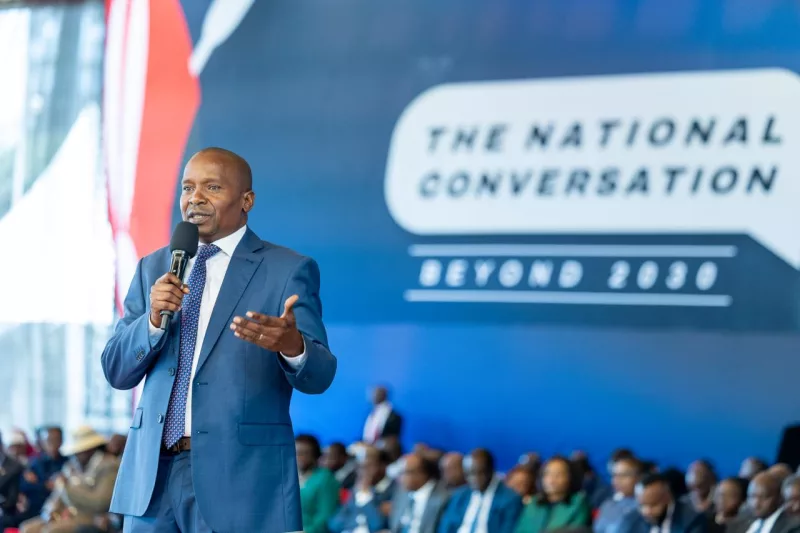
Deputy President Kithure Kindiki has said Kenya has the potential to join the league of wealthy and developed nations if the country maintains strong leadership, builds confidence in its capabilities and protects long-term development policies from disruption.
Speaking during the launch of the National Beyond 2030 Conversation on Wednesday, Kindiki said Kenya must use the new long-term development agenda to determine how to move the country to the next level of economic and social development.
He said the country had already laid a foundation that could support its transformation into a wealthy nation.
The Deputy President attributed the possibility of achieving the goal to good leadership and confidence among Kenyans in their ability to develop the country.
“I believe that, as Professor Hino has told us, Kenya, Africa, can venture into the league of wealthy, developed nations. We just need good leadership,” Kindiki said.
Kindiki said Kenya should not view development as something that can only be achieved by other countries, arguing that African countries have the capacity to overcome poverty and achieve sustained progress.
“We also need confidence in ourselves that what other nations can do, what other races can do, the African race can also generate countries that can move from poverty and move into progress. It is possible,” he said.
Kindiki said the Beyond 2030 conversation provides an opportunity for Kenya to assess the progress made so far and determine what needs to be done to achieve higher levels of development.
“Your Excellency the President, we have done some work. A lot of work needs to be done. Laid the foundation,” he said.
He cited economic performance as one of the areas where the government had made progress, saying foreign exchange reserves had risen to $15.1 billion, which he described as the highest in the country’s history.
Kindiki also said inflation had fallen from 9.6 per cent when the administration took office to below six per cent, while Kenya attracted $3.2 billion in foreign direct investment last year.
He added that Central Bank lending rates to commercial banks had fallen from 13.5 per cent to 8.7 per cent, which he said would enable the private sector to access credit.
The Deputy President also highlighted agriculture as another area where the administration had recorded progress.
He said the government had registered 7.2 million farmers, providing information on their location, crops, farm sizes and fertiliser requirements.
“We used to work on guesswork. We didn't know how many farmers we have, where they are, what they grow, the size of their farms, the kind of fertiliser they need,” Kindiki said.
He said maize production had increased from 44 million bags in 2022 to 75 million bags last year.
Kindiki further said tea production had increased from Sh138 billion in 2022 to Sh215 billion last year, while sugar production rose from 472,000 metric tonnes to 815,000 metric tonnes over the same period.
He also said Kenya had become Africa’s largest producer of processed milk, with production increasing from 4.6 billion litres in 2022 to 5.5 billion litres last year.
On education, Kindiki said government funding had increased from Sh500 billion in 2022 to Sh784 billion this year.
He said 100,000 teachers had been employed and 23,000 classrooms constructed.
The Deputy President also pointed to progress in healthcare, saying the number of Kenyans with public medical insurance coverage had risen from eight million under NHIF to 32.2 million.
On infrastructure, he said the government had paid Sh177 billion in pending bills owed to road contractors, allowing stalled projects covering about 6,000 kilometres across the 47 counties to resume.
Kindiki also cited increased electricity connectivity, saying the number of connected households had risen to 10.3 million from 8.9 million.
The target, he said, is to connect all 15.6 million households within four years.
The government has also invested in job creation, with Kindiki saying 650,000 Kenyans were working through the affordable housing programme, while about 300,000 were earning through digital jobs under the Ajira programme.
He said more than 30,000 kilometres of fibre-optic cable had been built to expand connectivity, while 382 ICT hubs had been completed and another 416 were under construction.
Kindiki, however, warned that Kenya’s progress could be undermined if successive administrations abandon policies and projects when governments change.
“The biggest threat of African countries, the biggest threat of developing countries, is policy disruption,” he said.
He urged leaders to place national interests above personal or political considerations when making decisions on development.
“Somebody comes with their ego as opposed to the national interest, and they want to change this, change the other, disrupt this, instead of perfecting the foundation on which our country has been raised,” Kindiki said.
He also urged Kenyans to avoid politicising development.
“We can politicise everything else. Let us not politicise the development of our country,” he said.
Kindiki said Kenya now has an opportunity through the Beyond 2030 process to establish a long-term framework capable of sustaining development and moving the country towards greater prosperity.