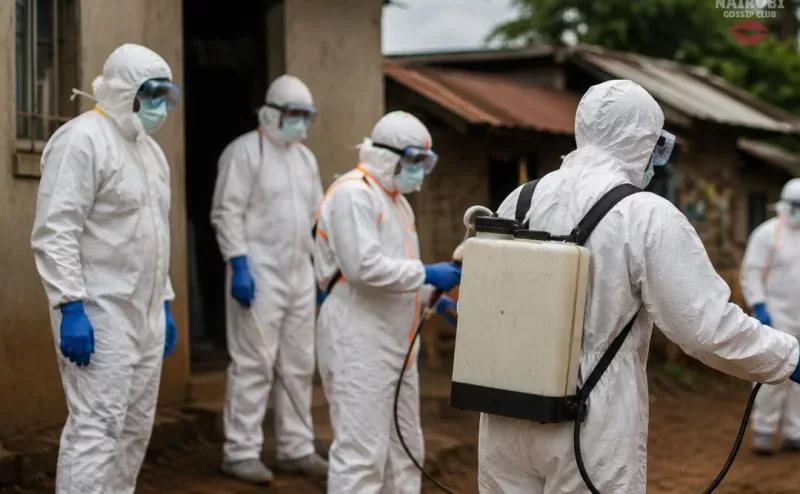

Kenya is stepping up efforts to contain the emergence of Plasmodium vivax malaria in Wajir County.
Speaking in Nairobi on Tuesday, Health Director-General Patrick Amoth said the government was exploring new treatment approaches and strengthening vector control to prevent the parasite from spreading further.
Amoth said the emergence of P. vivax presents a new challenge for Kenya’s malaria control programme, particularly because the parasite can remain dormant in the liver and cause relapses after treatment.
“Because of the effects of climate change, parasites are becoming more common. P. vivax has a dormant stage in the liver, so after treatment there might be a relapse,” Amoth said.
He was responding to concerns over the increasing number of locally transmitted P. vivax cases in Wajir, which borders Ethiopia, where cases of the parasite have been rising.
The first P. vivax case reported in Wajir in 2024 was imported, but health officials have since raised concerns over local transmission and are pushing for the county to be recognised as malaria endemic.
Amoth said the government is exploring multiple treatment options to respond to the emerging challenge.
“We are going to have multiple frontline therapies. Any molecule can be used anywhere that can help reduce Plasmodium vivax. The treatment equally works well,” he said.
He said Kenya's progress in reducing the overall malaria burden has been supported by a multi-agency approach.
“We have made progress in tackling malaria. We have reduced from 105 to 72 per 1,000 population because of a multi-agency approach,” Amoth said.
However, he cautioned that climate change could complicate efforts to control the disease by influencing malaria transmission and the distribution of different parasites.
Amoth said the government will also distribute 10.8 million mosquito nets in the next month as part of efforts to strengthen vector control.
The developments in Wajir come as health officials seek to prevent P. vivax, which has historically been less common in Kenya than Plasmodium falciparum, from establishing wider transmission across the country.
According to WHO, after an infected mosquito bites a person, the parasite travels to the liver, where some parasites develop into active forms while others enter a dormant hypnozoite stage.
The dormant parasites can later reactivate, causing a relapse even when the initial blood-stage infection has been adequately treated.
WHO says relapses can occur as early as 16 days or as late as three years after the initial infection, depending on factors including the parasite strain, the amount of parasites transmitted, the person's immunity and treatment received.