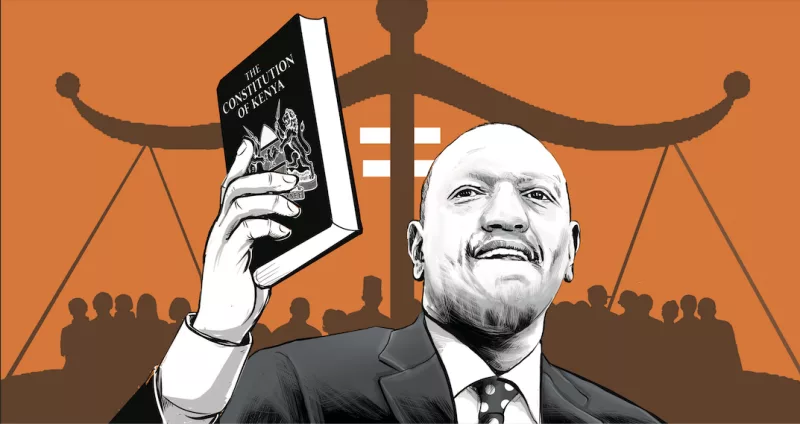
 Adow Mohamed/ HANDOUT
Kenyan politics has a peculiar habit of declaring elections won long before voters have cast their ballots. Every election cycle produces its prophets, its certainties and its premature coronations.
Yet, as Kenya approaches the 2027 General Election, there is an increasingly compelling argument that William Ruto enters the contest with something far more valuable than political rhetoric: a structural advantage.
This does not mean the election has already been decided. Kenya is still a year away from the polls and its politics can change dramatically in a matter of weeks.
But if elections are won through organisation, alliances, geography, incumbency, resources, political machinery and the ability to consolidate disparate voting blocs, then Ruto currently possesses many of the ingredients required for victory.
The biggest problem facing his opponents is therefore, not necessarily that Ruto is overwhelmingly popular. It is that no single opposition candidate has yet demonstrated the ability to build a coalition capable of defeating him.
Ruto has the most important advantage in politics: organisation
Elections are not won on X, TikTok or in political salons. They are won at polling stations. And on this front, Ruto has spent much of his political career building political machinery.
The United Democratic Alliance (UDA) has evolved from the relatively obscure vehicle that carried him to State House in 2022 into a nationwide political organisation.
In February 2026, the party brought together more than 1,200 aspirants for the 2027 elections, an indication of the scale of the grassroots network it is seeking to assemble.
That matters enormously. An opposition candidate can enjoy 60 percent approval on social media and still lose an election if supporters are not registered, mobilised and organised to turn out and protect their vote.
Ruto understands this better than most Kenyan politicians. His politics has always been deeply rooted in constituency-level organisation. The 2027 contest, therefore, is unlikely to be simply a referendum on the President. It will also be a contest between political machines. And at the moment, the government-aligned machine is considerably more developed.
The opposition has numbers, but numbers without unity are not enough
This is the central paradox of the 2027 election. There is clearly dissatisfaction with Ruto’s administration. There are legitimate grievances over the cost of living, taxation, unemployment and persistent governance challenges.
Recent polling does not suggest that the President enjoys an overwhelming national mandate. Yet dissatisfaction is not the same thing as an alternative.
A July 2026 Infotrak poll put President Ruto at 32 percent, while Edwin Sifuna and Fred Matiang’i each stood at 12 percent. Rigathi Gachagua was at 4 percent, while 18 percent of respondents remained undecided.
Those numbers should worry the opposition more than they should reassure it. Why? Because the anti-Ruto vote remains fragmented.
If several opposition politicians command 5, 10 or 12 percent each, they may collectively represent a formidable constituency.
But elections are not won by collective political sentiment. They are won by individual candidates who can consolidate enough of that sentiment behind a single ticket.
Kenya’s presidential election also requires a candidate to secure more than half of all votes cast nationally, as well as at least 25 percent of the votes cast in more than half of the counties. Fragmentation therefore, creates a potentially significant advantage for an incumbent who can hold a substantial base while preventing the opposition from consolidating around a single challenger.
The opposition consequently faces a brutally simple question: Who can unite all those votes behind one candidate? Until that question is answered, Ruto remains in a strong position.
Ruto has learned the most important lesson of 2022: broaden the coalition
The Ruto who won in 2022 was largely perceived as the candidate of the Rift Valley and significant sections of Central Kenya.
The Ruto preparing for 2027 is a different political animal. His strategy has increasingly been to move beyond the traditional Kenya Kwanza coalition and construct a broader national political arrangement.
The broad-based government, whatever one’s interpretation of its motives, has fundamentally altered Kenya’s political landscape.
The administration has established working relationships with political actors who were previously on the opposite side of the political divide. Ruto has also openly promoted cooperation between UDA and other political parties ahead of 2027. This is politically significant.
Kenyan elections are rarely won by one community alone. They are won by assembling enough communities into a coalition capable of producing a national majority.
Ruto’s calculation appears straightforward: retain his traditional base, reduce opposition hostility in Central Kenya, make inroads into Western Kenya and Nyanza, maintain strong support in Northern Kenya and build enough support in Nairobi and the Coast to make victory mathematically difficult for his opponent. That is a considerably more sophisticated strategy than simply defending the 2022 Kenya Kwanza vote.
The death of Raila Odinga has fundamentally changed opposition politics
This is another reality that cannot be ignored. For decades, Raila Odinga was one of the few Kenyan politicians capable of assembling an opposition coalition that transcended his own ethnic base. His political significance was therefore, much greater than the votes he personally commanded.
Raila could negotiate with Central Kenya, Western Kenya, Kamba leaders and smaller communities while simultaneously retaining an enormous Luo following.
His absence has created a political vacuum. The question is not simply whether another politician can inherit his supporters. It is whether anyone can inherit his coalition-building capacity.
So far, nobody has conclusively demonstrated that ability. Kalonzo Musyoka has experience and a substantial Kamba constituency. Fred Matiang’i brings administrative experience and potentially significant support among the Kisii. Rigathi Gachagua retains influence in sections of Mount Kenya.
Edwin Sifuna has considerable appeal, particularly among younger and urban voters. But none has yet demonstrated that he can simultaneously become the preferred candidate of the Kamba, Kikuyu, Luo, Luhya, Kisii, Coast, Northern and urban constituencies. Ruto does not need to win all those constituencies. He simply needs his opponents to remain divided across them.
The Mt. Kenya question may not save the opposition
Much of the opposition’s hope has rested on the assumption that Ruto’s relationship with Mt. Kenya has irreparably collapsed. That assumption may prove too simplistic. Politics is rarely about permanent friendships or permanent enemies. It is about interests. Ruto does not necessarily need Mt. Kenya to love him as passionately as it did in 2022. He needs to prevent the region from voting overwhelmingly for a single opposition candidate.
That distinction is crucial. A 70–30 opposition advantage would be devastating. A closely divided vote could be considerably more manageable.
The President’s broader political strategy therefore, appears designed not necessarily to win back every voter he lost, but to prevent any single opposition candidate from monopolising the region. In a presidential election, denying an opponent a decisive regional bloc can be almost as valuable as winning that bloc outright.
Northern Kenya may become more important than many analysts realise
Northern Kenya is often treated as an electoral afterthought in national political calculations. That is a mistake. The region may not possess the numerical strength of Mt. Kenya or the Rift Valley, but its political importance has grown considerably as national politicians increasingly understand the value of building genuinely national coalitions.
Ruto’s engagement with Northern Kenya has also been politically significant. His administration has placed greater emphasis on infrastructure, government presence and national recognition in a region that has historically complained of marginalisation.
For decades, Northern Kenya’s relationship with the Kenyan state was defined by suspicion, exclusion and historical grievances.
A President repeatedly travelling to the region and staging a major national event there sends a powerful political message: You are part of the national centre, not its forgotten periphery.
Whether that translates directly into votes is another question. But politically, Ruto appears to have understood something previous administrations often underestimated: symbolism matters.
Incumbency is an enormous advantage
There is something uniquely powerful about being an incumbent. The President controls the national political agenda. He occupies the centre of public attention.
He has access to the machinery and visibility of government, as well as the ability to announce and implement programmes that opposition candidates can only promise.
Every road inaugurated, every hospital opened, every development project launched and every government programme implemented becomes part of the incumbent’s political narrative. The opposition, meanwhile, must convince voters that whatever the government has done is insufficient and that it can do better.
That is a much harder message to sell when the incumbent can point to tangible projects. Politics is ultimately about competing narratives. Ruto’s narrative is likely to be: “Give me another five years to complete what I started.”
The opposition’s counter-narrative will probably be: “Give us a chance to undo what Ruto has done.” Historically, the first message is often easier to sell because it appeals to continuity, while the second requires voters to embrace uncertainty.
Ruto does not need universal popularity
The President does not need to be loved by the majority of Kenyans. He needs to build a sufficiently broad coalition to cross the constitutional threshold while ensuring that no single challenger can consolidate the anti-government vote.
That is a completely different political proposition. The 2027 election may therefore not be primarily a contest over whether Ruto is popular. It may be a contest over whether his opponents can agree on who should replace him.
That is why opposition fragmentation could prove more consequential than Ruto’s approval ratings.
A president with mediocre approval can still win if the opposition is fragmented. Conversely, an incumbent with relatively strong approval can lose if a credible challenger successfully consolidates the electorate against him. The mathematics of the election may therefore matter more than the mood of the country.
The opposition’s greatest weapon could also become its greatest weakness
There is considerable anti-government sentiment among young Kenyans. The Gen Z protests fundamentally changed Kenya’s political conversation. They demonstrated that a younger generation could challenge the political establishment with remarkable speed and intensity. But protest movements do not automatically become electoral machines.
Anger can mobilise people onto the streets. Elections require them to return to the same polling station months later, identify a candidate, mark a ballot and defend a political choice. That transformation from anger to organisation and from protest to votes, is where the opposition still faces a major challenge.
Ruto has demonstrated an ability to build political structures around a message and a candidate.
His opponents must now demonstrate that they can turn widespread frustration with the government into a coherent national electoral organisation. That distinction could determine the election.
The final advantage: time is still on the incumbent’s side
Perhaps the opposition’s biggest problem is that it is campaigning against a President who still has time to change the political equation. A year is an eternity in Kenyan politics. Ruto can still alter his economic message. He can deepen alliances.
He can recruit opposition politicians. He can deliver projects. He can repair relationships with regions where his support has weakened. And he can continue positioning himself as the centre of an increasingly broad political coalition.
His opponents must solve several problems simultaneously. They must identify a candidate, negotiate a coalition, divide positions, manage egos, build grassroots structures, raise money, agree on a common message and convince Kenyans that their candidate can actually defeat an incumbent President.
That is a formidable task. Kenyan elections have repeatedly demonstrated that political arithmetic is often more important than political noise. The loudest candidate does not necessarily win.
The most criticised candidate does not necessarily lose. And the politician who dominates social media does not necessarily command the most votes at the polling station. Ruto understands this. He is building an organisation, expanding alliances, courting former opponents and positioning himself at the centre of a broad political coalition.
His opponents, meanwhile, are still trying to determine who should lead the coalition against him.
That is the fundamental imbalance entering 2027. There is, of course, plenty of time for the equation to change.
A major economic crisis, a powerful opposition coalition, a serious political scandal, a dramatic regional realignment or the emergence of a compelling new candidate could transform the race.
But elections are ultimately won by what exists, not by what might exist. And as of August 2026, the political reality is increasingly difficult to ignore: Ruto does not need to convince every Kenyan to vote for him.
He needs to build a coalition large enough to cross the constitutional threshold while ensuring that those who want to defeat him cannot agree on whom to rally behind. That may ultimately be his most powerful route back to State House in 2027.
Adow Mohamed is a Communications and Media Relations Practitioner