On October 9, 2025, Prime Minister Narendra Modi said India’s tech systems are simple, easy to use, and accessible to everyone across the country.
From the 2011 vision of biometric identity for every citizen to building one of the world’s strongest payment systems, India’s DPI has gained global attention. At the heart of it is India Stack. “India Stack is not merely a story of India’s success, but a beacon of hope for the world, especially for countries in the Global South,” PM Modi said.
What Is India Stack?
It isn’t any software, app or website. It’s an open-source system that lets governments, businesses, and developers build services on it. It consists of four foundational layers:
Presence-less layer: Enables universal digital identity through Aadhaar – the world’s largest biometric ID system. It allows citizens to access services remotely.
Paperless layer: Digitises records via e-KYC and e-signature. These tools have sharply reduced paperwork across banking, education, and governance.
Cashless layer: Powers interoperable digital payments led by UPI (Unified Payments Interface), enabling peer-to-peer transfers, merchant payments, and even IPO (Initial Public Offering) subscriptions. It has made cashless transactions affordable and universal.
Consent layer: Ensures privacy-enabled data sharing through the RBI’s Account Aggregator framework, giving users control over how their financial data is shared.
The four foundational layers of India Stack.
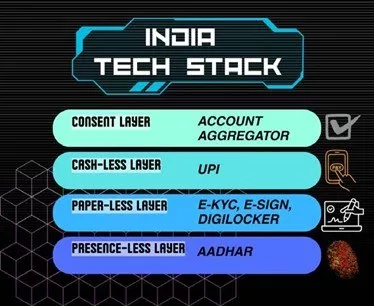 The four foundational layers of India Stack.
Understanding UPI
PM Modi highlighted that half of the world’s real-time digital transactions happen in India, powered by UPI, the backbone of India Stack. In FY25 alone, UPI processed over 185 billion transactions worth ₹261 lakh crore, accounting for more than 80 per cent of domestic payments.
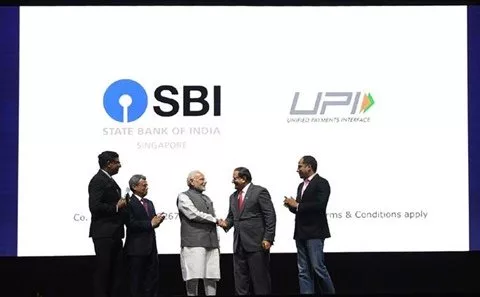
UPI Lite enables offline payments, and UPI123Pay helps people transact using feature phones. With banks now lending through UPI apps, a new wave of financial inclusion is emerging. UPI has become a part of everyday life, used by street vendors, retail chains, online stores, and investors applying for IPOs. Moreover, UPI has gone global, connecting with Singapore, the UAE, Nepal, Bhutan, and France.
PRIME MINISTER NARENDRA MODI India Stack is not merely a story of India’s success, but a beacon of hope for the world, especially for countries in the Global South. |
DPI in Action
In addition to UPI, India Stack powers a range of platforms that are reshaping governance and service delivery:
Direct Benefit Transfers (DBT): India’s DBT system has digitally transferred over ₹46.5 lakh crore (US$511.5 billion approx.) worth of subsidies across 327 schemes. By eliminating middlemen, it has saved ₹4.31 lakh crore (US$51.9 billion approx.) in leakages. Beneficiary coverage has surged 16-fold, from 11 crore in 2014 to 176 crore in 2024.
ONDC: Open Network for Digital Commerce helps small shops and services sell online without relying on big e-commerce platforms. It makes e-commerce open, fair, and accessible to all. It’s live in over 600 cities, with over 7.6 lakh sellers and over 16 million orders across sectors like food, fashion, and mobility.
UMANG: Unified Mobile Application for New-age Governance provides access to over 1,500 services from more than 50 departments. Citizens can apply for passports, pay utility bills, check EPFO balance, and view health records, all through a single app. Over 9 crore users are registered, with total transactions in 2024 reaching 129.84 crore.
Jeevan Pramaan: It is a digital life certificate system based on biometric authentication that has issued over 1.6 crore certificates. It has helped pensioners avoid physical visits to banks or government offices.
e-NAM: National Agriculture Market connects over 1,300 wholesale markets, allowing farmers to sell produce online and access better prices. Over 1.8 crore farmers and traders are registered, and the platform has handled trade over ₹4 lakh crore (US$48.2 billion approx.) by 2024.
DigiLocker: It stores and provides access to digital versions of official documents, including driving licences, Aadhaar cards, and PAN cards, eliminating the need for physical copies. Over 59 crore users and 835 crore documents have been issued.
Aadhaar eKYC & eSign: Aadhaar-based eKYC has reduced onboarding costs from ₹23 to ₹0.15 per customer for any financial institution. eSign allows secure digital signatures for contracts, loans, and applications.
Account Aggregator (AA): Operating across 10 platforms, AA enables secure data sharing within financial services, empowering users to access loans, insurance, and investments through consent-driven data portability.
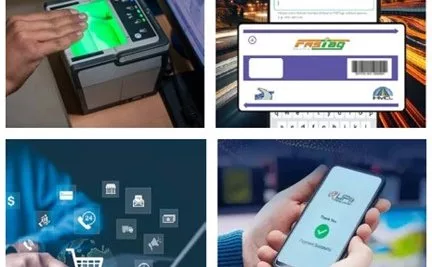 Examples of India's digital public infrastructure in use.
Global Public Good
India’s digital model is now seen as a global public good, open, affordable, and inclusive. It’s considered more open than the US’ market-led model, simpler than Europe’s regulation-heavy framework, and more transparent than China’s state-controlled setup.
The Road Ahead
Even with its rapid progress, India’s digital journey still faces a few hurdles. Financial literacy and internet penetration, though steadily improving, remain uneven across regions. Ongoing efforts to expand infrastructure and boost digital awareness aim to bridge this divide.
Recent advances in artificial intelligence (AI) bring new risks, but also new possibilities. For instance, AI is already detecting fraud in UPI transactions in real time. Looking ahead, PM Modi said that efforts are underway to deliver the benefits of AI to every district and in every language. By driving inclusive development both within the country and across borders, India Stack has emerged as one of the most impactful models of digital public infrastructure in the world.
Swapnil Karkare is known for bridging economics and storytelling. A Chartered Accountant and economist by profession, he analyses finance and policy through research, writing, and podcasts.