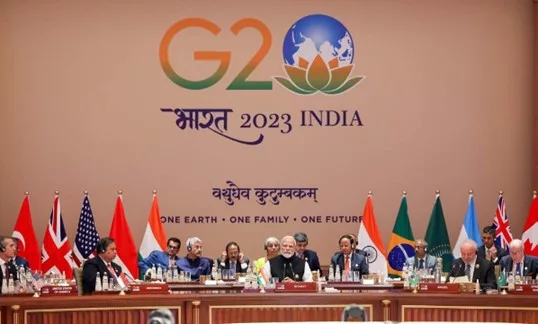
 India's G20 Presidency placed the concerns and priorities of the Global South at the centre of the international agenda./HANDOUT
India became independent of British colonial rule on August 15, 1947. Articulating its decision to opt out of the armed confrontation of the Cold War, Ms. Vijayalakshmi Pandit, the leader of India’s delegation to the United Nations, said in a speech to the UN General Assembly (UNGA) on September 19, 1947,
“We cannot eat an ideology. We cannot brandish an ideology and feel that we are clothed and housed. Food, clothing, shelter, education, medical services; these are the things we need.”
Early Days
India’s support for the self-determination of other colonial countries produced significant results. In December 1963, these countries, known today as the “Global South,” forced amendments to the UN Charter through a recorded two-thirds majority vote in the UNGA to obtain greater representation in the UN bodies responsible for peace, security, and development.
As a result, UN Security Council (UNSC) elected seats were expanded to 10, while UN Economic and Social Council (ECOSOC) seats were expanded from 18 to the current 54. However, greater representation did not automatically translate into the Global South’s ability to influence multilateral decisions. The decisions of the UNSC continue to be taken based on the veto power of its five permanent members (P5), i.e., China, France, Russia, the UK, and USA. On the other hand, decisions of the ECOSOC and UNGA are taken democratically, by consensus or majority vote, with each country having one vote.
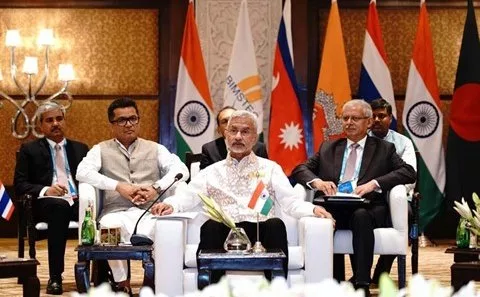 India’s External Affairs Minister, Dr. S. Jaishankar,
hosting the Bay of Bengal Initiative for Multi-Sectoral Technical and Economic
Cooperation (BIMSTEC) Foreign Ministers’ retreat in New Delhi.
Emerging Alliance
The consolidation of the Global South was achieved incrementally between 1964, when the G-77 (Group of 77 developing countries) platform was created, and 2015. The G-77 Charter of Algiers of 1967 identified priorities for accelerated socio-economic development through international cooperation. India became the first chair of the G-77 in 1970.
In 1986, the UNGA adopted its historic Declaration on the Right to Development by a recorded vote. In 1987, the UN’s Brundtland Commission converged the demands for accelerated socio-economic development and environmental protection into the concept of “sustainable development".
Proactive diplomacy has ensured the Global South’s core interests in upholding their sovereignty while participating in the post-Cold War legal frameworks of a new world order. This includes the principle of “common but differentiated responsibilities” in the UN Framework Convention on Climate Change (1992) and the principle of “special and differential treatment” in international trade, which allows the use of higher tariffs through the World Trade Organisation Agreement (1994) signed at Marrakesh.
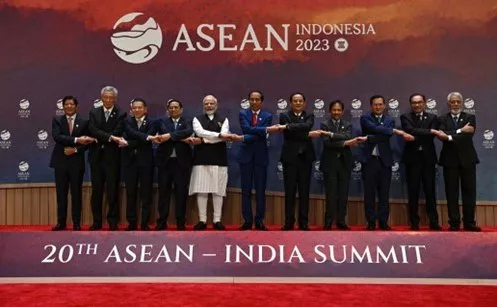 The 20th ASEAN-India Summit in Jakarta, Indonesia
The path-breaking Agenda 2030 on Sustainable Development (2015), with its 17 Sustainable Development Goals (SDGs), contains the negotiated priorities of the Global South within a holistic framework incorporating socio-economic, environmental and political objectives. India’s Prime Minister Narendra Modi asserted that “much of India’s development agenda is mirrored in the Sustainable Development Goals.”
Overcoming Challenges
Agenda 2030 marked the first time since the signing of the UN Charter in 1945 that the interlinkage between peace, security, and development was accepted unanimously. The Global South expected the SDGs to be implemented through supportive multilateral financial flows and non-restrictive transfers of technologies for sustainable development. However, this did not unfold as expected. Developments in international relations since 2015 have instead underscored the weakening of the idea of “great power responsibility,” which originally justified the P5’s veto power in 1945.
The consequence of this is the spread of violent conflicts affecting two billion people living in the Global South, mostly in Asia and Africa. The COVID-19 pandemic caused a major socio-economic setback as well.
Prime Minister Narendra Modi arrives at the 21st ASEAN-India Summit in Vientiane.
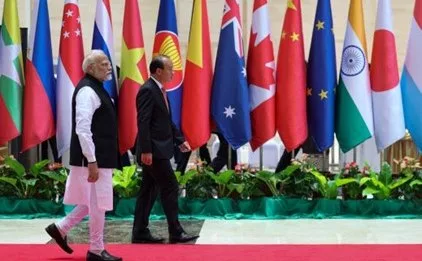
Prime Minister Narendra Modi arrives at the 21st ASEAN-India Summit in Vientiane.
The Future
India’s G20 Presidency in 2023 provided a ray of hope. The three virtual Voice of the Global South Summits chaired by Prime Minister Modi in January and November 2023, and in August 2024, contained a blueprint for action by the Global South. This was anchored in the call for “reformed multilateralism,” seeking to restore the focus on the right to development, which is acknowledged to be “an inalienable human right.”
“Reformed multilateralism” urgently requires a new platform for dialogue and diplomacy. Such a platform exists in Article 109 of the UN Charter, and it is time for India and the Global South to prioritise the implementation of the article.
Ambassador Asoke Mukerji was India’s Permanent Representative to the UN in New York. He is a Distinguished Fellow at Vivekananda International Foundation, New Delhi.