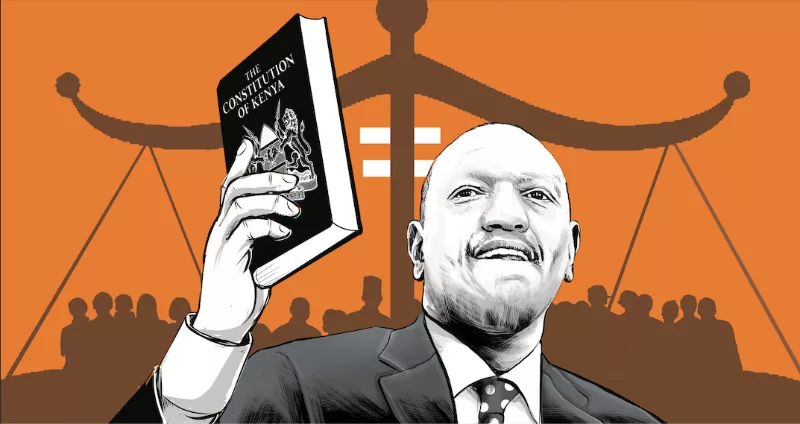
President William Ruto has introduced a new phrase, "Usawa ni Sawa". It is deliberate and calculated, not a stumble, but a promise that equality is not a favour you beg from the government but a right you claim from the constitution. Every Kenyan, in every region, deserves the same opportunity to prosper.
The phrase raises difficult questions of whether the people are getting a fair chance in governance and development. For decades, politicians ran on a formula of counting tribal numbers, rewarding loyalty and punishing the rest. Opportunity was a reward for political obedience. That is the architecture "Usawa ni Sawa" is designed to demolish.
"Usawa ni Sawa" is a constitutional promise of equal opportunity, resting on three inseparable pillars: equal dignity, equal protection under the law and equal chances to participate in national prosperity. Men and women enjoy equal opportunities in Article 27; the state ensures that the youth enjoy the benefits of education, training and economic opportunity under Article 55; marginalised communities are guaranteed special opportunities in Article 56, and economic and social rights to all are provided for in Article 43, with the Equalisation Fund in Article 204 ensuring equal opportunity for marginalised communities.
A constitutional promise is accompanied by a political philosophy of equal opportunity and inclusivity, which tells us how power must be exercised and by what standard it should be judged, who gets a start where and when, how the tax burdens and benefits are shared, and how fairness is measured.
It makes us demand no other philosophy in our politics. Equal opportunity must never be a handout but identical chances for everyone in how they are governed. It demands a level field in education, health, capital, infrastructure, markets and jobs. That is a political philosophy, not a slogan.
But let us be honest about the barriers to equal opportunity in Kenya. Yes, the Equalisation Fund has been slow to reach the communities it was designed to serve. The SHA rollout has had glitches, claims have been delayed and facilities have been overwhelmed. The cost of living is crushing households. The Finance Bill, 2024 crisis ruptured public trust. These are indeed unresolved governance challenges that we must confront.
The first dividends and instalments of the constitutional promise and political philosophy are now visible nationwide, region by region and sector by sector. Government figures show that 32.3 million Kenyans are registered under SHA, over eight million have been treated and 107,800 promoters are reaching nine million households. In agriculture, two million subsidised fertiliser bags have reached six million farmers, while 330,000 young Kenyans are earning online.
In affordable housing, approximately 8,800 units have been completed and handed over, with more than 260,000 others under active construction; the programme has generated over 640,000 construction jobs, alongside 244,000 direct jobs recorded in the sector. On roads, 1,798 kilometres of new roads have been constructed nationally, and KeNHA, Kura and KeRRA have built a further 2,584 kilometres across recent financial years.
Now picture the Kenya ‘Usawa ni Sawa’ describes. The youth will no longer need a godfather to push for a job or business opportunity because a digital hub opened in their village and electricity reached their homestead. A mother in the remote villages will reach a stocked hospital on a tarmac road that exists. The people living in the slums will have a fair opportunity to own a home. That is an attempt at an inclusive Kenya with equal opportunity. ‘Usawa ni Sawa’ is a claim we must hold against the government. On election day, we must remember who answered the call for equality and who dodged it.
Therefore, 'Usawa ni Sawa' echoes both Kenya’s constitutional promise of equality and a political philosophy of equal opportunity and inclusivity. Every Kenyan deserves equal dignity, equal protection before the law, and an equal chance to contribute to and benefit from national prosperity, in every region, every sector and every household. This is a national mirror, not a barrier to development: we should look into it and see whether our commitment to equality is real.