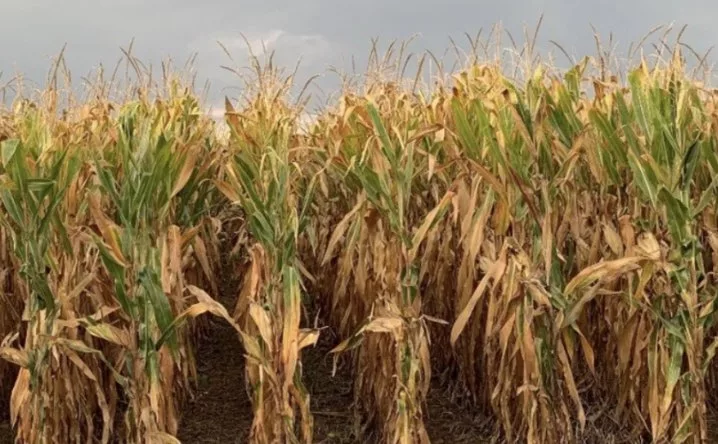
It is a dry, windy evening in Chemomoroch, near Moi’s Bridge, and Jacob Kiprono can only stare in disbelief at his 10-acre maize farm.
The crop that should have been standing tall and filling its cobs is instead drying in the field.
Some plants are already brown, while others remain deceptively green but carry little or no grain.
For Kiprono, a farmer who has cultivated maize for more than three decades, the sight is deeply unsettling.
“I anticipate a huge loss. As you can see, almost 60 per cent of the crop has dried up. I have not witnessed this phenomenon in this area for a long time,” he says.
The farmer invested more than Sh50,000 in labour, seed and fertiliser, hoping to reap enough maize to feed his family and earn a return on his investment. "All that is up in smoke."
His predicament is being repeated across large swathes of Kenya’s traditional grain basket.
From Trans Nzoia and Uasin Gishu to Nandi, Elgeyo Marakwet, Kakamega and parts of Bungoma, maize fields that normally supply millions of bags to the national market have been hit by prolonged dry spells and erratic rainfall.
What started as a bad season for individual farmers is rapidly becoming a national food-security concern.
Jane Nekesa, a mother of six in Matunda who depends largely on subsistence maize farming, is already contemplating what the failed harvest will mean for her household.
“This kind of loss is alarming. A proper analysis should be conducted to establish other factors beyond dryness that have led to this. That will be vital in informing solutions to avert a future crisis,” she says.
“I normally get around two tonnes per acre. This time, I will be very lucky to get 50 kilograms per acre. This means hunger and poverty in the near future,” she says.
From green fields to empty cobs
The North Rift’s maize crisis is particularly worrying because of the region’s importance to Kenya’s food supply.
Uasin Gishu Governor Jonathan Bii says the prolonged dry spell disrupted the traditional farming calendar, with thousands of acres appearing green while producing little grain.
“The maize is green, yet there is nothing inside the cobs,” Bii said during the launch of the Integrated Natural Resources Management Programme at the University of Eldoret.
In Trans Nzoia, county officials have estimated that about 50,000 acres of maize have already been destroyed by hot, dry conditions.
Farmers in other counties report similarly severe losses. In Tinderet, Nandi County, agricultural experts estimate maize production could fall by between 30 and 40 per cent from normal levels.
The sub-county normally produces between 90,000 and 100,000 bags annually, but output could fall to between 55,000 and 65,000 bags this season.
The timing of the dry spell has made matters worse.
An agricultural expert at the Kenya Maize Development Program (KMDP), Nelly Wamae, says that the crop requires adequate moisture during flowering and grain filling. When rains disappear at those critical stages, plants may remain standing but fail to develop viable cobs.
"The painful truth: It's no longer about waiting for rain. For many farmers, the maize has already lost the battle. Even if it rains today, there is no coming back for these fields."
For farmers who borrowed money to plant, that means the problem does not end in the field. It follows them to the bank.
Fears of Loan defaults
Barnabas Kiptoo, a contracted maize farmer in Soy, is staring at losses of at least Sh60,000 per acre.
He took a Sh5 million loan to prepare his 100-acre farm, expecting the harvest to generate enough income to repay the facility and finance the next season.
"The situation is particularly painful for commercial farmers because maize production requires significant upfront expenditure on land preparation, seed, fertiliser, chemicals, labour and machinery. A failed crop therefore converts an expected income stream into a debt burden,'' Kiptoo said.
Even so, some farmers are trying to salvage whatever they can. Gabriel Kitazi and others are turning immature or damaged maize into animal feed, hoping to recover a fraction of what they invested.
But for many smallholders, there is little to salvage.
The crisis is exposing one of the biggest weaknesses in Kenya’s rain-fed agricultural economy: farmers bear much of the weather risk while still being expected to repay loans regardless of whether the rains come.
The Agriculture and Food Authority notes that cereal production in Kenya is highly dependent on rain-fed agriculture, contributing to significant fluctuations in output.
The Kenya National Bureau of Statistics (KNBS) says the sector directly contributes about 24 per cent of Kenya’s GDP, while about 72 per cent of the population derives its livelihood directly or indirectly from agriculture.
Rising maize prices
The effects are now moving beyond the farms and into the marketplace.
A 90-kilogram bag of maize that was selling at around Sh3,700 two months earlier has climbed to between Sh4,500 and Sh4,600 in parts of the Rift Valley as traders respond to tightening supplies.
The Warehouse Receipt System Council put the average price of a 90-kilogram bag of white maize at Sh4,482 in mid-July.
That matters because maize is not simply another agricultural commodity in Kenya. It is the foundation of the national food basket.
The Agriculture and Food Authority describes maize as the country’s leading cereal in both production and acreage, noting that it constitutes a daily subsistence food for the majority of Kenyans.
When grain prices rise, the pressure eventually moves down the value chain to millers, retailers and consumers.
The immediate concern is therefore that a poor harvest could translate into higher prices for maize flour at a time when households are already dealing with elevated living costs.
State data shows maize flour prices were already above their level a year earlier before the latest harvest shock fully worked its way through the market.
From bumper harvest to looming shortage
The irony is difficult to miss. Only months ago, Kenya was celebrating what the government described as a historic maize harvest.
Agriculture officials said production had risen from 34 million bags in 2022 to 67 million bags in 2025, while maize imports fell from 9.9 million bags to 3.3 million bags over the same period.
Government projections for the 2025 harvest had put production even higher, at about 70 million 90-kilogramme bags, compared with 67 million bags in 2024 and just 34.3 million bags in 2022.
The increase was attributed partly to favourable weather and subsidised fertiliser.
Kenya’s maize consumption is enormous, with human consumption alone running into millions of tonnes annually, while additional grain is required for animal feed, seed, industrial processing and strategic reserves.
This leaves little room for a major production shock.
The government has not ruled out imports if domestic supplies prove inadequate.
AFA data show that Kenya imported more than 160,000 tonnes of maize in April-June 2025, more than double the volume recorded in the corresponding period in 2024. Tanzania supplied about 96 per cent of those imports.
The Cereal Millers Association has also been exploring alternative regional sources, including Zambia and Tanzania, as the industry anticipates possible supply constraints.
Race against time
The government has begun responding.
Agriculture Principal Secretary Paul Ronoh says scientists and officials have been deployed to assess the extent of the crop damage and establish the causes before determining the scale of intervention.
A digital assessment involving county governments has also been launched in the North Rift.
The government says it will continue subsidising fertiliser and certified seed, while exploring mobile grain dryers and ways of converting damaged or immature crops into animal feed.
The immediate challenge, however, is to determine precisely how much maize has been lost.
According to Rono, the assessment is critical because the consequences of getting the numbers wrong could be severe.
The government has also been working to rebuild strategic reserves. Early this year, Agriculture CS Mutahi Kagwe said Sh1.7 billion had been set aside to purchase an initial 1.7 million bags of maize, with a longer-term target of building strategic stocks to four million bags.
By January, however, only about 186,000 bags had been delivered, prompting the government to threaten duty-free imports if traders continued withholding stocks.
President William Ruto has weighed into the matter, acknowledging that changing weather patterns are making reliance on rainfall increasingly risky.
Speaking in Uasin Gishu, he said the government would accelerate investment in irrigation, water harvesting and storage, including plans for 50 large dams, 200 medium-sized dams and 1,000 water-harvesting projects.
To insulate the economy from adverse effects of climate change and ongoing war in the Middle East, Kenya hopes to get World Bank approval by October to spend $450 million (Sh58.2 billion) from undisbursed loans to cushion it from El Niño and Middle East conflict shocks.
This follows a warning from climate experts that a strengthening El Niño could bring severe weather disruptions across East Africa later this year.
The World Meteorological Organisation (WMO) has warned that El Niño is expected to strengthen rapidly between August and October, with an 80 per cent probability.
Against this backdrop, Parliament is considering a proposal for a dedicated legal framework for the maize sector.
The proposed Maize Bill, 2026, sponsored by Moiben MP Phylis Bartoo, seeks to remove maize from the list of scheduled crops under the Crops Act and establish a Maize Board of Kenya to take over maize-related functions and assets.
The proposal would also establish a Maize Research Institute, a Development Fund and an Arbitration Tribunal, while giving counties greater responsibilities for farmer registration, agricultural statistics, extension services and pest and disease monitoring.
The legislation is arriving at a moment when the sector's vulnerabilities could hardly be clearer.
While some experts have hailed the proposed law as forward-looking, others say Kenya does not merely need policies that respond to a failed harvest.
"It needs institutions capable of anticipating one,'' Abigael Kemunto, an economist, told the Star on the phone from the US.