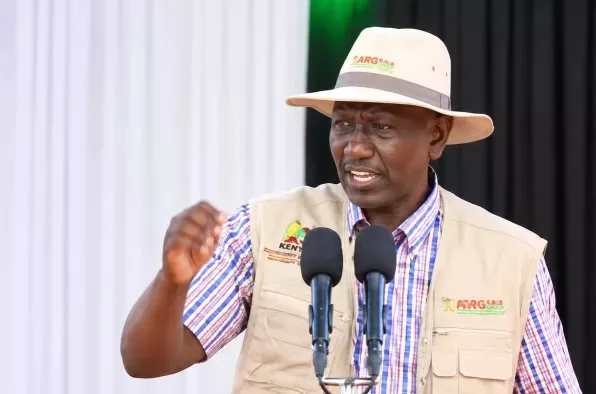
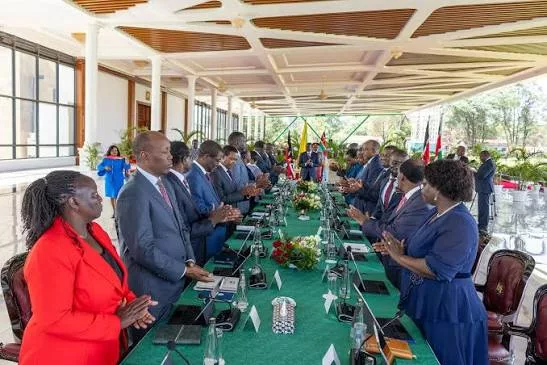
 High Court ruled 25-member Cabinet - 18 men and only seven women — violates Article 27(8) of the Constitution on two-thirds gender principle /FILE
Separation of powers
Parliament, particularly, usually raises this argument - when someone petitions the courts to declare that Parliament has not followed the constitution. The argument is essentially “Parliament is given this job and because of separation of powers no other branch of government can interfere with it.” In this case that (i) the President appoints Cabinet Secretaries (CSs) and (ii) the National Assembly approves them (or not); these tasks are not those of the courts.
This case, with its judgment on June 30, was only the latest in a long series, including in the Supreme Court, to dismiss this argument. What matters is what our constitution says. It does say that the people have delegated their sovereign power to legislatures at national and county levels, executives (Cabinet and county executive committees), courts and independent tribunals
However, the constitution is not saying to the branches of government: “This is your power and you decide how to use it and what the limits of those powers are.” All power, say Articles 1(1) and 2(2) must be exercised according to the constitution.
And the constitution is clear that the High Court is the body to decide whether anything that is “said to be done” under the constitution is in fact constitutional (Article 165(3)(d)). This does not mean the court decides who is to be a CS ¾ but it can decide if the process of appointment was constitutionally done and whether the individuals chosen meet constitutional requirements.
Gender and inclusivity
Article 27(8) says that the state must ensure that the “no more than two thirds of either gender” rule is satisfied for all “elective and appointive” agencies. This, the court said, is not - at least for appointive agencies like the Cabinet ¾ something that needs time to work on. It is an immediate obligation. Indeed, the judges were agreeing with earlier court decisions, one of which was also about the gender make-up of the Cabinet. That decided, in 2016, that President Uhuru Kenyatta’s Cabinet with 18 men and five women was unconstitutional. It ordered that following the 2017 election the Cabinet must satisfy the rule. The case was not appealed.
President Ruto was a member of that earlier Cabinet and could hardly fail to be unaware of the decision and the rule underlying it. An example of the “I don’t care what the constitution says unless it is to my benefit” approach that seems so common.
Parliament and the Attorney General (AG) in the new case raised arguments such as (i) factors other than gender are important in appointing Cabinet members and (ii) women were occupying some important Cabinet posts. These were dismissed as irrelevant to the Article 27(8) issue.
Another argument bound to fail was about the definition of “Cabinet”. The National Assembly said that the Cabinet includes the AG and the Secretary to the Cabinet - both women. On that basis, they said, only 62.5 per cent were men.
The flaw here was that the Secretary to the Cabinet is not a member of the Cabinet. The Secretary to the Cabinet is an officer in the public service and is not included in the definition of Cabinet in Article 152: the President and Deputy, the CSs and the AG.
The Cabinet, according to the court, in June this year, had 25 members, seven women and 18 men. The men were therefore 72 per cent of the body, unconstitutionally.
Who had acted wrongly? Clearly the President was the primary mover of the Cabinet make-up. But the actual appointments need the approval of the National Assembly.
Unlike the 2016 court, the recent court did not make a formal order on the National Assembly but it did say in its judgment that both the President and National Assembly “possess the constitutional capacity to ensure compliance with Article 27(8)”.
Inclusivity and representation
This was another argument doomed to fail. While reports from agencies like the NCIC show that some government agencies have a very limited range of ethnicities among their members, it is hard to show that the Cabinet is too restricted. While Kenyatta I had 28-31 per cent Kikuyus in his Cabinets, even he did not have exclusively Kikuyus. Kenya is not Nigeria (where “the President shall appoint at least one minister from each state, who shall be an indigene of such State”) - we have no rigid requirement. The Kenyan Cabinet must “reflect the regional and ethnic diversity of the people of Kenya”. If 42 (or 45?) “tribes” exist in Kenya (let’s not go into that!) they could not all be represented in a Cabinet of at most 25 members.
It was not surprising that the court found no breach of the constitution in this respect. It’s hard to say what full compliance would mean. Even to say groups must be roughly represented in proportion to their presence in the country would mean that the chances of people from the dozen or so groups with fewer than about 30,000 members each ever being in the Cabinet would be very low.
It’s not surprising that the court said that the diversity provision “embodies one of the central transformative objectives of the Constitution” but it also said the issue comes down to “whether the composition of the Cabinet demonstrates a genuine effort to reflect the diversity of Kenya and avoids domination by a particular region, community or interest group”.
On the question of presence of persons with disability, the court stressed this was to be achieved “progressively”, as Article 54(2) says. One wonders how progress is to be made - and for how long - at least for appointive bodies. Ensuring presence in elective bodies may be harder.
However, there is some sense in their saying that it does not require a Cabinet of 25 to have one member with a disability; overall their (PWDs) presence in at least appointive agencies should reach five per cent. Commissions, for example, are to have three to nine PWD members (Article 250(1)). Five per cent of nine is less than half a person.
Appointment of AG
Like the question of Secretary to the Cabinet, this shows some confusion about political and civil service appointments. Petitioners argued that Article 232, “Values and principles of public service”, applies to the AG who must therefore be appointed on the basis of “fair competition and merit”.
But the office of AG is a “State Office” (Article 260) and not an office in the public service (Article 156), so Article 232 is irrelevant.
Like other non-elected state officers, the AG ought to be selected “on the basis of personal integrity, competence and suitability” (Article 73(2)(a)). The court said this was satisfied for the CSs. It was raised in connection with the AG but the Court did not mention it in its decision on that officer.
What next?
The court said “a declaration of constitutional violation coupled with a mandatory structural order directing compliance within a period of 120 days constitute the most proportionate and effective remedy.” One hundred twenty days takes us to October 28.
An obvious problem is that there is no way of enforcing a court order against the President. When October 28 comes, if there are still more than 66 per cent men in the Cabinet, will someone go back to court to get the High Court’s order on unconstitutionality of the Cabinet? Or are we just back to where we were 10 years ago?
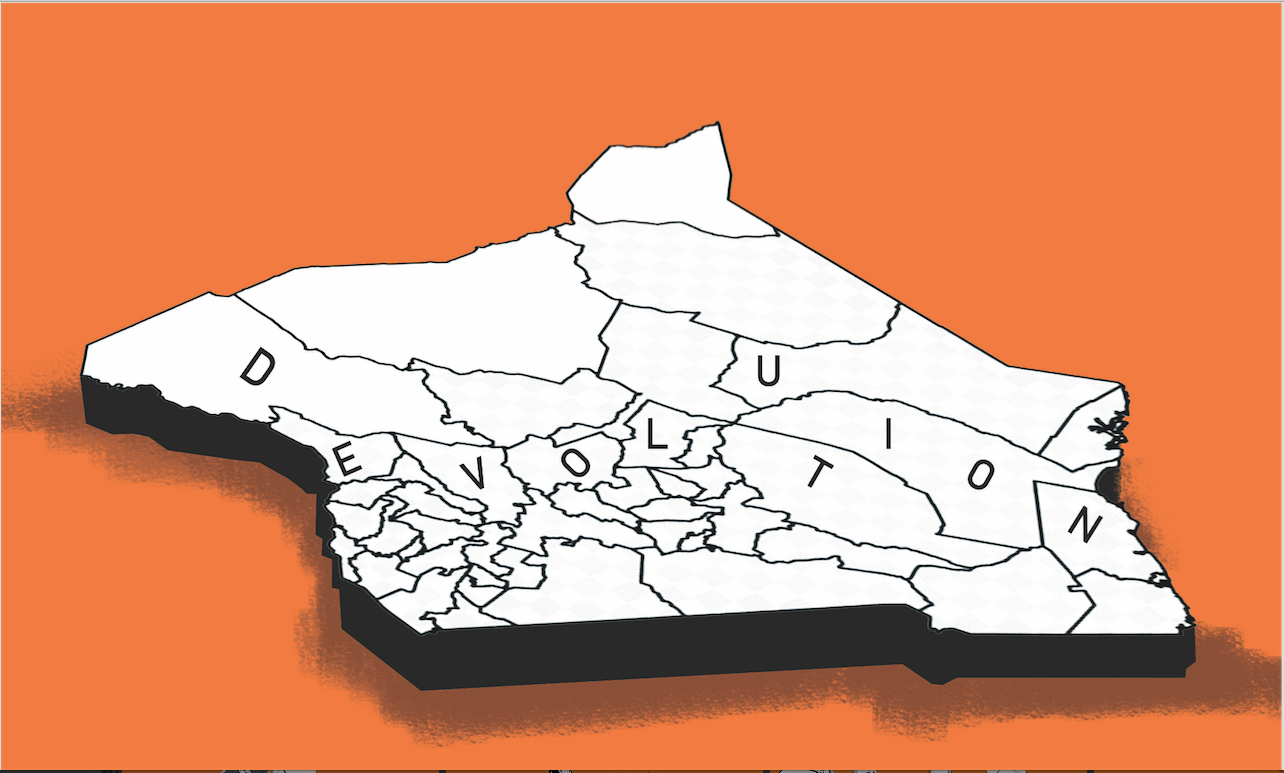
And, by the way, county executive committees are subject to the same rule. They include the governor and deputy as well as the members with portfolios. A quick check suggests Nairobi has 75 per cent men and Uasin Gishu 79 per cent men, for example.
Jill is a retired law teacher and member of the Katiba Institute Board. The author writes in her personal capacity