 The attack occurred almost simultaneously with another bombing at the US Embassy in Dar es Salaam, Tanzania.
August 7 remains etched in Kenya's history as one of the country's darkest days, not only because of the devastating loss of life but also because of the physical and emotional scars that thousands of survivors continue to carry.
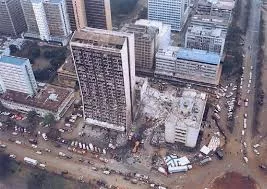
On that day in 1998, at around 10:30 am, Al Qaeda terrorists drove a truck laden with explosives and detonated it outside Ufundi Cooperative House, killing 213 people in Kenya and injuring more than 5,000 others. Among the dead were 44 US Embassy Nairobi staff.
The terrorists' target was the US Embassy in Nairobi, which stood adjacent to the 14-storey office building at the intersection of Moi Avenue and Haile Selassie Avenue.
The attack occurred almost simultaneously with another bombing at the US Embassy in Dar es Salaam, Tanzania.
Together, the two attacks occuring just 11 minutes of each other claimed 224 lives.
Al Qaeda leader Osama bin Laden later claimed responsibility, describing the bombings as retaliation against the United States over its close alliance with Israel and its political and military presence in the Muslim world, including Somalia.
Kenya and Tanzania were considered soft targets because Al Qaeda operatives had established an extensive logistical network and operational cell across East Africa.
Over the years, survivors of the Nairobi bombing have recounted the horrifying events of that morning in vivid detail, helping piece together what unfolded.
Among them was Cassandra Cooke, a Security Engineering Officer with the US Department of State's Diplomatic Security Service (DSS).
"It was another beautiful day in Nairobi. I was putting the finishing touches on a report while the rest of the Engineering Services Center (ESC) staff drove off to view new storage facilities at the warehouse compound on the other end of town," Cooke recalled in an account published in August 2017.
"I had just hit 'save' when I heard gunshots... and I immediately knew something was wrong. Then I heard the sound of an explosion."
Cooke said she instinctively leapt into the hallway, and just as she rounded the corner, the main blast struck.
"That instinctive response saved my life," she said. "Hundreds of pounds of steel and concrete now occupied the space where I had been sitting seconds before."
She recalled an enormous pressure wave sweeping down the corridor, almost knocking her off her feet.
"The sound was so great that it seemed soundless. A fierce wind of grit and debris filled the air. I stopped and dropped."
What followed resembled a scene from a disaster film. Power was cut, the air filled with the smell of cordite and dust, and thick black smoke quickly made breathing difficult.
"I knew that I had to get out of there. I was soon joined by a couple of others and we held hands as we groped in the dark for the nearest stairwell door. By the dim light in the stairwell, we found the stairs, which had turned into a slide of rubble. We stumbled and slid down them."
Another survivor, Stanley Macharia, a retired Kenyan police officer who later worked for the DSS, said he narrowly escaped death.
"I'm one of the people who would have died," he recalled during an interview nearly two decades after the attack.
Macharia said he had worked at the embassy for about a year after retiring as an assistant commissioner in the National Police Service.
About 15 to 20 minutes before the explosion, he walked from his office to the second floor to submit travel-related paperwork at the Financial Management Center.
He intended to wait for the documents to be processed before returning to his office. However, a clerk persuaded him not to wait, assuring him that he would personally deliver the papers once they were ready.
Macharia reluctantly agreed, believing the paperwork could easily have been delayed until the following Monday.
"I went back to my office. A few minutes later, my papers and that boy (the clerk) were no more."
Only three people from the Financial Management Center survived the blast.
"How I survived makes me believe God works wonders," Macharia said.
It was only after investigators reconstructed the sequence of events that he fully realised how narrowly he had escaped death.
Investigators established that the attackers had initially intended to drive the truck, loaded with about 2,000 pounds of explosives, into the embassy's underground parking garage.
However, an embassy security guard denied the truck entry and radioed for assistance.
At that point, one of the attackers threw a stun grenade. Many survivors, including the then US Ambassador to Kenya Prudence Bushnell, later recalled hearing what sounded like muffled sounds of construction work outside.
The stun grenade would later be blamed for significantly increasing the death toll.
Drawn by the unusual noise, many office workers left their desks and rushed to the windows to check what was happening outside.
Moments later, the truck bomb exploded, sending shattered glass and debris flying through nearby buildings and causing catastrophic injuries. Some survivors went blind after their eyes were severly damaged by flying debris.
For Macharia, survival came down to a split-second decision. When the stun grenade exploded, he initially walked towards a gate that would have taken him directly to the blast site.
"Then I have this funny feeling ... like, all is not well. Instead of going outside, something tells me to turn back. And I keep asking myself why. But I started running."
He had only just turned in the opposite direction when the bomb detonated, throwing him to the ground.
After regaining his footing, he rushed outside and saw colleagues and passers-by, including Ambassador Bushnell, covered in blood.
He helped her into an embassy vehicle and drove her to a nearby hotel to clean up before she returned to the bomb site, where an operations centre had been hastily established in an undamaged USAID office.
Today, the site of the bombing is home to a memorial garden where survivors, families of the victims, government leaders and religious groups gather every year to lay flowers, light candles and honour those who died.
Their names are inscribed on a memorial wall. The memorial also houses a museum where visitors can learn about the attack through photographs, artefacts and documentary films.
While American citizens, US government employees and Kenyan embassy staff received compensation, thousands of Kenyan civilians, including pedestrians and workers injured outside the embassy compound, remain uncompensated because of legal limitations.
In January 2026, the High Court in Nairobi dismissed a long-running compensation petition filed by Kituo Cha Sheria on behalf of local victims, ruling that the petitioners had failed to prove state liability or actionable negligence by the Kenyan government in preventing the attack.
The victims' legal team has since appealed the decision, while parliamentary committees continue to push for diplomatic efforts aimed at securing compensation for those who have yet to receive justice.