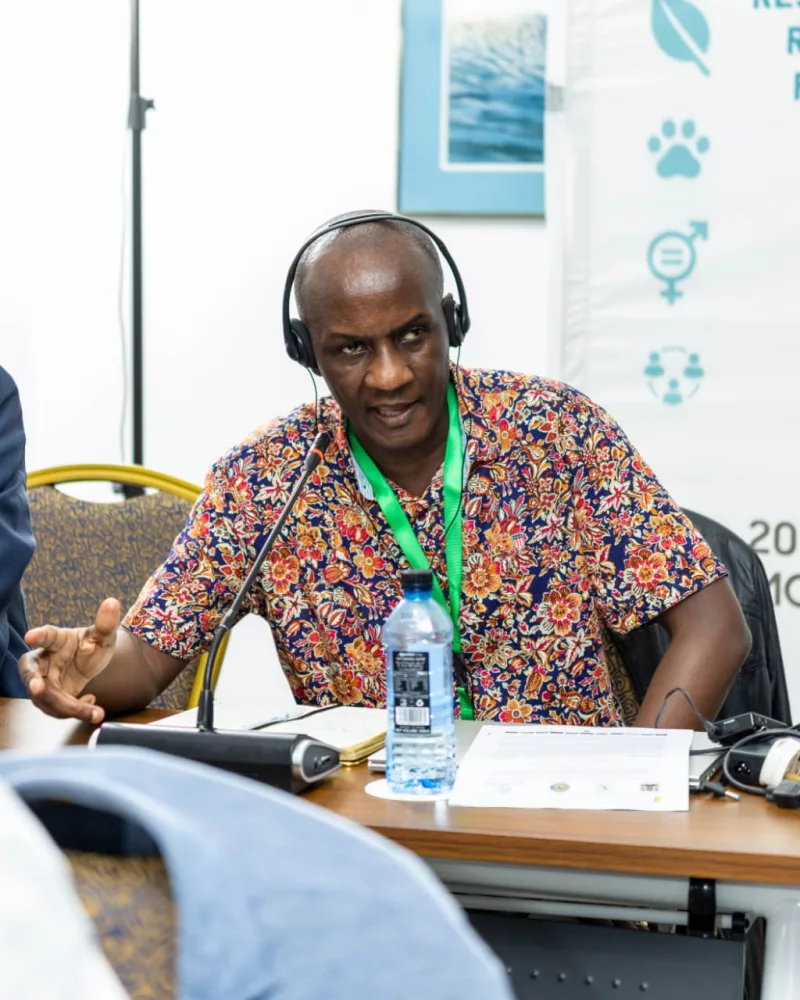
 Wilson Chandomba during IGAD’s meeting in Mombasa on July 22 / BRIAN OTIENO
Lack of confidence in its own capabilities is making Africa lag in the manufacturing sector, despite being rich in raw materials, expertise, and manpower, an expert has said.
Wilson Chandomba on Monday said many African countries have the capacity to manufacture their own products, but since they lack the courage and belief in themselves, they opt to import some of the products whose raw materials emanate from their very own backyards.
According to Chandomba, confidence is one of the most valuable assets in strengthening regional manufacturing.
“Confidence encourages investment. Confidence strengthens partnerships. Confidence supports procurement decisions. Confidence enables countries to rely on one another. Ultimately, confidence is built through evidence, not assumptions,” he said.
He said a look at the international organisations and the big companies reveals that many Africans work there.
“That means Africa has the expertise. But why don’t they apply that expertise at home for the benefit of their brothers and sisters?” Chandomba posed.
He is an African pharmaceutical value chain expert and founder and managing consultant of CMCOMMS Supply Chain Quality Assurance.
CMCOMMS Supply Chain Quality Assurance is an African-led organisation established in 2011 to strengthen the integrity of pharmaceutical and health supply chains across the continent.
Speaking to the Star on the phone, Chandomba said this is more so in the pharmaceutical sector, where manufacturing of drugs in Africa started way back in 1952.
“As Africa, we should have greater confidence in our own capabilities, especially in the pharmaceutical sector,” he said.
He said Africa is not starting from zero.
The continent has decades of pharmaceutical manufacturing experience, increasingly mature regulatory systems, expanding scientific expertise and stronger regional institutions than ever before.
“In Kenya, manufacturing of drugs started in 1957. Can we not look at the key lessons from the success stories? Can we not build on that and manufacture more drugs instead of relying on imports? We should stop underestimating ourselves. We are much closer than many people realise,” he said.
He said Africa could be the next pharmaceutical frontier, but only if countries stop seeing the continent as fragmented markets but as one connected ecosystem.
This way, he says, Africa will unlock enormous opportunities.
He said when Africa starts thinking as a region rather than as individual countries, it could leverage on the individual countries’ strengths and build one behemoth of a manufacturing powerhouse.
"One country may have manufacturing strengths, another regulatory excellence, another laboratory capacity, another logistics capability, another research expertise. Together, these strengths become a regional competitive advantage,” he explained.
His sentiments come two weeks after the Intergovernmental Authority on Development (IGAD) called for collaboration in the pharmaceutical sector, especially in the manufacture of pharmaceutical products and vaccines.
In an IGAD meeting in Mombasa, players in the pharmaceutical industry from across the continent said it is unacceptable that Africa imports 80 per cent of pharmaceutical products and about 99 per cent of vaccines.
“Basically, we are importing all health products,” Stephen Njuguna, the Community of Practice (COP) on Local Health Manufacturing chair, said at the IGAD meeting in Mombasa.
John Patrick Mwesigye, the East Africa Community regional centre of excellence for vaccines, immunisation and health supply chain management director, said Africa spends about USD28 billion (about Sh3.6 trillion) in importing pharmaceutical products and vaccines.
The African Union’s vision is to ensure the continent is able to produce 60 per cent of its pharmaceutical products and vaccines by the year 2040.
On Monday, Chandomba said Africa has reached a defining moment in its journey towards pharmaceutical self-reliance.
While the continent has made significant progress in strengthening local manufacturing, he said the next phase must focus on building regional manufacturing ecosystems that leverage the comparative strengths of individual countries rather than working in isolation.
The conversation, he said, is evolving from local manufacturing initiatives towards a regional manufacturing ecosystem, where countries cooperate, specialise and leverage one another's comparative strengths to ensure equitable access to quality, safe, effective and efficacious health products and technologies.
“Our conversation should now move beyond whether Africa can manufacture,” he said.
“The real question is whether we can build a regional ecosystem that consistently delivers quality, safe, effective and affordable health products to every patient, regardless of where they live."
He said no single country can realistically manufacture every essential health product or possess every specialised capability required across the pharmaceutical value chain.
“Africa's strength lies in regional collaboration, regulatory harmonisation, shared markets and coordinated investment,” Chandomba said.
He believes this ecosystem approach represents the natural evolution of IGAD’s Community of Practice (COP) on Local Manufacturing of Health Products and Technologies, which he said has created an important platform for governments, regulators, manufacturers, academia, procurement agencies, national medical stores, quality control laboratories, logistics providers, development partners and the private sector to work towards common regional goals.
“Manufacturing does not succeed in isolation. It depends on an ecosystem where policy, regulation, science, manufacturing, procurement, quality assurance, logistics and health systems function together.
“If one component is weak, the performance of the entire system is affected. Manufacturing creates products, but ecosystems create access,” he said.
Although he acknowledges remarkable progress has been made across the continent, Chandomba argues that the greatest challenge is no longer developing policies or adopting international standards but ensuring they are implemented consistently and effectively.
“Our next challenge is implementation. Standards establish what should happen, but implementation determines what actually happens. That is where countries now need to focus their attention,” he said.
He believes the next frontier is Implementation Assurance, a practical approach that demonstrates, through objective evidence, that systems are not only compliant on paper but are correctly implemented and functioning as intended on the ground.
"Implementation Assurance provides objective evidence that systems are working—from source to point of use.
“It demonstrates that quality management systems, regulatory requirements, procurement processes, storage, transportation and distribution controls are functioning together as intended.
“That evidence builds confidence among governments, manufacturers, development partners and, most importantly, patients,” Chandomba said.
He also believes regional integration will determine whether Africa achieves sustainable pharmaceutical manufacturing.
“If we continue thinking only within national borders, we limit ourselves. But if we recognise Africa as one interconnected market with a shared interest in protecting public health, we create the scale necessary for competitive manufacturing, stronger supply chains, regulatory reliance and more resilient health systems,” he said.
For Chandomba, the common interest extends beyond economic development.
“Our common interest is ensuring that every African has access to quality, safe, effective and efficacious health products and technologies whenever and wherever they are needed. That shared purpose should continue driving our collaboration,” he said.
“Africa has the knowledge, the talent, the institutions and the determination to succeed. What we need now is greater collaboration, confidence in our own capabilities and a relentless focus on implementation,” he said.
“The future of African pharmaceutical manufacturing will ultimately be defined not only by what we produce, but by how effectively we implement, collaborate and build confidence across the entire ecosystem.
INSTANT ANALYSIS:
With Africa having a population of approximately 1.58 billion, it can only enjoy economies of scale if it looks at the region and not the individual countries. This is why the Community of Practice (COP) was established in 2024 - to serve as a regional platform for cross-country learning and knowledge exchange. This is to ensure better access to medicines, vaccines, and medical devices for the African population.