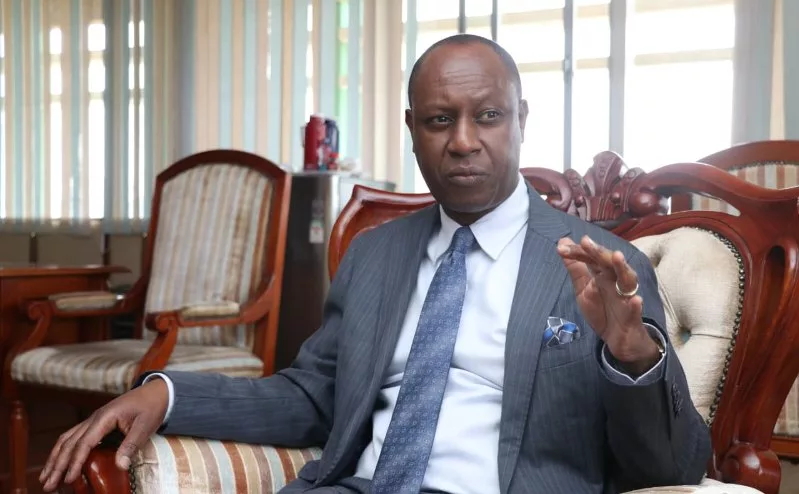
 State Department for Livestock Development PS Jonathan Mueke during an interview with the Star in his Kilimo House office on July 30, 2026 /LEAH MUKANGAI
Livestock PS Jonathan Mueke has dismissed claims he betrayed Wiper leader Kalonzo Musyoka. Despite serving as the pioneer Nairobi deputy governor on Kalonzo’s party ticket, he has maintained the former Vice President did not make him politically. In an exclusive interview with the Star, Mueke says he spent about 14 years working alongside Kalonzo without receiving a government appointment. He says his first major political breakthrough came under former Nairobi Governor Evans Kidero rather than the Wiper leader. Excerpts.
Critics say you betrayed Wiper leader Kalonzo Musyoka by joining President William Ruto's administration. Did you?
I do not agree with that narrative because Kalonzo did not make me politically. My first major political opportunity came through former Nairobi Governor Evans Kidero, who picked me as his running mate. That was not Kalonzo's decision.
Long before that, I contested the Westlands parliamentary seat on a Wiper ticket. After the election, I asked for an opportunity to serve in government, but I was told I was too young.
Later, after the 2017 elections and the Handshake, Wiper received several government positions, including ambassadorial appointments and board positions, but I was never considered. I worked with Kalonzo for about 14 years and received nothing.
When President William Ruto invited me to join his team in 2020, I accepted because I believed in his development agenda. Two years later, I was appointed PS. Those are simply the facts.
So, what convinced you to leave Kalonzo and work with President Ruto?
I wanted to be part of a government that focuses on transformation and development. Politics should ultimately be about improving people's lives. President Ruto presented a clear development agenda and I believed I could contribute to it.
Having served in government, I have seen projects move from the drawing board to implementation. Today, I can confidently point to roads, markets, electricity connections, dams and programmes that are changing lives. That is what convinced me. I made the right decision.
You recently accompanied President Ruto during his tour of Ukambani. Has the region's political landscape changed?
Completely. Ruto has done more development in Kitui over the last three years than at any other time since Independence. Because of those investments, Kitui is no longer an automatic opposition zone. It has become a political battleground. People vote based on what they see.
Today, we have about 150 kilometres of roads under construction in Kitui. More than 18 modern markets are being built.
The government has invested more than Sh2 billion in last-mile electricity connectivity.
Major water projects such as Thwake Dam are nearing completion, while the long-stalled Umaa Dam, which had remained dormant for almost 15 years, is finally progressing.
Kitui now has its first modern stadium, an upgraded airstrip and a livestock training institute that will serve nearly 10 counties.
Do you genuinely believe President Ruto can win significant support in Ukambani?
Absolutely. What is happening in Kitui is happening equally in Machakos and Makueni.
Every Friday and Monday, teams of leaders and supporters go into different constituencies to explain government programmes and show residents exactly what has been delivered. People appreciate facts.
Once they understand where public resources have gone and can physically see roads, markets, electricity and water projects, politics changes. Ukambani is no longer a guaranteed opposition region. It is becoming one of the country's key political battlegrounds.
Some leaders argue these are ordinary government projects that should not be politicised. How do you respond?
Government exists to deliver development. Citizens have every right to assess whether promises have been fulfilled.
When people compare what has been delivered over the years with what has been achieved in the last three years, they reach their own conclusions. Our work is simply to present the facts.
There is growing speculation that you could contest the Kitui governorship next year. Will you?
I have heard the calls from many people asking me to run. At the moment, I have not made that decision.
My responsibility today is to serve President Ruto as PS. I have not discussed elective politics with the President. Perhaps ask me again in about six months.
Let us turn to your work at the State Department for Livestock. What have been your biggest achievements?
We focused on the two Presidential Priority Value Chains—dairy and meat. When we assumed office, Kenya was producing about 4.6 billion litres of milk annually. Our target is to reach 10 billion litres.
Already, production has increased to about 5.5 billion litres, meaning we have added almost one billion litres within a relatively short period. Today, Kenya is the largest milk producer in Africa.
Our dairy exports have also grown significantly—from about Sh5 billion to nearly Sh15 billion.
What has driven this remarkable growth?
Three major interventions. First was the national livestock vaccination programme. Healthy animals naturally produce more milk.
Once diseases that suppress production were brought under control, milk yields increased dramatically. Secondly, we invested heavily in milk cooling infrastructure.
The government procured more than 230 milk coolers across the country.
Previously, farmers lost billions of shillings because milk spoiled before reaching processors.
Today, much more milk is preserved and sold. Thirdly, we introduced quality-based milk payment.
Instead of paying every farmer the same price, processors now reward quality.
Farmers producing cleaner milk with higher butterfat and protein content earn better returns.
Some are now earning up to Sh70 per litre because they have invested in animal health, feeding and hygiene. That encourages quality while increasing farmers' incomes.
The vaccination programme initially faced resistance. Has that changed?
Yes. Initially, some politicians discouraged farmers from vaccinating their livestock.
Then Meru, one of our biggest dairy-producing counties, experienced an outbreak of foot-and-mouth disease. Farmers immediately saw milk production collapse.
Someone producing 100 litres a day suddenly found themselves producing only 30 litres. The financial losses were enormous. Vaccination costs very little compared with the income lost when disease strikes. Once farmers experienced those realities, politics disappeared. Facts defeated misinformation.
How many animals have been vaccinated so far?
About 18 million animals over the last one and a half years. Our target is around 60 million.
We have also established a digital biosurveillance system that allows veterinary officers across counties to report disease outbreaks immediately.
Once an outbreak is detected, we coordinate a rapid response and targeted vaccination. That has greatly strengthened disease control.
Kenya's meat exports have also grown significantly. What changed?
Before introducing reforms, we conducted market studies in Saudi Arabia and the United Arab Emirates, which account for roughly 85 per cent of our meat exports. The markets wanted three things—quality, consistency and volume. Kenya already had quality livestock but could not guarantee a consistent supply. We also could not prove the animals had been vaccinated.
A vaccinated goat can fetch almost Sh4,000 more than one without proper health records.
Once we introduced vaccination, confidence in Kenyan meat increased.
As a result, meat exports have grown by about 87 per cent.
You have described Anitrack as one of the biggest reforms in the livestock sector. Why?
Anitrack, the digital livestock identification and tracking system, gives every animal a unique digital identity. For the first time, we can track livestock from birth to slaughter. Vaccination history, breeding records, ownership and movement are all digitally captured.
That level of traceability is required if Kenya wants access to premium export markets in Europe, China and the US.
It will also make livestock theft much harder because every registered animal will have a digital identity.
Finally, what is your long-term vision for Kenya's livestock sector?
Last year, the livestock sector generated almost Sh400 billion. Our goal is to grow that to Sh1 trillion by 2030.
If we successfully implement vaccination, breed improvement, Anitrack, livestock insurance, quality-based milk payment and the County Livestock Investment Companies programme, livestock will become Kenya's largest agricultural contributor. The demand already exists.
Our task is to organise farmers, maintain quality and produce consistently. That is exactly what these reforms are designed to achieve.