While humans typically require seven to eight hours of sleep each night, several members of the animal kingdom function on remarkably less rest.
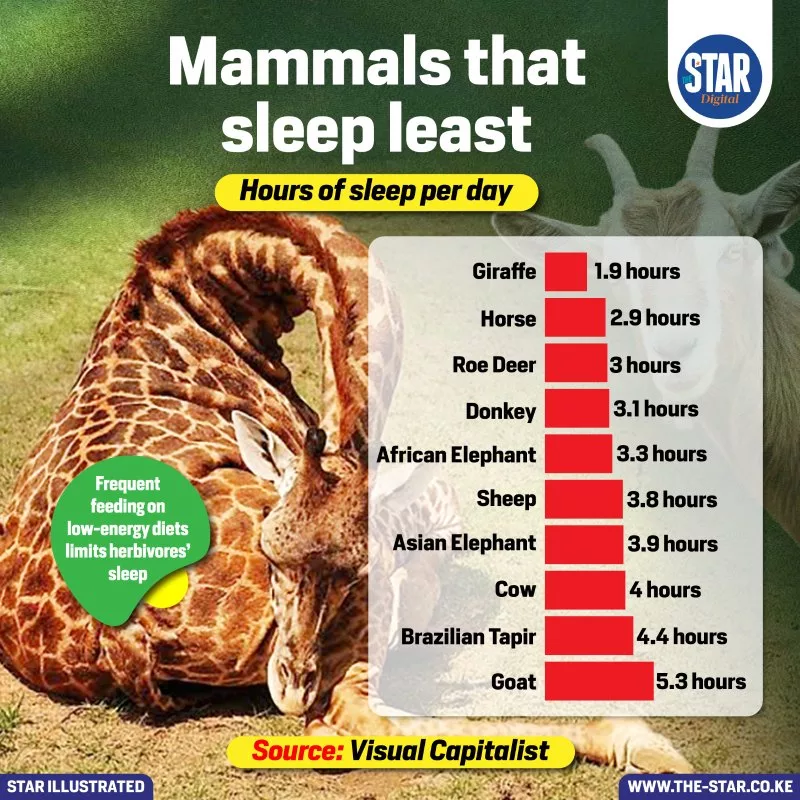
According to data from Visual Capitalist, frequent feeding on low-energy diets severely limits the amount of sleep herbivores can get each day.
Topping the list of mammals that sleep the least is the giraffe, which manages to survive on just 1.9 hours of sleep per day.
Horses follow closely behind, recording an average rest time of 2.9 hours daily, while roe deer secure approximately 3 hours of sleep.
Donkeys average 3.1 hours, slightly less than the African elephant, which logs 3.3 hours of sleep each day.
Other large herbivores also exhibit minimal daily sleep cycles. Sheep get around 3.8 hours of sleep, while their relative, the Asian elephant, sleeps for 3.9 hours daily.
Domestic cattle manage 4 hours of rest per day, followed by the Brazilian tapir at 4.4 hours. Among the animals highlighted, the goat sleeps the most, yet still only averages 5.3 hours of sleep in a 24-hour period.
The dietary demands of these herbivores play a central role in their brief sleep duration. Because plant-based food sources yield low amounts of energy, these animals must spend a vast majority of their daily lives feeding continuously to sustain themselves, leaving minimal time reserved for sleep.