

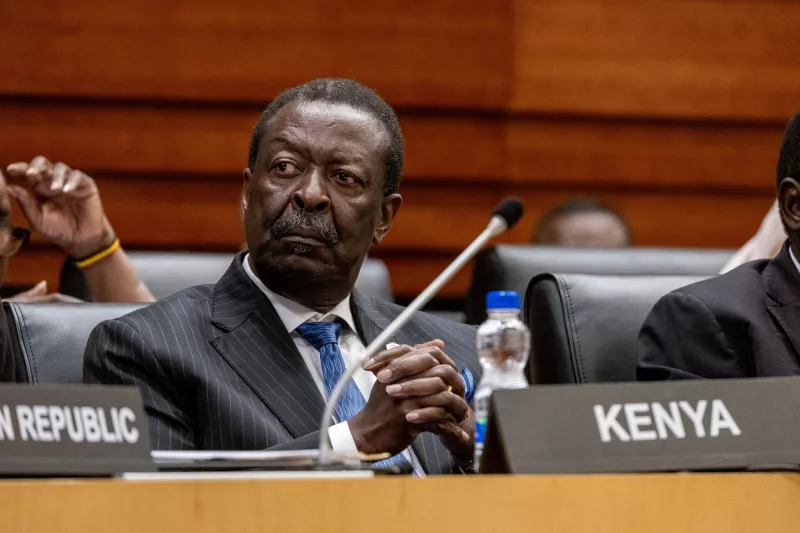
 Foreign AQAffairs,S Musalia Mudavadi
Auditor General Nancy Gathungu has flagged Sh2.65 billion in development funds that remained idle in bank accounts operated by Kenyan missions abroad at the close of the 2024-25 financial year.
“The statement of financial position reflects cash and cash equivalents balance of Kshs.3,575,290,181 which as disclosed in Note 15 to the financial statements, includes an amount of Kshs.2,649,907,845 in respect of unutilized development funds in Kenya Missions abroad.
“The balance has been built up over the years as a result of failure to surrender the unutilized development funds at the end of the financial year. However, Management did not explain how the amount would be utilized without factoring the same in the budget process,” Gathungu said in the report.
This marks a sharp increase from Sh1.8 billion reported in the previous audit.
The report said the accumulation of unutilised balances points to persistent weaknesses in project implementation and financial management within the State Department.
These means the funds transferred to the Kenyan missions to finance development projects remained unused long after disbursement.
The findings come at a time when several Kenyan missions have repeatedly cited inadequate funding for maintenance, renovations and operational expenses.
Consequently, the Auditor General exposes what appears to be a disconnect between available resources and implementation of planned projects.
The report identifies several missions where planned capital projects either stalled or failed to commence despite allocations having been made.
Among the concerns raised is the condition of Kenya House in Berlin, where the government-owned property continues to require major rehabilitation.
The audit also notes that the Ambassador's residence in the German capital remains in need of significant repairs despite previous commitments to restore the property.
In Dar es Salaam, the Auditor flagged delays in the renovation of staff houses as well as concerns over government-owned land that remained unfenced, exposing it to the risk of encroachment.
Other missions, including those in Paris and Abuja, were also cited over delayed maintenance and renovation works, adding to a growing list of government properties abroad that continue to deteriorate because of slow implementation of development projects.
The findings reinforce concerns that have been raised in previous audit reports over the management of Kenya's diplomatic assets overseas.
The latest audit also highlights the contradiction facing the Foreign Affairs ministry: while missions have consistently complained about inadequate financing to maintain government properties and meet operational needs, billions of shillings intended for development projects remain idle.
The issue had also emerged in reports by the Controller of Budget, which showed that several foreign missions received allocations for development and refurbishment but registered little or no expenditure on the approved projects during the review period.
The Controller warned that slow absorption of development funds continued to undermine implementation of planned projects, delaying much-needed rehabilitation of diplomatic properties.
Over the years, Kenyan ambassadors and heads of mission have repeatedly complained about ageing chancery buildings, leaking roofs, obsolete electrical systems and insufficient office space.
Some missions have also cited inadequate housing for diplomats and mounting maintenance bills for government-owned properties, forcing the ministry to defer critical repairs because of budget constraints.
The Auditor's latest findings, however, suggest that delayed procurement, weak project planning and implementation bottlenecks may be contributing as much to the deterioration as funding shortages.
The accumulation of idle balances also raises concerns over the efficiency of public spending at a time when the government continues to grapple with fiscal pressures and rising debt obligations.
Parliament has in recent years questioned the ministry over recurring audit queries involving delayed projects, poor asset management and weak financial controls across several missions abroad.
The latest findings also show that many of the State Department's longstanding financial management challenges remain unresolved despite repeated audit recommendations.
A review of issues raised in previous audit reports found the department had failed to address a raft of concerns touching on financial reporting, budget management, procurement, asset management and governance.
Among the outstanding issues are unreconciled bank balances, discrepancies in financial statements, pending accounts payable, delayed disbursement of funds to Kenyan missions abroad and procurement deficiencies at foreign missions.
Others are poor management of diplomatic assets, delays in presenting ambassadors' letters of credence to host nations, and weaknesses in governance systems for security-related expenditure.







