A new study by the Brookings Institution warns that unless the campaign finance laws are enforced, the next election risks being shaped by opaque funding, unequal competition and corruption.
This situation will allow wealthy interests to exert disproportionate influence over who contests, who wins and how elected leaders govern.
The report, Building Resilient Democracies: Campaign Finance Issues and Reforms in Kenya, says money has become one of the biggest threats to democratic accountability as political and business interests increasingly overlap.
"In Kenya and elsewhere in Africa, the role of money in politics has been a concern, especially because politics and businesses often intertwine, thereby leading to corruption and abuse of office by public leaders," the report says.
The warning
comes as the Independent Electoral and Boundaries Commission moves to
operationalize campaign financing rules ahead of the 2027 polls following years
of failed implementation.
 Under the
draft framework, a presidential candidate would be allowed to spend up to Sh4.4
billion, while a political party fielding candidates for all elective seats
would have a spending ceiling of Sh17.7 billion.
Under the
draft framework, a presidential candidate would be allowed to spend up to Sh4.4
billion, while a political party fielding candidates for all elective seats
would have a spending ceiling of Sh17.7 billion.
The limits for governors, senators, woman representatives, MPs and MCAs would vary depending on the size and population of their electoral areas.
For instance, gubernatorial candidates in counties such as Turkana and Nairobi would be allowed to spend more than Sh100 million, while parliamentary candidates in some constituencies could spend up to Sh94 million.
The regulations would also require candidates and political parties to operate designated campaign bank accounts, disclose campaign contributions and expenditure, and submit financial returns to the IEBC.
Although Parliament enacted the Election Campaign Financing Act (ECFA) in 2013 to regulate campaign spending, expenditure limits and donor disclosures were suspended before both the 2017 and 2022 polls, leaving candidates free to spend without enforceable ceilings or meaningful transparency.
According to Brookings, the result has been an electoral system where financial muscle increasingly outweighs ideas and policy.
Without spending limits, wealthy candidates enjoy a significant advantage over less affluent rivals.
Voters however, remain in the dark about who finances campaigns and what interests successful politicians may later serve.
The report argues that campaign financing extends well beyond elections because it ultimately influences public policy and government decision-making.
It warns that politicians who spend heavily to win office often face pressure to recover campaign costs through abuse of public resources, patronage networks or preferential allocation of government contracts.
“The use of money in politics and the lack of transparency in sources of funding and how resources are used has potential of contributing to corruption and the manipulation of voters," it adds.
Unlike previous election cycles, however, there are signs that campaign finance regulation could finally take effect before Kenyans return to the ballot in 2027.
A key turning point came after a High Court ruling overturned one of the biggest legal obstacles that had stalled implementation of the law for years.
In 2021, the IEBC prepared draft campaign finance regulations, but Parliament declined to approve them, arguing that the Commission lacked authority to publish the rules without parliamentary approval.
Civil society organisations challenged that position, accusing legislators of frustrating reforms that would expose campaign financiers to public scrutiny.
The High Court subsequently ruled that provisions empowering the IEBC to set campaign spending limits and disclosure requirements do not require parliamentary approval, provided the Commission conducts adequate public participation.
The judgment effectively cleared the way for the electoral agency to proceed with implementation.
Building on that decision, the IEBC has stepped up preparations to regulate campaign financing before the next General Election.
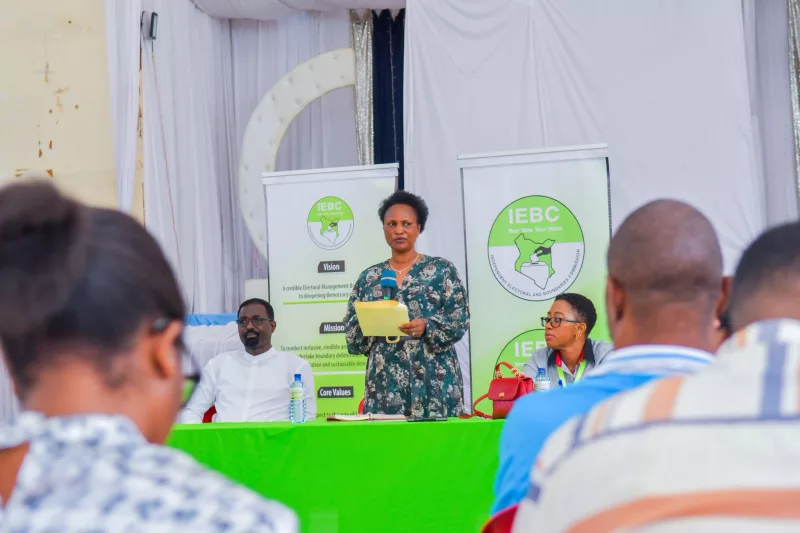
IEBC Chairperson Erastus Ethekon has urged Parliament to enact a comprehensive campaign finance law, warning that the current legal vacuum leaves elections vulnerable to unchecked spending, illicit funding and foreign influence.
The Commission is also reviewing public submissions on proposed regulations covering expenditure ceilings, disclosure requirements and financing limits as part of wider electoral reforms.
Brookings says, however, that regulations alone will not guarantee cleaner elections.
The study calls for stronger enforcement powers for the IEBC, stricter disclosure requirements for candidates and political parties, and sustained oversight by the courts, civil society and the media.
Without effective enforcement, the report warns, campaign finance reforms risk becoming little more than legal provisions on paper.
With campaigns already gathering pace, the study says the remaining period will determine whether Kenya holds its first election under a transparent campaign finance regime—or whether billions of shillings will once again flow through campaigns beyond public scrutiny.