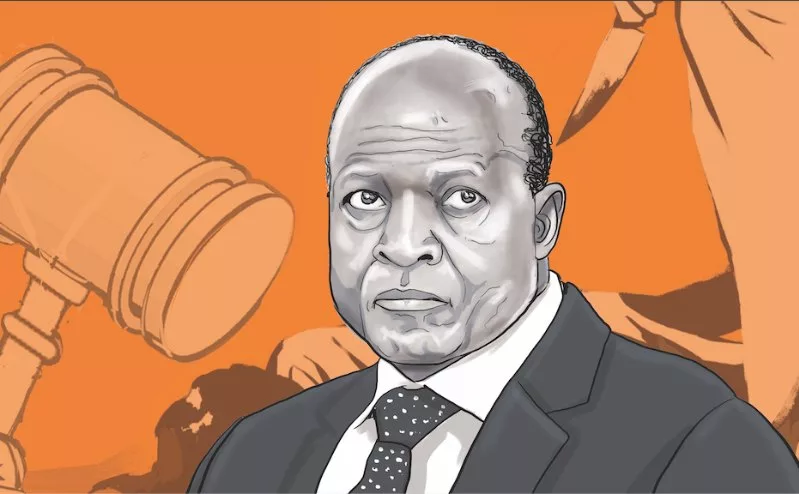
There is nothing particularly striking, let alone spectacular, about Zacharia Okoth Obado.
In speech, he is so soft-spoken as to be barely audible, and thoroughly unimpressive.
A thick Luo accent wrestles constantly with a heavy tongue, loudly betraying his rural upbringing.
His physical inventory offers little to write home about either: a slender, bony frame, browless eye sockets, prominent cheek and jawbones, razor-thin lips and an aggressively receding hairline.
In action, he is about as expressive as a wet weekend. In thought, absolutely unremarkable. There is virtually no quote, no memorable saying, and certainly no philosophy associated with his name.
As for his political pedigree, the most he could boast of was a rather obscure background in sugar politics, small-scale farming and trade.
Yet, for 10 solid years, between 2013 and 2022, this human equivalent of beige presided over the executive affairs of the entire Migori county.
In fact, his initial electoral win was a coup of sorts. He somehow defied the roaring Orange Democratic Movement (ODM) wave in Luo Nyanza to clinch the gubernatorial seat on a ticket from the virtually unknown People’s Democratic Party (PDP).
By the 2017 election, he graciously allowed ODM to welcome him back—strictly on his own terms—and cruised to a second term.
Not once, but twice, through universal suffrage, the good people of Migori entrusted this man with the delicate task of steering their collective destiny.
Throughout his tenure, he remained a cold, calculative, average and stubbornly resolute political character.
Behind this aggressively boring demeanour, however, lay a cold-hearted, ruthless monster—finally unmasked by the High Court last week.
Obado was convicted of the gruesome 2018 murder of his then-girlfriend, Sharon Otieno. Alongside his two aides, the former governor is currently cooling his heels in remand, awaiting sentencing next month.
The events leading to the murder most foul are commonplace. In philandering, Obado impregnates Sharon, who then begins making demands for greater comfort.
Initially, he plays along but changes course midway.
Rather than negotiate an amicable settlement with Sharon, Obado elects to eliminate her altogether, along with her unborn baby.
It strains the imagination to figure out how he hoped to get away with such a horrific crime in the digital age, let alone how he planned to sleep at night if he did.
Yet, according to court findings, he had absolutely no qualms conjuring up a plot to permanently silence the young college student, all to save himself a bit of public embarrassment.
To Obado, Sharon was not a human being; she was merely an inconvenient PR problem.
The execution of the crime was as clumsy as it was barbaric. Sharon, along with a journalist who was helping her, was crudely abducted and driven toward a forest.
In a twist of fate for which we must thank the heavens, the hit job was so poorly planned that the journalist managed to leap out of the moving vehicle, surviving to tell the tale.
Sharon, tragically, was not as lucky; she was brutally violated and stabbed to death.
This sordid affair leaves us with uncomfortable questions.
How does a man of such base instincts end up presiding over the lives of a million citizens?
Beyond Sharon’s tragic death and the massive corruption uncovered during his tenure, one wonders just how many other bones are rattling around in Migori and other gubernatorial closets.
More broadly, what does this saga say about the quality of our democratic processes?
Obado’s indictment is not just an isolated tragedy; it is a damning indictment of an electoral system that consistently plucks villains, cheapskates and moral vacuums from the bottom of the social pyramid and deposits them right at the top.
It is a stark reminder of the dangers of elevating individuals whose personal ethics wouldn't pass muster at a village bar, let alone a state office.
An ignoble sensualist—someone enslaved by their lowest appetites, be it sex, food or cash—should never be allowed near a steering wheel of power.
Such scoundrels certainly have their place in society, perhaps in the rogue's gallery or a maximum-security facility, but absolutely not in leadership.
Political leadership is a serious enterprise. It is high time we ring-fenced it against lowlifes and scoundrels.
Advocate of the High Court and Senior Project Manager with the Friedrich Naumann Foundation. The views expressed here are his own