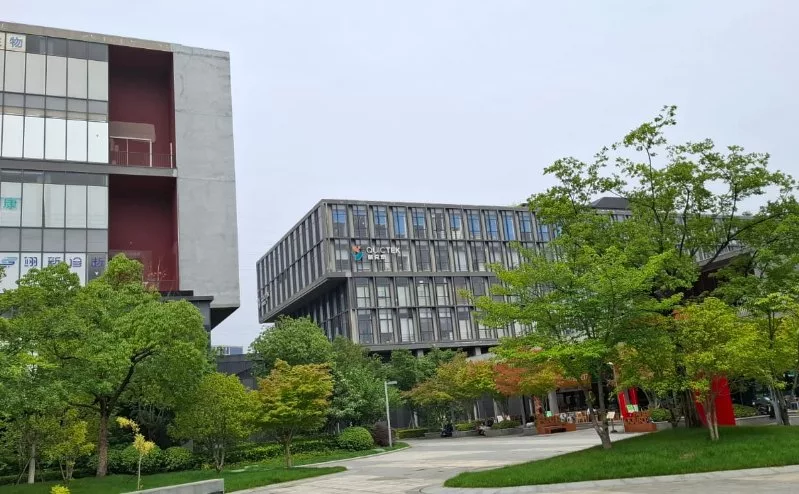
 Medpark Industrial Park, Suzhou city, China /HANDOUT
On the eastern edge of China, where canals weave through centuries-old neighborhoods and ultra-modern factories stretch for kilometres, lies one of the country's most remarkable economic success stories.
Suzhou was once known mainly for its classical gardens and silk production. Today, it is among China's manufacturing powerhouses, home to globally competitive industrial parks that have attracted thousands of companies, generated millions of jobs and become symbols of China's economic transformation.
For many African officials attending a two-week China Aid Seminar on the Construction and Management of Industrial Parks for African English-speaking countries at the Suzhou University of Science and Technology (SUST), the visit offered more than classroom lessons. It was an opportunity to witness how decades of planning, policy consistency and investment have reshaped entire cities.
The seminar, which brought together participants from Kenya, Ethiopia, Nigeria, Rwanda, Cameroon, The Gambia, South Africa and several other African countries, came at a time when many African governments are investing heavily in industrial parks and Special Economic Zones (SEZs) to spur manufacturing, create jobs and diversify their economies.
For Kenya, the experience raises an important question: What exactly makes China's industrial parks work, and can those lessons be replicated back home?
More than factories
Industrial parks are often viewed simply as areas where factories are built.
China sees them differently.
Across the country, industrial parks function as complete economic ecosystems. Manufacturing plants sit alongside research centres, universities, logistics hubs, housing estates, hospitals, commercial districts and recreational facilities.
The idea is simple.
Workers should not spend hours commuting. Companies should easily access suppliers. Universities should produce graduates with skills needed by industries nearby. Roads, railways, ports and airports should seamlessly connect manufacturers to domestic and international markets.
Everything is planned as one integrated system.
That integrated approach has become one of the defining characteristics of China's industrialisation strategy.
Speaking during the seminar, SUST Vice Dean Hu Ying said industrial parks have become strategic platforms for countries seeking to reorganise industries and strengthen economic competitiveness.
"Against the backdrop of the accelerated reconstruction of global industrial and supply chains, industrial parks have emerged as a pivotal platform for African countries to pool industrial resources, optimise business environments and fuel economic growth," she said.
She urged developing countries to improve planning, management and maintenance systems while continuously upgrading industries.
The message resonated with many participants.
Rather than measuring success by the number of factory buildings constructed, the emphasis was on creating environments where businesses can grow for decades.
 Medpark Industrial Park, Suzhou city, China
China's industrial revolution did not happen overnight
China's rise as the world's manufacturing powerhouse is often associated with massive factories, exports and infrastructure.
Yet the country's transformation took decades.
Following economic reforms launched in 1978 under Deng Xiaoping, China gradually shifted from a centrally planned economy towards a more market-oriented model while opening itself to foreign investment.
One of the boldest decisions came in 1980 when the country established its first Special Economic Zones in Shenzhen, Zhuhai, Shantou and Xiamen.
These zones offered investors tax incentives, simpler regulations and better infrastructure.
The experiment worked.
Shenzhen, once a fishing village of about 30,000 people, has since grown into a global technology hub with a population exceeding 17 million. It hosts companies including Huawei, Tencent, DJI and BYD, illustrating how long-term industrial policy can reshape entire regions.
According to the World Bank, China's sustained investment in manufacturing, infrastructure and export-oriented industries lifted hundreds of millions of people out of poverty over four decades while transforming the country into the world's second-largest economy.
Today, China hosts hundreds of national and provincial development zones, many specialising in sectors such as electronics, biotechnology, automobiles, artificial intelligence and renewable energy.
Their success has relied not only on infrastructure but also on stable policies that gave investors confidence to commit billions of dollars over long periods.
Planning beyond political cycles
One lesson repeatedly emphasised throughout the seminar was the importance of sticking to long-term development plans.
Unlike projects that change direction whenever political leadership changes, China's industrial parks are developed over decades.
Master plans guide land use, transport systems, utilities, environmental conservation and industrial clustering.
Participants heard that changing approved plans midway can discourage investors, increase costs and undermine confidence.
Architect Shadrack Tulon Kimeli, Chairman of the Lands Committee and Board member at the LAPSSET Corridor Development Authority in Kenya, said consistency remains one of the biggest lessons African countries should embrace.
"We cannot afford to overlook the need for long-term planning and inclusive, eco-friendly buildings as well as sticking to the approved plans," he said.
He noted that industrial parks should become centres of investment, innovation and employment rather than merely pieces of physical infrastructure.
For Kenya, where changes in policy and project priorities sometimes accompany changes in administration, maintaining continuity could significantly improve investor confidence.
Reform and opening up
China's industrialisation story is also closely tied to economic reforms.
Dr. Yuan Lihong, a lecturer in Modern World History, told participants that reform alone would not have been enough.
"We can't have reform alone without opening up. They go hand in hand," she said.
China gradually opened its economy to foreign investment while maintaining development strategies suited to its national priorities.
The approach attracted multinational companies seeking competitive production bases while simultaneously building local industrial capacity.
Over time, Chinese firms learned from foreign manufacturers, improved technology and developed globally competitive products.
This combination of openness and domestic capability building helped move Chinese industries from labour-intensive manufacturing into advanced technology sectors.
 A robot at an Industrial park in Suzhou city, China
The power of industrial clusters
Another noticeable feature of China's industrial parks is specialisation.
Instead of every industrial park attempting to manufacture everything, many focus on specific industries.
One city becomes known for electronics.
Another specialises in medical devices.
Others dominate textile production, automotive manufacturing, renewable energy equipment or biotechnology.
This clustering creates powerful business networks.
Suppliers, manufacturers, logistics companies, researchers and skilled workers all operate within the same ecosystem.
Production costs fall. Innovation accelerates. Knowledge spreads faster. Businesses become more competitive globally.
Economists have long argued that industrial clusters increase productivity by allowing firms to share suppliers, labour markets and specialised services.
China has applied this principle extensively.
Green industry is no longer optional
Environmental sustainability featured prominently throughout the seminar.
Participants were encouraged to integrate green infrastructure into industrial planning from the beginning instead of treating environmental protection as an afterthought.
China itself has faced significant environmental challenges during rapid industrialisation.
In recent years, however, the country has invested heavily in cleaner production, renewable energy, energy-efficient buildings and ecological restoration.
Many newer industrial parks incorporate green buildings, waste recycling systems, water treatment facilities and renewable energy technologies.
Professor Qiu Dehua, Dean of the School of Architecture and Urban Planning at SUST, said participants were expected to study practical examples that could be adapted within their own countries.
"China's exploration and experience in comprehensive industrial park planning, construction and management will provide abundant real-world cases for all participants to analyse, discuss and adapt to their own context," he said.
The emphasis was not on copying China exactly but understanding principles that could be adapted locally.
Skills matter as much as roads
Modern factories cannot succeed without skilled workers.
China invested heavily in education, vocational training and technical universities to supply industries with qualified personnel.
Many industrial parks maintain close partnerships with universities and research institutions.
Students undertake internships. Researchers solve industrial problems. Businesses commercialise innovations. This close collaboration shortens the gap between education and employment.
African countries face similar opportunities.
Expanding technical education alongside industrial development could help reduce unemployment while improving productivity.
Africa's shared challenges
Participants noted that despite differences in geography and economic size, many African countries face similar industrialisation challenges.
Limited infrastructure, high logistics costs, policy uncertainty, expensive financing.
Skills shortages.
President of the Confederation of Gambian Industries, Farimang Saho, said the seminar provided a valuable platform for countries facing similar obstacles.
"Even though we are from different countries, the challenges of industrial development are somewhat similar," he said.
He expressed optimism that lessons learned could improve planning and management of industrial parks back home.
 A guide at Medpark Industrial park explains how research is conducted and products developed, Suzhou, China /HANDOUT
Kenya's industrial ambitions
Kenya has not been idle.
The government has identified manufacturing as a major pillar of economic transformation under successive national development strategies.
Several Special Economic Zones and industrial parks are already operational or under development.
Konza Technopolis aims to become a technology and innovation city.
Dongo Kundu Special Economic Zone seeks to strengthen manufacturing and logistics linked to the Port of Mombasa.
The Naivasha Special Economic Zone leverages the Standard Gauge Railway and geothermal energy to attract manufacturers.
Tatu City continues attracting local and international investors in manufacturing, logistics and services.
The LAPSSET Corridor seeks to unlock economic opportunities across northern Kenya while improving regional connectivity through roads, railways, ports and logistics infrastructure.
According to the Kenya Investment Authority, Special Economic Zones offer investors tax incentives, improved infrastructure and simplified regulatory processes designed to attract investment.
These initiatives reflect Kenya's determination to expand manufacturing and increase exports.
However, infrastructure alone will not determine success.
Where Kenya can improve
China's experience suggests several practical lessons.
First, industrial parks require long-term policy stability.
Investors making billion-dollar commitments need confidence that regulations, incentives and development plans will remain predictable.
Second, transport infrastructure must connect seamlessly with industrial production.
Roads, railways, ports, airports and energy systems should complement rather than compete with one another.
Third, industrial parks should develop around sectors where Kenya enjoys competitive advantages.
These include agro-processing, pharmaceuticals, textiles, leather, electric mobility, digital services and renewable energy technologies.
Fourth, environmental sustainability should become a central design principle.
Green industrialisation is increasingly becoming a requirement for accessing global markets.
Finally, industrial parks should be integrated with universities, research institutions and technical training centres to continuously supply skilled workers.
Looking beyond buildings
Successful industrial parks are ultimately built around people rather than infrastructure alone. While factories, roads and power lines are essential, they are only part of the equation. The experience in Suzhou demonstrates that physical infrastructure delivers lasting results only when it is supported by strong institutions that create an environment where businesses and industries can thrive.
The evolution of China's industrial parks over several decades has been underpinned by strong planning, transparent governance, efficient public services, reliable regulations and continuous innovation. Together, these elements have enabled the parks to grow beyond manufacturing centres into sustainable engines of economic development.
The seminar itself forms part of China's broader human resource development programme under the China Aid initiative. Since 1993, SUST has trained more than 2,500 participants from over 130 developing countries in areas including urban planning, environmental engineering, logistics management, energy science and education.
For African delegates, the experience was less about importing a Chinese model than understanding why it works.
The answer lies not in impressive skylines or enormous factories.
It lies in disciplined planning, consistent implementation and a willingness to invest patiently over generations.
As Kenya expands its own network of industrial parks and Special Economic Zones, those lessons may prove just as valuable as the infrastructure itself.
The buildings can be constructed within a few years.
Building the institutions that make them succeed takes much longer.
China's experience shows that, with patience and consistency, the returns can transform an entire economy.