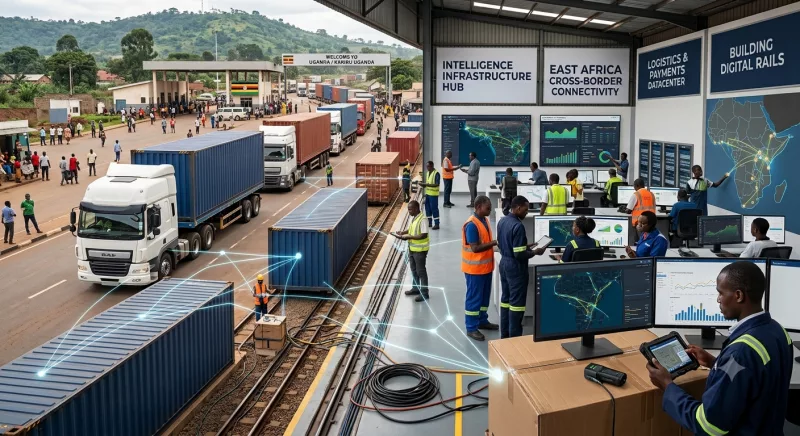
 AI ILLUSTRATION
Artificial intelligence has captured the world's imagination. Every week brings another breakthrough model, AI assistant, or prediction that technology will fundamentally reshape how we live and work. Yet beneath the excitement lies a more important question: what makes artificial intelligence valuable at scale?
The answer is not simply better algorithms or more powerful models. AI is only as capable as the infrastructure beneath it: the digital rails that collect data, move information, connect businesses, and enable better decisions. Just as roads, ports, and electricity powered the industrial economy, intelligence infrastructure is emerging as the foundation of the AI economy.
For Africa, this presents an opportunity not simply to catch up, but to build differently. Rather than replicating systems designed elsewhere, the continent can develop intelligence infrastructure tailored to African markets, institutions, and customer needs.
This opportunity is particularly significant in East Africa, where mobile money and a new generation of technology companies have transformed financial services, retail, transport, healthcare, agriculture, and logistics. Yet the region continues to face a fundamental contradiction: economic activity is becoming increasingly regional, while the systems that support it remain largely national, fragmented, and difficult to integrate. A shipment traveling from the Port of Mombasa in Kenya to Kampala in Uganda may pass through multiple logistics providers, payment systems, and regulatory processes. A farmer selling produce across borders may still lack access to reliable pricing, traceability, finance, or real-time transport information. A patient may seek treatment in another country while their medical records remain locked within a single facility. Regional businesses often operate without a unified view of customers, inventory, payments, or risk. This fragmentation is precisely why Gullit VC is investing in intelligence infrastructure.
By intelligence infrastructure, we do not mean artificial intelligence alone. Nor are we referring only to data centres, fibre networks or cloud computing. We mean the interconnected digital systems that allow economic activity to be captured, organised, understood and acted upon. These systems include connectivity, payments, digital identity, cybersecurity, cloud computing, APIs, data platforms, analytics and operational networks. Together, they transform isolated transactions into reliable information and reliable information into better decisions.
Every major technology shift has depended on foundational infrastructure. The internet required broadband networks, mobile money depended on trusted payment rails, e-commerce relied on digital payments, logistics and fulfilment systems. Likewise, AI depends on structured data, interoperable systems and resilient operational networks. Without these foundations, AI remains an impressive demonstration rather than a scalable business capability.
Some of East Africa's most enduring technology companies will not be those building yet another standalone application. They will be the companies connecting fragmented sectors by integrating payment providers, transport operators, warehouses, health facilities, merchants and regulators. In this environment, operational integration will become intellectual property. The opportunity is already visible across several sectors.
In logistics, intelligence infrastructure provides end-to-end visibility from ports and border posts to warehouses and final delivery. Every shipment generates data. Every warehouse improves forecasting. Every delivery creates new insight into demand, routing, and inventory. Logidoo, a Gullit VC portfolio company, is building Africa's digital commerce infrastructure by connecting warehousing, fulfilment, and cross-border logistics through data-driven technology that enables smarter, more efficient trade.
In transport, the opportunity extends well beyond digital ticketing to demand forecasting, route optimisation, fleet management and integrated payments. Another Gullit VC portfolio company, Buupass, demonstrates how technology can bring structure and intelligence to fragmented transport networks by building Africa's mobility infrastructure through digitization of transport booking and payments, generating the data and connectivity that enable smarter travel and logistics systems.
In financial services, the next opportunity lies in expanding beyond mobile money into regional merchant payments, digital identity, fraud detection, and cross-border settlement. Gebeya similarly demonstrates how digital infrastructure can organise and unlock access to African professional talent by connecting businesses with vetted digital professionals while helping organisations build, manage, and scale technology talent across Africa.
These varied sectors share the same underlying principle: that technology creates greater value when embedded within real operational workflows and connected to existing economic infrastructure. This is also where the commercial opportunity becomes particularly compelling.
Strong intelligence infrastructure can generate recurring revenues through subscriptions, transaction fees, enterprise contracts, embedded finance and analytics products. As these networks expand, they accumulate valuable operational data that continuously improves forecasting, risk assessment, service delivery and product development. Over time, this creates network effects, higher switching costs and stronger competitive advantages.
East Africa is not a single homogeneous market. Its economies differ in regulatory frameworks, infrastructure maturity and commercial realities. Successful regional companies will therefore build modular systems that adapt locally while remaining interoperable across borders.
The region must establish robust frameworks governing where data is stored, how it is used, how consent is obtained and how organisations exchange information securely. Cybersecurity, privacy and responsible AI cannot be treated as compliance requirements introduced after growth; they must be embedded into products from the outset.
The region must also avoid a future in which it generates valuable data but captures little of the economic value derived from it. Strategic control does not require digital isolation. East Africa will continue partnering with global technology companies and investors. Still, its businesses, institutions and citizens must play a meaningful role in the ownership, governance and commercialisation of regional data. Governments can accelerate this opportunity by supporting interoperable payment systems, compatible digital identities, clear cross-border data frameworks and harmonised electronic transaction standards. Corporates can open appropriate systems for integration, partner with startups and treat operational data as a strategic asset. Investors, meanwhile, must provide capital suited to the realities of infrastructure-oriented businesses.
In many cases, this will require financing structures that combine venture equity with debt, guarantees, development finance or strategic corporate investment. Founders, for their part, must remain focused on solving genuine operational challenges. Artificial intelligence should strengthen a business model, not substitute for one.
Africa's next technology breakthrough will not be defined solely by the number of AI applications it creates. It will be defined by whether the continent builds the systems that enable its markets to understand themselves, connect more effectively and make better decisions from the information they generate.
That is the opportunity Gullit VC sees in intelligence infrastructure: companies that transform fragmented economic activity into connected, trusted and actionable intelligence. When Africa's systems can communicate seamlessly, its markets can scale more efficiently. When its data becomes usable, its institutions become more effective. And when intelligence is embedded across trade, transport, healthcare, agriculture and finance, the continent will not simply participate in the next digital economy, rather, it will help shape it.