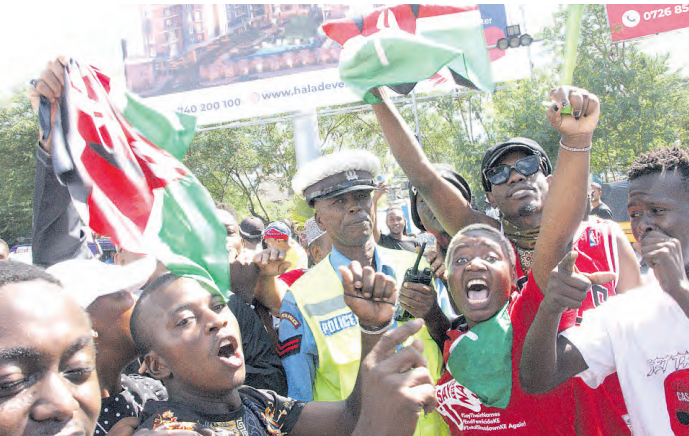
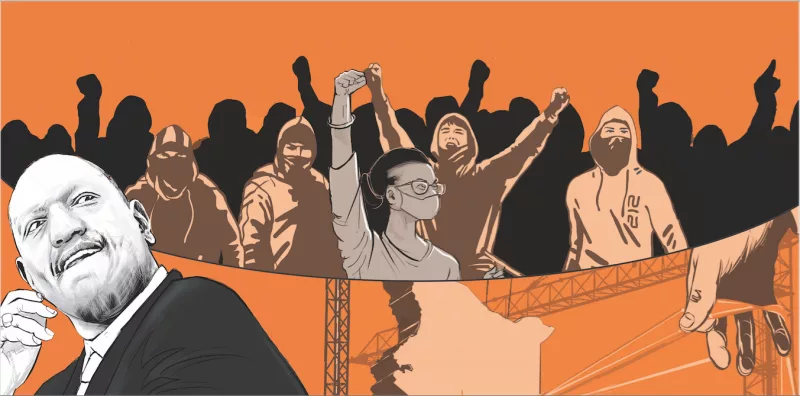
 Routine protests cause disruption, death and injury, crime and property destruction /STAR ILLUSTRATION
Since the Gen Z protests of 2024, the country has witnessed repeated civil disobedience every year. In every such demonstration, lives have been lost and injuries sustained. Businesses have been disrupted and property destroyed.
The government spends inordinate sums of fund to support emergency security operations. The insecurity that arises promotes criminal activities and establishes political instability. These events create hostile environment for national development.
While it is the duty of the government to provide leadership for development, every citizen has the civic duty to support peace.
However, the country has not benefited from the political leadership in the
opposition. The advent of multiparty politics has created tribal balkanisation
as the mode of mobilisation. Politicians brazenly appeal to tribal instincts of
their support base to campaign.
The Kenya Kwanza government has launched very ambitious development projects. The projects require colossal sums of funds to implement.
The major projects include the Sh170 billion Rironi-Mau Summit Road expansion, Sh50 billion Nairobi River Regeneration Programme and the 60,000-seatTalanta Sports City being built for the 2027 Africa Cup of Nations.
The Standard Gauge Railway extension (Suswa-Kisumu-Malaba) and plans for a massive sovereign-fund-backed modernisation of Jomo Kenyatta International Airport.
They include new geothermal power plants in Menengai and the signing of Kenya's first public private partnership-funded electricity transmission lines through Ketraco.
The flagship affordable housing programme is backed by the Affordable Housing Fund, while an Sh80 billion Nairobi county modernisation plan was launched to upgrade roads, streetlights and waste management. These projects will have profound impact on the economic growth of the whole country.
The constant protests organised by the opposition politicians and civil society organisations threaten the smooth implementation of the projects. It is therefore imperative that all leaders take seriously the preservation of a peaceful environment for the general economic development of the country.
The actions of the key political players which border on recklessness serve to undermine the credibility of the governance institutions. They progressively erode the internal strength and capacity to support public order.
Political
instability is primarily promoted by a combination of weak institutional
governance, severe economic disparities and deep-seated social or ethnic
divisions.
When these foundational structural elements fail, citizens lose trust in their leadership, creating an environment ripe for civil unrest, regime changes, or systemic conflict. Fragmented legal frameworks and unpunished political violence undermine public safety and legal accountability.
This will consequentially lead to anocratic regimes which often lack both democratic inclusion and authoritarian enforcement mechanisms. An autocratic regime is neither fully democratic nor fully autocratic, often combining elections with extra-judicial force and suppression of dissent.
The decay naturally results in high levels of public corruption which erode trust in government legitimacy and fuel anti-social behaviour.
Political instability directly harms economic development by creating widespread uncertainty, deterring domestic and foreign investment and shortening government planning horizons.
This unstable environment stifles productivity growth, disrupts infrastructure investment and often triggers capital and "brain drain", causing a downward spiral of economic stagnation.
Political instability also affects growth through physical and human capital wastage, with the former having a slightly larger impact than the latter.
Unrest often forces the government to divert funds away from education, healthcare and infrastructure toward security, while also interrupting schooling and employment. This causes disruption in human capital accumulation. All political leaders must be obligated to support a secure environment that promote economic progress.
Political stability serves as the bedrock for a nation's economic prosperity. Conversely, political instability, characterised by frequent regime changes, civil unrest and policy uncertainty, casts a long shadow, hindering economic growth and development.
One of the most potent weapons in the arsenal of political instability is its ability to create an environment of uncertainty. Investors, the lifeblood of economic growth, are wary of committing resources to a volatile landscape.
Unpredictable policy shifts, the threat of violence and the potential for expropriation all act as deterrents. This hesitation translates into a decline in investments, both domestic and foreign, crucial for propelling economic expansion.
Furthermore, political instability disrupts the smooth functioning of production processes. Strikes, protests and civil unrest can lead to disruptions in supply chains, transportation networks and overall economic activity.
Businesses struggle to maintain consistent production schedules, leading to inefficiencies and decreased output.
This not only impacts the immediate economic environment but can also damage a nation's reputation as a reliable producer, further jeopardising its economic prospects.
Prolonged political instability has caused severe economic stagnation in a number of African nations, primarily through the destruction of infrastructure, capital flight and diminished foreign investment.
Some of the countries that have been deeply affected by political instability include Democratic Republic of the Congo which has gone through decades of civil war, corruption and armed conflicts in the mineral-rich eastern regions have severely crippled economic development and deterred international investment.
Sudan has had frequent military coups, political transitions and the devastating civil war have led to hyperinflation, mass displacement and the collapse of vital industries like agriculture.
In the Central African Republic, prolonged armed conflicts and governance failures have devastated the national economy, leading to a permanent crisis and the stagnation of development efforts.
While Burundi has suffered many years of ethnic tensions and civil wars. This has created fragile governance that has deeply damaged the economy and left the country as one of the poorest in the region.
Somalia has undergone prolonged absence of a stable central government and ongoing militant insurgencies have destroyed infrastructure and stifled economic.
In Zimbabwe there have been deep-seated political volatility, currency crises and disputed elections have historically triggered hyperinflation and stalled overall macroeconomic progress.
Recent military coups in the Sahel region and widespread regional insecurity have resulted in international sanctions, capital flight, and severe economic downturns.