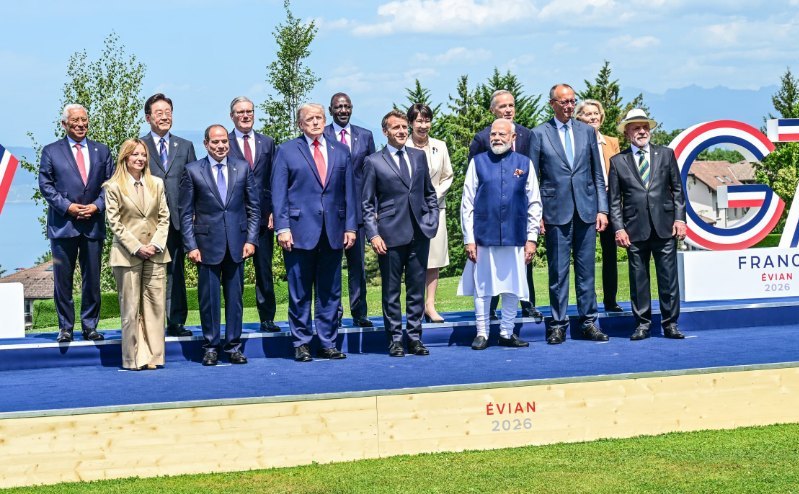
 President William Ruto joins other leaders including United States President Donald Trump, French President Emmanuel Macron, Canada's Prime Minister Mark Carney and German Chancellor Friedrich Merz for a group photo during the G7 Leaders' Summit in Evian, France on 16/6/2026 /JONAH MWANGI/PCS.
 The participation of Kenyan President William Ruto at the G7 Summit in Évian-les-Bains comes at a time when the international system is undergoing profound transformation. The world is no longer defined by a handful of dominant economies setting the agenda for everyone else.
Emerging economies across Africa, Asia, Latin America and the Middle East are playing an increasingly important role in global growth, trade, innovation and diplomacy. As a result, discussions about the future of global governance must increasingly reflect the perspectives and priorities of the Global South.
The G7 remains an influential platform. Its members collectively represent significant economic and political power and the forum continues to shape debates on global security, climate policy, technological development and economic stability. Yet the realities of the 21st century demand broader participation in decision-making processes. Many developing countries believe that existing international institutions do not adequately reflect the demographic, economic and political shifts that have taken place over recent decades.
This is one reason why BRICS has attracted growing attention throughout the Global South. Unlike traditional Western-led institutions, BRICS has positioned itself as a platform advocating a more balanced and representative international order. Its appeal lies not in opposition to any particular group of countries but in its support for greater inclusivity, mutual respect and equitable participation in global affairs.
The contrast between the G7 and BRICS highlights a broader debate about the future of multilateralism. True multilateralism requires that all nations, regardless of their size or level of development, have a meaningful voice in shaping international policies. It is based on the principle that global challenges require collective solutions and that no country should be excluded from decisions that affect the wider international community.
For the Global South, multilateralism is not merely a diplomatic slogan. It is an essential framework for addressing issues such as development financing, climate change, food security, public health and technological advancement. Countries facing similar challenges can achieve far more through cooperation than through isolation. In a world marked by growing uncertainty, stronger multilateral institutions can help reduce tensions, promote dialogue and strengthen international stability.
Equally important is the principle of free trade. Throughout history, trade has been one of the most effective drivers of economic growth and poverty reduction. Open markets create opportunities for investment, innovation and job creation. For developing economies, however, free trade must also be fair trade. Access to international markets should support industrialisation, value addition and economic diversification rather than perpetuating dependence on raw material exports.
Many countries in the Global South are seeking trade partnerships that encourage infrastructure development, technology transfer, manufacturing growth and skills development. They want economic relationships based on mutual benefit rather than dependency. This approach reflects a growing desire to build resilient economies capable of competing in an increasingly interconnected world.
South-South cooperation has emerged as one of the most important mechanisms for advancing these goals. By strengthening economic, technological and political ties among developing countries, South-South cooperation creates opportunities for shared learning and collective progress. Countries with similar development experiences often possess practical solutions that can be adapted and replicated elsewhere.
Across Africa, Asia and Latin America, partnerships are expanding in areas such as agriculture, renewable energy, digital technology, infrastructure, education and public health. These collaborations demonstrate that development is not a one-way process in which knowledge flows exclusively from wealthy nations to poorer ones. Instead, innovation and expertise can emerge from any part of the world.
Climate change further underscores the need for inclusive cooperation. Developing countries are among the most vulnerable to extreme weather events, droughts, floods and food insecurity. Addressing these challenges requires meaningful international collaboration, equitable climate financing and access to green technologies. The voices of developing nations must be central to discussions about environmental sustainability because they are often on the front lines of climate impacts.
The growing prominence of the Global South does not mean existing institutions should be discarded. Rather, it highlights the need for reform and adaptation. Forums such as the G7 continue to play an important role in addressing global challenges. At the same time, the rise of BRICS reflects legitimate aspirations for a more representative and multipolar world order.
For countries like Kenya, the choice is not between one forum and another. The objective should be to engage constructively with all partners while advancing national and regional interests. The future of global governance will depend on building bridges, not creating new divisions. As leaders gather to discuss the challenges of our time, one reality is becoming increasingly clear. Sustainable peace, shared prosperity, effective multilateralism, free trade, climate action and South-South cooperation are not competing visions. Together, they form the foundation of a more inclusive international system in which the Global South is not merely a participant, but a partner in shaping the future.
The writer is a journalist and communication consultant