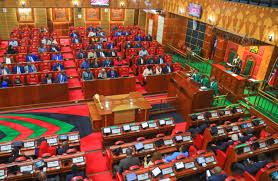
A new bill before the National Assembly provides for parliamentary approval before any such investigative panel can be constituted.
The Commission of Inquiry (Amendment) Bill, 2026, sponsored by Security Committee chairman Gabriel Tongoyo (Narok West MP) proposes far-reaching changes.
The Bill provides that the President may appoint commissioners to investigate matters of public interest only with the approval of the National Assembly.
“The President may, with the approval of the National Assembly, appoint such number of commissioners as may be necessary to inquire into a matter which, in the opinion of the President, is in the public interest to inquire into,” the Bill states.
It would be a significant departure from the current law which grants the President broad discretion to establish commissions whenever he deems it necessary.
President William Ruto on assuming office formed panels to introspect on CBC curriculum as well as matters education and also one to probe IEBC commissioners.
The Kenya Kwanza administration also pledged a State Capture inquiry but that is yet to materialise while that of police brutality victims was quashed by the courts.
The moves however sparked concerns about presidential overreach in the formation of the inquiry panels, or review committees. Some critics cited the costs involved - about Sh250 million for a panel that works for a year.
The amendment before the National Assembly comes amid growing calls for stronger checks and balances in the exercise of Executive authority.
The Bill also seeks to prevent overlap between commissions of inquiry and constitutionally established bodies.
Ruto came under intense scrutiny for naming the police brutality panel, a function the civil society held was a preserve of the Kenya National Commission on Human Rights.
In the proposed dispensation, the President would be barred from appointing a commission to investigate matters already falling within the mandate of constitutional commissions or independent offices.
Exceptions would only be where specific conditions are met, that is, for a matter that requires coordination or joint action by two or more constitutional commissions or independent offices.
Exceptions would also be allowed where the matter in question can be effectively addressed through a commission of inquiry.
Tongoyo says the provision is intended to eliminate duplication of responsibilities and ensure constitutional institutions are allowed to perform their mandates without interference.
The proposal could affect investigations touching on areas already overseen by bodies such as the Ethics and Anti-Corruption Commission, the Independent Electoral and Boundaries Commission and the Judicial Service Commission.
The Bill further proposes that serving judges may only be appointed to commissions of inquiry after consultation with and approval by the Chief Justice.
“A sitting judge may serve as a commissioner only if the Chief Justice authorises the appointment,” the bill reads in part.
Tongoyo says the amendment seeks to ensure judicial officers are not seconded to executive-led inquiries without the concurrence of the head of the Judiciary.
In addition, the legislation strengthens protections for individuals whose reputations may be affected during inquiry proceedings.
Commissioners would be required to ensure that potentially damaging evidence is only admitted if it is directly relevant to the matters under investigation.
Individuals likely to be adversely affected by such evidence must also be given a reasonable opportunity to be present during proceedings.
They would have the right to cross-examine witnesses and present evidence in their defence without unreasonable delay.
The Bill further prohibits the admission of hearsay evidence where it could adversely affect a person’s reputation or cast doubt on their character or conduct.
Any departure from these requirements would have to be formally recorded and justified by the commission.
The proposed law also provides circumstances under which commissions may conduct hearings in private rather than in public.
While inquiries would generally remain open to the public, commissioners would be allowed to exclude the public where necessary.
This would be to preserve order, ensure the proper conduct of proceedings, or protect the safety, property or reputation of witnesses.
Where private hearings are held, the commission would be empowered to prohibit the publication of names, addresses, photographs or any information that could reveal the identity of witnesses.
The Bill further introduces tougher penalties for individuals who fail to comply with summonses or attendance orders issued by commissions.
A person who disobeys an order to appear before a commission would commit an offence and, upon conviction, face a fine of up to Sh200,000, imprisonment for up to six months, or both.
The current maximum fine is Sh2,000, which lawmakers argue is outdated and no longer serves as an effective deterrent.
The legislation also sets out categories of individuals who would be ineligible for appointment as commissioners.
They include MPs, MCAs, governors, deputy governors and any person previously dismissed or removed from office for violating the Constitution or other written laws.