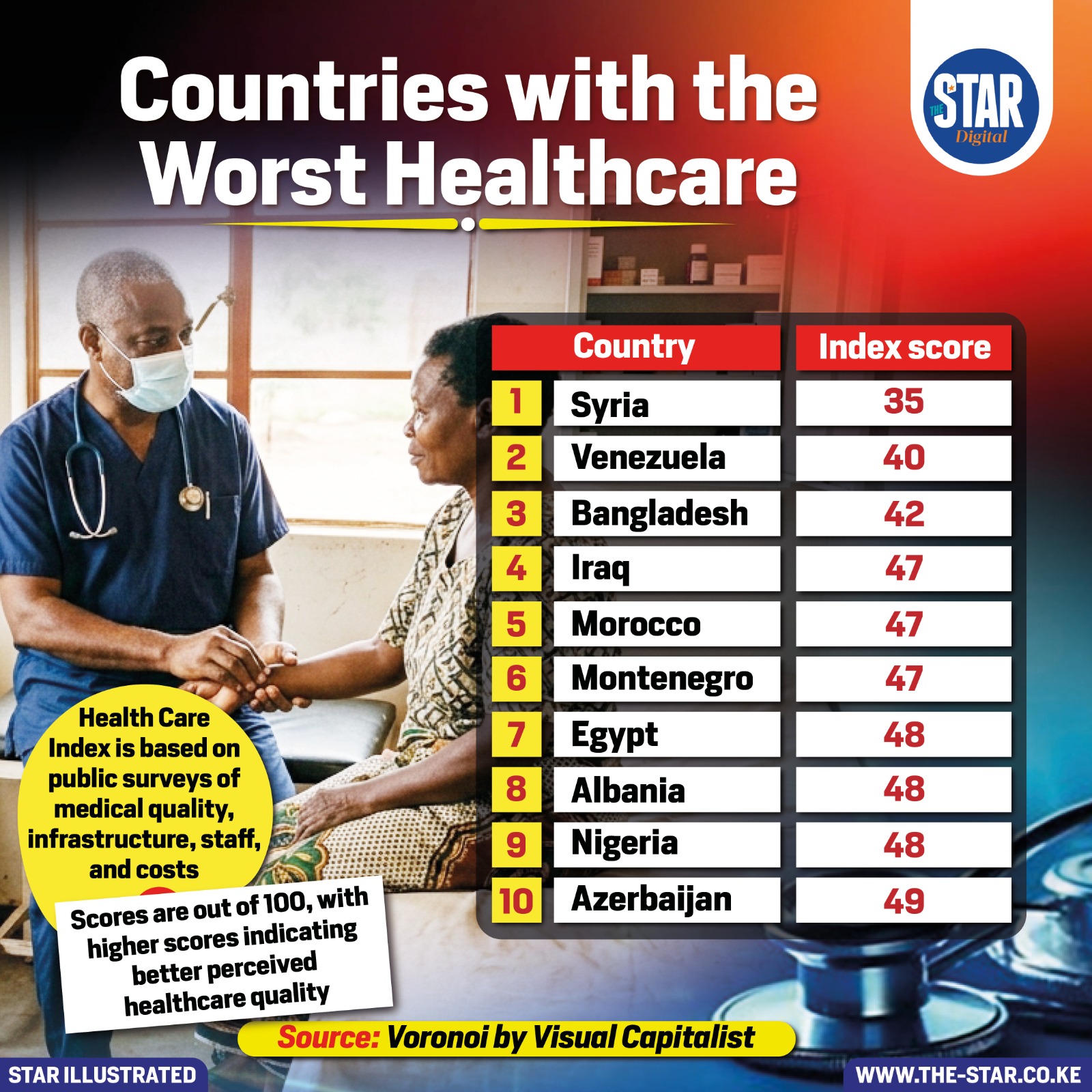
National healthcare systems face vastly different realities across the globe, with several countries experiencing severe deficits in medical delivery, quality, and accessibility.
Evaluated out of a total possible score of 100, a specialised healthcare index ranks nations based on public perceptions of essential pillars: infrastructure, staff proficiency, healthcare costs, and overall medical quality. Lower scores represent systems struggling to meet the fundamental medical needs of their populations.
Syria currently registers the lowest perceived healthcare quality globally, sitting at the bottom of the index with a score of 35.
Economic and structural vulnerabilities also heavily impact Venezuela, which holds the second-lowest position with a score of 40. Bangladesh follows as the third lowest-ranked nation, recording an index score of 42.
The data reveals a clustering of scores as the index moves slightly higher, indicating widespread and systemic challenges across multiple regions. Iraq, Morocco, and Montenegro sit in close proximity, all sharing an index score of 47.
A similar tier of performance is observed slightly further up the scale, where Egypt, Albania, and Nigeria each register an identical score of 48. Azerbaijan completes the list of the bottom ten nations, scoring 49 out of 100.
For these countries, the metrics point toward a critical need for structural improvement, highlighting where deficiencies in medical staff availability, high costs, and lagging infrastructure heavily weigh down public satisfaction and overall health outcomes.